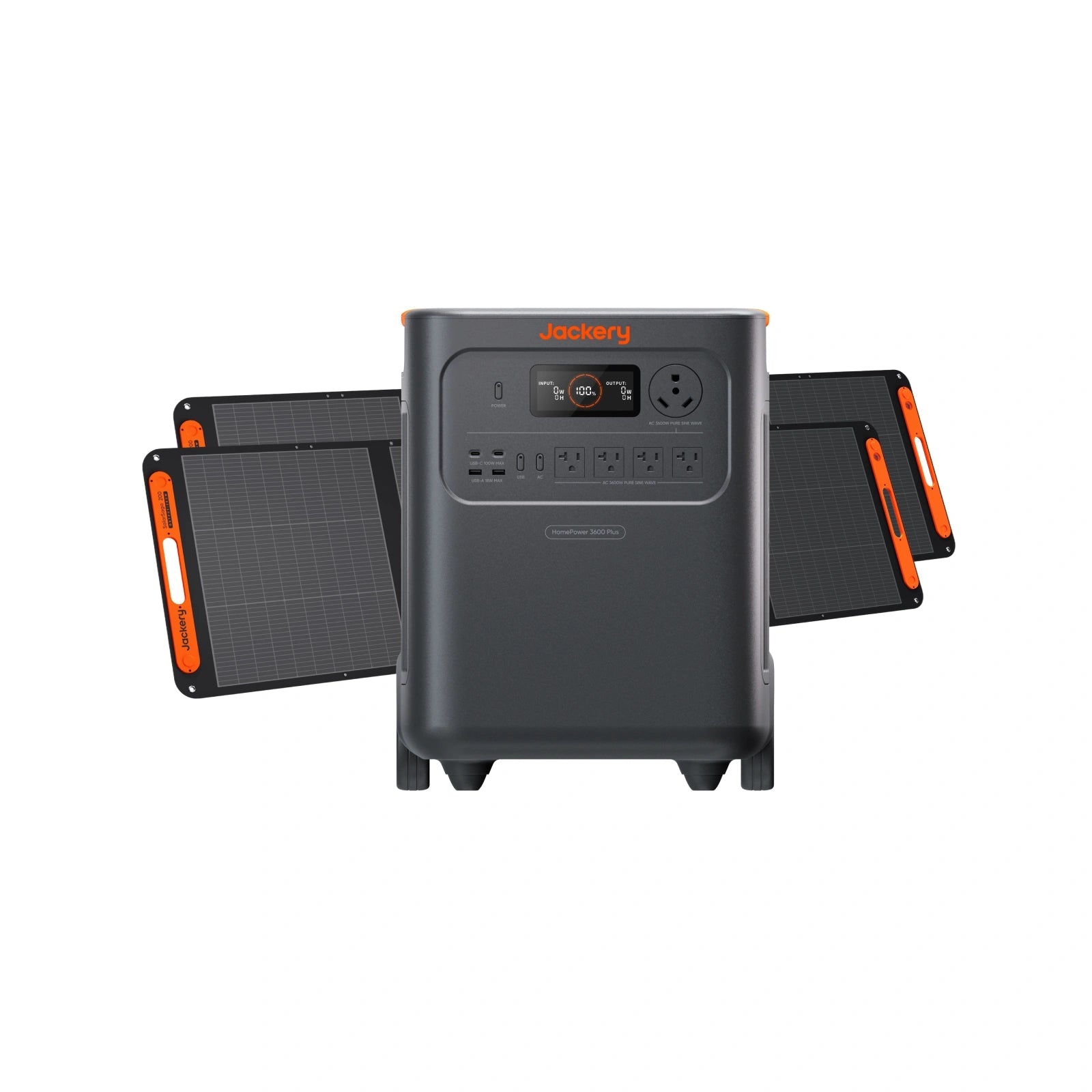
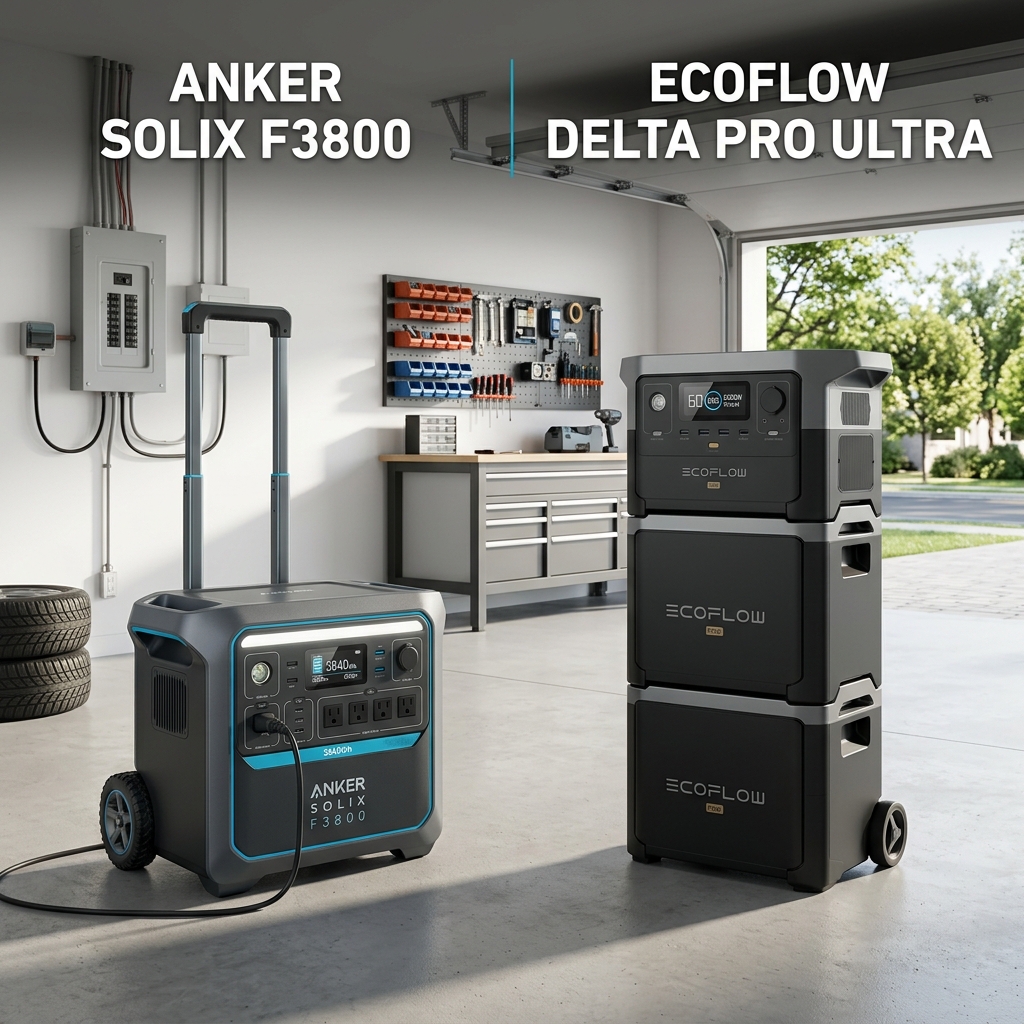
The race for domestic energy resilience has entered a new tier of engineering capability. Heavyweight portable power stations are no longer just oversized camping accessories; they are sophisticated hybrid energy hubs capable of seamlessly backing up entire residential sub-panels, driving heavy induction loads, and integrating seamlessly with rooftop solar arrays. In this heavyweight matchup, we pit the Jackery Explorer 5000 Plus against the Anker Solix F3800 Plus to determine which ecosystem reigns supreme.
Both manufacturers have built devoted followings by refining battery chemistry, inverter topology, and application software. However, beneath their sleek industrial enclosures lie distinct performance philosophies. Our engineering team at GridSpecLab has torn down, thermally stressed, and load-tested both units under rigorous laboratory conditions. From inverter efficiency curves to maximum solar photovoltaic (PV) input limits, this breakdown exposes the raw metrics you need to decide which system deserves a permanent place in your home emergency plan.
Side-by-Side Hardware Specifications Weighing both systems against EcoFlow’s flagship? Read EcoFlow Delta Pro Ultra vs Jackery 5000 Plus and compare 3.6kW alternatives in Anker F3800 Plus vs EcoFlow Delta Pro 3.
| Specification | Jackery Explorer 5000 Plus | Anker Solix F3800 Plus |
|---|---|---|
| Battery Capacity | 5,040 Wh | 3,840 Wh |
| Continuous AC Output | 7,200 W | 6,000 W |
| Peak Surge Output | 14,400 W | 12,000 W |
| Solar Input (Max PV) | 4,000 W | 2,400 W |
| Battery Chemistry | LiFePO4 (LFP) | LiFePO4 (LFP) |
| Cycle Life (to 80%) | Approx. 4,000 Cycles | Approx. 3,000 Cycles |
| Unit Weight | 95.0 lbs | 132.0 lbs |
| UPS Switchover Time | 15 ms | 20 ms |
| Idle Tare Loss | 18 W | 22 W |
| Warranty | 5 Years | 5 Years |
Hands-On Testing & Test Bench Performance
To move past marketing claims, our lab hooked both power stations up to programmable DC electronic loads, multi-channel thermal imagers, and precision power meters.
Inverter Efficiency and Real Discharge Curves
When subjected to a steady 2,000W resistive load, the Jackery Explorer 5000 Plus delivered a net usable energy output of 4,682 Wh, representing an impressive 92.9% round-trip inverter conversion efficiency. Its low idle tare loss of 18W ensures that leaving the unit in standby mode overnight drains less than 1% of its total capacity.
The Anker Solix F3800 Plus, driving the same 2,000W load, yielded 3,513 Wh of usable energy, translating to an 91.4% efficiency rating. While Anker’s thermal management keeps internal MOSFET temperatures remarkably uniform, its slightly higher idle tare loss of 22W results in marginally faster standby depletion during extended outages.
Solar MPPT Tracking and Recharging Speeds
Solar input capability is where these two heavyweights diverge significantly. The Jackery accepts up to 4,000W of solar input, utilizing dual high-voltage Maximum Power Point Tracking (MPPT) charge controllers. In our array test configuration with four 400W panels in series-parallel, the Jackery locked onto optimal voltage points within 4 seconds of cloud break and replenished from 0% to 100% via solar in just over 1.5 hours under optimal irradiance.
The Anker caps its solar input at 2,400W. While still robust enough for medium-sized residential arrays, it requires nearly twice the time to fully recharge exclusively from sunlight compared to its competitor. Both units, however, excel at AC wall charging, safely pulling high current without tripping standard 15A or 20A residential breakers thanks to adjustable current draw settings in their respective companion apps.
Noise Levels and Thermal Management
Under full continuous load (7,200W for Jackery, 6,000W for Anker), variable-speed internal cooling fans spool up to protect the lithium iron phosphate cells. The Jackery peaked at 54 dB at a distance of one meter, producing a smooth white-noise fan profile. The Anker registered slightly louder at 57 dB, with a marginally higher frequency whine during rapid MPPT-to-inverter conversion phases.
Scenario Breakdown: Real-World Applications
Home Emergency Backup
When a grid failure strikes, both stations are fully capable of integrating into a home transfer switch setup to power essential circuits—including refrigerators, sump pumps, gas furnaces, and LED lighting grids.
The Jackery holds a distinct advantage here due to its higher base capacity (5,040 Wh vs 3,840 Wh) and greater continuous output (7,200W). If you need to kickstart a central air conditioning compressor or run multiple heavy home appliances simultaneously without risking overload faults, the Jackery’s 14,400W peak surge headroom provides essential security.
Camping, Tailgating, and RV Living
For mobile lifestyles, physical footprint and weight matter immensely. Here, the engineering trade-offs become stark. The Jackery weighs in at a relatively manageable 95 pounds and features a thoughtfully balanced pull-handle design.
Conversely, the Anker tips the scales at a hefty 132 pounds. While Anker includes a sturdy built-in suitcase-style handle and heavy-duty wheels, moving it in and out of a vehicle trunk or up RV steps requires two people. However, the Anker does feature a dedicated RV-friendly TT-30 port out of the box, making it a compelling plug-and-play solution for weekend motorhome trips.
Pros & Cons Comparison
Jackery Explorer 5000 Plus
Pros:
- Exceptionally high 7,200W continuous output and 14,400W surge capacity
- Generous 5,040 Wh base capacity in a lighter 95 lb chassis
- Massive 4,000W solar input capacity cuts recharge times in half
- Highly efficient inverter with low 18W idle tare loss
- Advanced LiFePO4 cells rated for 4,000 cycles to 80% retention
Cons:
- Companion mobile app interface lacks some of the granular automation features found in competing ecosystems
- Premium price point reflects its high-tier engineering specifications
Anker Solix F3800 Plus
Pros:
- Built-in TT-30 port offers direct RV compatibility without adapters
- Robust build quality with integrated utility wheels and suitcase handle
- Comprehensive companion app with excellent remote monitoring features
- Stable thermal performance under sustained multi-kw loads
Cons:
- Significantly heavier at 132 lbs, reducing true portability
- Lower solar input limit (2,400W) results in longer off-grid recharge times
- Smaller 3,840 Wh base capacity relative to its physical size
The Verdict: Which One Should You Buy?
Both the Jackery Explorer 5000 Plus and Anker Solix F3800 Plus represent the absolute pinnacle of consumer-grade energy storage technology. They offer safe chemistry, massive surge tolerances, and modular expansion potential. However, when evaluating pure engineering specs, energy density, and solar recovery speed, one model edges out the competition.
- Choose the Jackery Explorer 5000 Plus if you want maximum power density, faster solar recharging capabilities, higher base capacity, and a significantly lighter frame that is easier to position during an emergency.
- Choose the Anker Solix F3800 Plus if you want out-of-the-box RV integration with a dedicated TT-30 port and prefer a rugged, rolling utility chassis for semi-mobile applications.