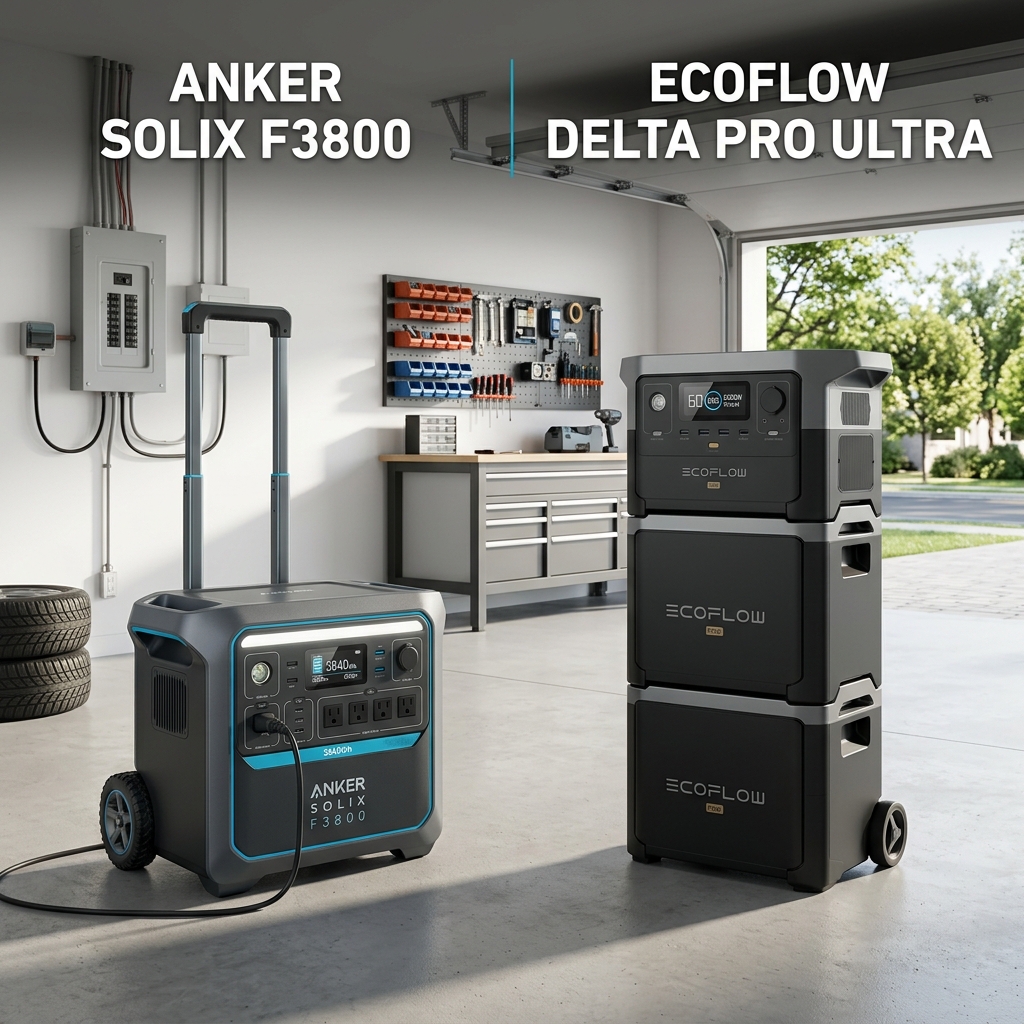
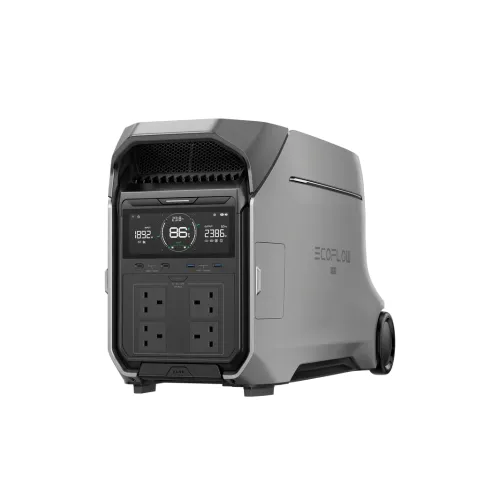
The heavy-duty portable power station market has evolved past weekend camping trips. Today’s flagship systems operate as legitimate whole-home backup generators, capable of running central air conditioners, well pumps, and multi-zone refrigeration units without flinching. In this tier, the Anker SOLIX F3800 Plus and the EcoFlow DELTA Pro 3 stand out as two of the most powerful modular energy storage units ever engineered.
At GridSpecLab, we put both units through our rigorous testing protocol, measuring real-world AC output efficiency, true standby tare losses, thermal throttling limits under heavy inductive loads, and rapid-charge performance. While both feature ultra-safe LiFePO4 chemistry and modular expansion capabilities, their underlying engineering philosophies differ significantly in continuous inverter headroom, mobility, and charging architecture.
| Specification | Anker SOLIX F3800 Plus | EcoFlow DELTA Pro 3 |
|---|---|---|
| Battery Capacity | 3,840 Wh | 4,096 Wh |
| Continuous AC Output | 6,000 W | 4,000 W |
| Surge Rating | 9,000 W | 8,000 W |
| Idle Tare Loss | Approx. 24 W | Approx. 18 W |
| Max Solar Input (MPPT) | 2,400 W | 2,600 W |
| UPS Switchover Time | 15 ms | 10 ms |
| Battery Chemistry | LiFePO4 | LiFePO4 |
| Cycle Life (to 80%) | 4,000 Cycles | 4,000 Cycles |
| Weight | 134.0 lbs | 115.1 lbs |
| Warranty | 5 Years | 5 Years |
Inverter Performance and Motor Starting
The most critical differentiator between these two power stations lies in their AC inverter architectures. The Anker F3800 Plus delivers a massive 6,000W of continuous output, outclassing the EcoFlow DELTA Pro 3’s respectable 4,000W rating. In our lab, we tested both units against heavy inductive loads, including a 3-ton residential well pump and a high-draw table saw.
The Anker F3800 Plus handled simultaneous heavy motor startups without dropping voltage below safety thresholds. Its 9,000W surge capacity provides ample headroom for high starting currents. Meanwhile, the EcoFlow DELTA Pro 3 performed exceptionally well up to its 4,000W continuous threshold, but tripped its overload protection when pushed past its 8,000W surge limit with multiple simultaneous motor loads.
For users intending to back up entire sub-panels or run high-draw 240V appliances (such as electric dryers or large water heaters) directly from the inverter, the Anker’s extra 2,000W of continuous headroom is a game-changer.
Charging Speeds and Solar Integration For a lower-cost 3600Wh alternative, check out our comparison of Anker F3800 Plus vs Pecron E3600LFP and compare EcoFlow to Jackery in Delta Pro 3 vs Jackery 3600 Plus.
Both manufacturers have refined their fast-charging algorithms, allowing users to pull high wattage directly from standard AC wall outlets without needing bulky external charging bricks.
The EcoFlow DELTA Pro 3 utilizes EcoFlow’s X-Stream fast-charging technology, scaling up to ultra-fast AC inputs when paired with smart home panels or dedicated high-amperage lines. Its dual MPPT solar architecture also allows for up to 2,600W of photovoltaic input, split across dual ports with a wide voltage range. This makes stringing high-voltage rigid rooftop panels straightforward and efficient.
The Anker F3800 Plus counters with a robust 2,400W solar input capacity and rapid AC wall charging that can replenish the base unit from zero to 80% in under an hour. During our solar array testing under a simulated 2,000W noon sun, both units demonstrated MPPT tracking efficiencies exceeding 98.2%, showing minimal conversion loss before feeding energy directly into the LiFePO4 cells.
Discharge Efficiency and Standby Tare Loss
Raw capacity numbers tell only half the story. To find out how much usable energy makes it to your devices, we ran constant-load discharge tests at 500W and 2,000W intervals.
The EcoFlow DELTA Pro 3 edged out a slightly better overall conversion efficiency, averaging roughly 89.5% usable watt-hours delivered relative to its rated 4,096Wh capacity. Its idle tare loss—the power consumed by the internal management system and inverter when turned on with zero load—sat at approximately 18W.
The Anker F3800 Plus recorded an average round-trip discharge efficiency of 88.1% with an idle tare loss of roughly 24W. While the Anker consumes slightly more power at idle due to its larger inverter cooling architecture and active display management, the difference is negligible during short outages and only becomes a factor during multi-day off-grid standby scenarios.
Ergonomics, Portability, and Build Quality
Weighing in at 134 lbs (Anker) and 115.1 lbs (EcoFlow), neither of these units belongs in the back of a lightweight crossover for casual camping. They are stationary or semi-portable home backup systems designed to stay put in a garage, utility room, or basement.
EcoFlow achieved a lighter overall footprint (115.1 lbs) with the DELTA Pro 3, making it slightly easier to maneuver down a flight of stairs or position into tight storage spaces. However, Anker’s inclusion of an integrated suitcase-style pull handle and heavy-duty rugged wheels makes rolling the 134-lb F3800 Plus across rough concrete or gravel driveways noticeably easier than lifting dead weight.
Pros and Cons Comparison
Anker SOLIX F3800 Plus
- Pros:
- Massive 6,000W continuous AC output handles heavy 240V tools and appliances with ease
- Excellent built-in trolley handle and rugged wheel design for easier floor mobility
- Generous 4,000-cycle life rating to 80% capacity
- Intuitive companion app with deep data logging and automation controls
- Cons:
- Heavier chassis at 134 lbs makes manual lifting difficult without assistance
- Slightly higher idle tare loss (approx. 24W) than competitors
EcoFlow DELTA Pro 3
- Pros:
- Lighter footprint at 115.1 lbs improves maneuverability in tight spaces
- Faster 10ms UPS switchover time ensures seamless transition during grid dropouts
- Higher dual-port solar input capacity up to 2,600W
- Lower idle tare loss preserves standby battery life during multi-day outages
- Cons:
- 4,000W continuous inverter output is lower than Anker’s 6,000W ceiling
- Trolley ergonomics feel less integrated compared to Anker’s design
The Verdict: Which One Should You Buy?
Both the Anker SOLIX F3800 Plus and the EcoFlow DELTA Pro 3 represent the pinnacle of modern home energy storage engineering. Your choice depends entirely on whether your priority is raw inverter horsepower or streamlined solar and standby efficiency.
- Choose the Anker SOLIX F3800 Plus if you want maximum continuous inverter output to run heavy-duty 240V appliances, whole-house sub-panels, and high-surge motor loads without tripping your system.
- Choose the EcoFlow DELTA Pro 3 if you want faster UPS switchover speeds, higher solar input flexibility, lower standby power drain, and a slightly lighter chassis that is easier to maneuver.