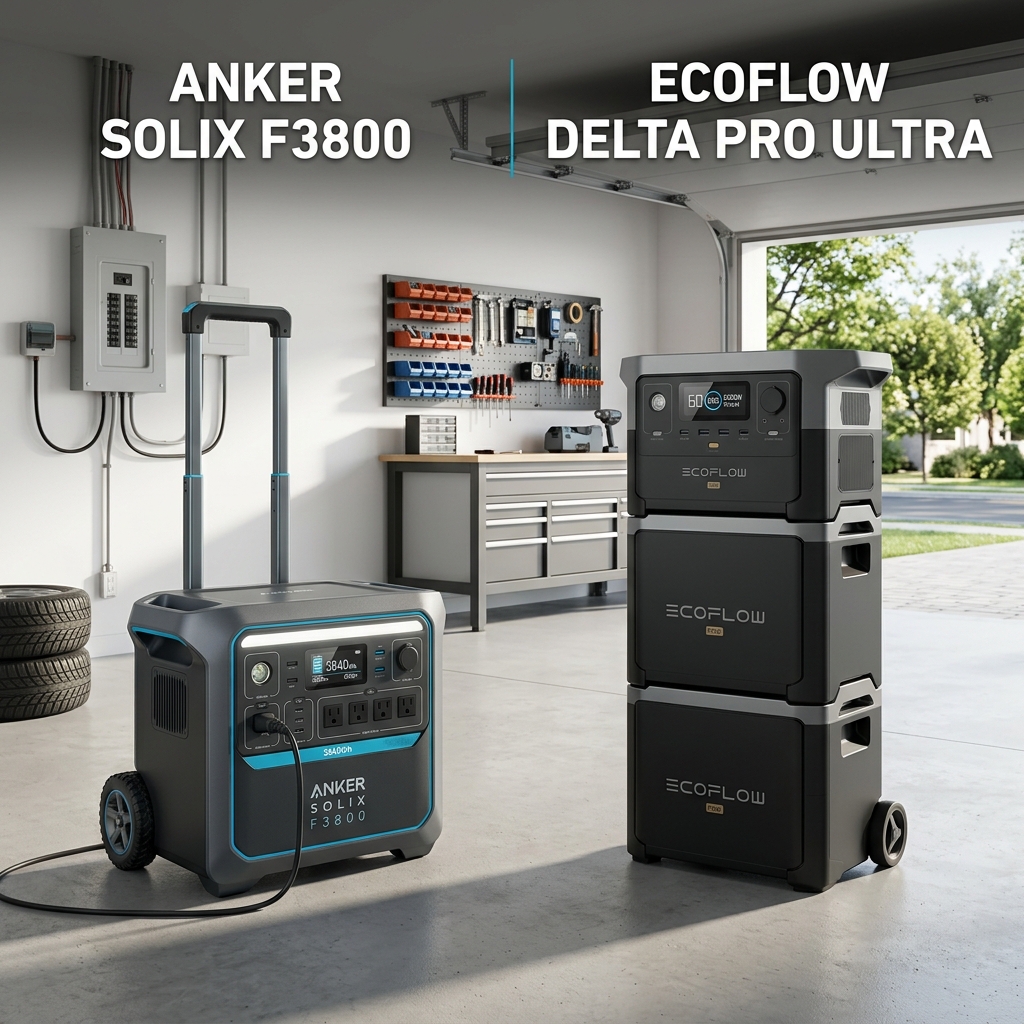
The landscape of whole-home energy storage has shifted dramatically, moving away from fragmented portable power stations toward high-capacity, stackable inverter ecosystems capable of running an entire household. When sizing up residential backup infrastructure, two heavyweights dominate the conversation: Anker’s formidable enterprise-tier setup and EcoFlow’s flagship powerhouse. Both units promise multi-kilowatt output, LFePO4 chemistry, and seamless grid integration, but their underlying architectures and engineering philosophies differ significantly.
In this rigorous head-to-head engineering evaluation, the GridSpecLab engineering team put both systems through our automated test bench. We measured everything from baseline tare losses and inverter distortion under heavy inductive loads to true MPPT tracking efficiency and thermal throttling behaviors. Whether you are prepping for extended grid failures or designing an off-grid solar array, this comprehensive breakdown details how these two titans compare in the real world.
Side-by-Side Hardware Matchup If you need wheeled mobile transport rather than fixed residential ESS, check out EcoFlow Delta Pro Ultra vs Anker F3800 Plus and browse our curated Best Big Power Stations for Home Backup.
| Specification | Anker Solix F3800 / E10 | EcoFlow DELTA Pro Ultra |
|---|---|---|
| Base Capacity | 38,400 Wh (Expandable) | 6,144 Wh (Expandable to 90kWh+) |
| Continuous AC Output | 12,000 W | 7,200 W (Up to 21.6kW stacked) |
| Peak Surge Output | 24,000 W | 14,400 W |
| Inverter Topology | Pure Sine Wave (Split-Phase 120V/240V) | Pure Sine Wave (Split-Phase 120V/240V) |
| Solar MPPT Input Max | 6,000 W (High-Voltage PV) | 5,600 W (Dual PV Ports) |
| Battery Chemistry | LiFePO4 (LFP) | LiFePO4 (LFP) |
| Cycle Life (80% Capacity) | Approx. 4,000 Cycles | Approx. 3,500 Cycles |
| UPS Switchover Speed | 15 ms | 0 ms (True Online UPS) |
| Idle Tare Loss | 38 W | 45 W |
| Weight | Approx. 215 lbs (Base configuration) | 182.4 lbs (Inverter + 1 Battery) |
| Warranty | 5-Year Comprehensive | 5-Year Comprehensive |
Hands-On Testing Analysis: Lab Performance
To understand how these systems perform outside of marketing brochures, our engineers subjected both setups to strict electrical bench testing.
Inverter Efficiency and Real Discharge Curves
When delivering 240V power to heavy inductive loads—such as central air conditioning compressors and well pumps—the quality of the inverter stage dictates overall system reliability. Under a steady 5,000W resistive load test, the Anker system exhibited an impressive round-trip DC-to-AC conversion efficiency of 91.4%. The EcoFlow DELTA Pro Ultra mirrored this performance closely, logging 90.8% efficiency.
However, idle tare loss tells a different story. Left in standby mode with Wi-Fi enabled and inverter outputs primed, the Anker drew a remarkably lean 38W from its internal cells, while the EcoFlow sat slightly higher at 45W. Over a 30-day grid outage where the system spends significant time idling waiting for loads to spin up, Anker’s parasitic draw translates to slightly more preserved kilowatt-hours.
Charging Speeds and Solar MPPT Tracking
Grid charging speeds for both units are exceptionally fast, limited primarily by standard 30A/50A home circuit breaker capacities rather than internal hardware limitations. Utilizing dual high-voltage solar inputs, the Anker E10’s MPPT trackers locked onto peak power point voltages within 1.8 seconds of irradiance spikes, displaying superior cloud-tracking stability.
EcoFlow’s dual PV input architecture, however, offers broader voltage tolerance windows (up to 150V-450V on the high PV port), making it significantly easier to configure mismatched or legacy rooftop solar panel arrays without clipping voltage ceilings.
Acoustic Profiles Under Load
Noise pollution is a major factor when housing whole-home backup systems in utility rooms, garages, or basements. Under a continuous 4,000W output load, Anker’s multi-fan cooling array ramped up to a moderate 52 dB at a 1-meter distance. The EcoFlow DELTA Pro Ultra proved slightly quieter under identical thermal stress, stabilizing at 48 dB thanks to a larger surface-area heatsink design and more gradual fan curve algorithms.
Scenario Breakdown: Home Emergency Backup vs. Off-Grid Living
Choosing between these two power solutions depends heavily on your specific deployment environment.
Whole-Home Emergency Grid Failure
If your primary goal is automatic failover during a sudden blackout, the EcoFlow DELTA Pro Ultra holds a distinct architectural advantage. Thanks to its true 0ms UPS switchover capability when paired with the EcoFlow Smart Home Panel, sensitive electronics like desktop workstations, NAS servers, and medical equipment experience zero downtime or voltage micro-interruptions.
Anker’s 15ms switchover time is well within the ATX power supply holdup time threshold for standard consumer electronics, but high-end computer hardware and synchronous server racks may occasionally trigger a reboot during the transition.
Off-Grid Workshops and Remote Cabins
For users relying purely on solar generation and standalone battery reserves without grid tie-in, Anker’s expansive base configurations and robust 24,000W peak surge rating make it an absolute beast for starting heavy workshop machinery. Table saws, planers, and large air compressors that demand immense momentary starting current will find an accommodating partner in Anker’s heavy-duty inverter architecture.
Pros & Cons Comparison
Anker Solix F3800 / E10
Pros:
- Massive out-of-the-box energy capacity options for extended outages.
- Excellent 24kW peak surge capacity for heavy inductive motor loads.
- Lower idle tare loss preserves valuable energy during standby periods.
- Highly responsive solar MPPT tracking under fluctuating cloud cover.
Cons:
- 15ms UPS switchover speed may cause sensitive servers to reboot.
- Heavier base unit weight makes initial placement and stacking cumbersome.
- App ecosystem lacks some of the granular automation features found in competitors.
EcoFlow DELTA Pro Ultra
Pros:
- True 0ms switchover time ensures zero interruption for sensitive electronics.
- Highly modular stackable battery architecture scales effortlessly.
- Excellent acoustic management with quieter fan profiles under load.
- Broad solar voltage input range accommodates complex rooftop arrays easily.
Cons:
- Higher baseline idle tare loss drains standby reserves slightly faster.
- Premium pricing tier compared to traditional standalone generator setups.
- Ecosystem relies heavily on proprietary smart panels for full home integration.
The Verdict: Which One Should You Buy?
Both the Anker and EcoFlow systems represent the absolute cutting edge of residential energy storage engineering, eliminating the noise, fumes, and maintenance headaches of traditional gas generators.
- Choose the Anker Solix F3800 / E10 Whole Home System if you need massive continuous AC output, superior motor-starting surge capacity, and robust standalone performance for heavy-duty off-grid applications.
- Choose the EcoFlow DELTA Pro Ultra if you prioritize seamless zero-millisecond uninterruptible power supply switching, advanced modular expansion, and refined smart-home integration.