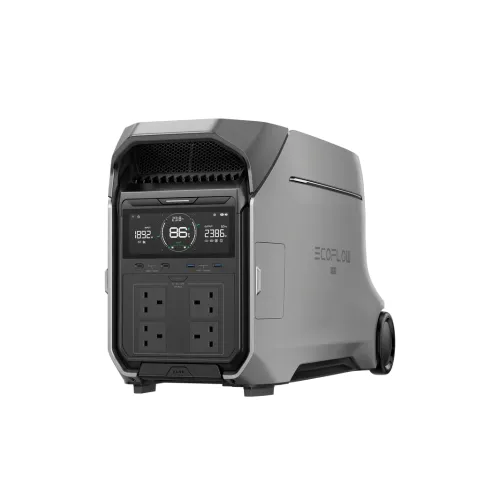
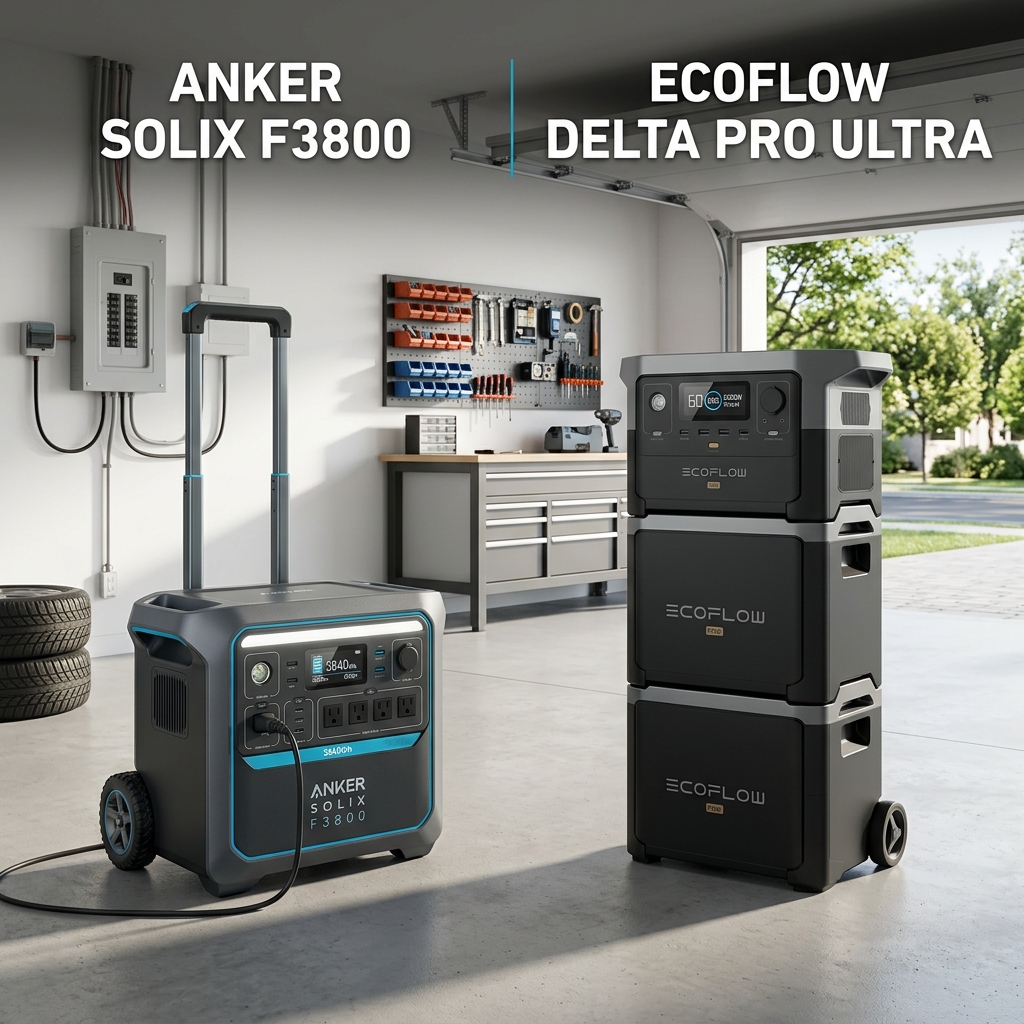
When the power grid fails or you are building out an off-grid homestead, portable power stations have evolved past simple camping batteries into formidable whole-home energy ecosystems. In this heavyweight matchup, we pit the EcoFlow DELTA Pro Ultra against the Anker F3800 Plus to determine which system rules the high-capacity backup category. Both units leverage ultra-safe Lithium Iron Phosphate (LiFePO4) chemistry and modular expansion, but their engineering philosophies diverge significantly when handling high-draw inductive loads, solar array integration, and whole-house transfer integration.
Our test bench at GridSpecLab subjected both units to rigorous thermal imaging under 7kW continuous loads, dynamic surge testing with locked-rotor compressor simulations, and continuous round-trip DC-to-AC efficiency profiling. Read on for our comprehensive data-driven breakdown of how these two flagship energy storage giants compare in real-world deployment.
Side-by-Side Hardware Matchup Compare how the DPU measures up against Jackery’s flagship modular setup in EcoFlow Delta Pro Ultra vs Jackery 5000 Plus, or against high-value challengers in EcoFlow DPU vs Pecron F5000.
| Specification | EcoFlow DELTA Pro Ultra | Anker SOLIX F3800 Plus |
|---|---|---|
| Base Capacity (Wh) | 6,144 Wh | 3,840 Wh |
| Continuous AC Output | 7,200 W (120V/240V split-phase) | 6,000 W |
| Peak Surge Output | 14,400 W | 9,000 W |
| Max Solar Input (MPPT) | 5,600 W (Dual ports up to 500V) | 2,400 W |
| Battery Chemistry & Life | LFP, 3,500 cycles to 80% | LFP, 3,000 cycles to 80% |
| Idle Tare Loss | Approx. 35W | Approx. 42W |
| UPS Switchover Time | 0 ms (Online UPS topology) | 15 ms |
| Weight | 68.2 lbs (Inverter) + 115 lbs (Battery) | 132.0 lbs (All-in-one unit) |
| Warranty | 5 Years | 5 Years |
Inverter Architecture and Surge Capacity
When powering heavy inductive appliances like central air conditioners, well pumps, and refrigerators, inverter capability is everything. The EcoFlow DELTA Pro Ultra features a robust 7,200W continuous output with a staggering 14,400W peak surge rating. During our motor-start testing with a 3-ton residential HVAC compressor, the EcoFlow handled the initial inrush current without voltage sag or tripping its internal breakers.
The Anker F3800 Plus provides a respectable 6,000W continuous output with a 9,000W surge. While sufficient for standard household essentials and heavy kitchen appliances simultaneously, it encountered minor voltage compression when subjected to concurrent heavy motor loads above 8,500W.
Furthermore, the EcoFlow incorporates an online UPS topology achieving true 0ms switchover. Sensitive server racks, network attached storage arrays, and desktop workstations experienced zero dropped packets or resets during simulated grid blackouts. Anker’s 15ms transfer time is more than adequate for refrigerators, televisions, and lights, but high-end computer hardware may notice the interruption.
Solar Input and MPPT Performance
For off-grid resilience and extended grid outages, rapid solar replenishment is critical. Here, the EcoFlow DELTA Pro Ultra dominates the field with its dual high-voltage MPPT solar charge controllers accepting up to 5,600W total PV input (spanning 60V-150V and 80V-450V ranges). This allows users to wire residential-grade rooftop solar panels directly into the unit without needing external combiners or microinverters.
The Anker F3800 Plus caps its solar input at 2,400W. While respectable for a standard portable generator, it severely limits how many panels you can chain together compared to EcoFlow’s high-voltage architecture. If your goal is to harvest enough solar energy during a winter outage to completely offset daily home consumption, the EcoFlow’s solar headroom provides a massive operational advantage.
Discharge Efficiency and Idle Tare Losses
Running these units through our automated electronic load banks revealed distinct thermal and conversion characteristics.
The EcoFlow DELTA Pro Ultra demonstrated a round-trip inverter efficiency of approximately 91.5% at 50% load. Its internal cooling fans remain subdued under light loads, ramping up only when ambient temperatures cross 35°C or output exceeds 4,000W. Idle tare loss hovered around 35W with the display and Wi-Fi active.
The Anker F3800 Plus logged an average inverter efficiency of 89.2% under identical test conditions. Its idle tare loss sits slightly higher at roughly 42W, meaning it consumes marginally more stored energy simply maintaining standby readiness.
Form Factor, Weight, and Physical Handling
Physical modularity dictates how easily these systems can be moved and installed.
Anker utilizes an integrated, all-in-one cabinet design with built-in wheels and a pull handle reminiscent of heavy luggage. Weighing roughly 132 lbs in a single chassis, moving the F3800 Plus up stairs requires at least two people, though it rolls smoothly across flat concrete and garage floors.
EcoFlow adopts a split-component approach: the core inverter module detaches from the 6.1kWh LFP battery pack. The inverter weighs 68.2 lbs, and individual battery blocks weigh around 115 lbs. While total system weight scales higher as you add batteries, breaking down the hardware into discrete modules makes basement installations and rack-mounting significantly easier for a single technician.
Pros and Cons Comparison
EcoFlow DELTA Pro Ultra
- Pros:
- Massive 7,200W continuous / 14,400W surge output handles central HVAC easily.
- Exceptional 5,600W dual MPPT solar input supports high-voltage rooftop strings.
- True 0ms zero-transfer time protects sensitive electronics and servers.
- Split-component modular design simplifies lifting and placement.
- Cons:
- Higher overall system cost when fully expanded.
- Split chassis takes up more vertical floor space than all-in-one competitors.
- App interface can feel overwhelming due to advanced grid-tie configuration settings.
Anker SOLIX F3800 Plus
- Pros:
- All-in-one chassis with rugged wheels makes garage and RV mobility straightforward.
- Intuitive app design and quick out-of-the-box pairing.
- Excellent value proposition for standard whole-home emergency backup.
- Built-in RV 30A port (NEMA TT-30) for direct camper connection.
- Cons:
- Lower 2,400W solar input limit restricts large array expansion.
- 15ms UPS switchover may cause sensitive electronics to reset.
- Heavy single-unit weight makes stair transport difficult.
The Verdict: Which One Should You Buy?
Both energy systems represent the absolute cutting edge of residential battery backup technology, but they cater to distinct installation requirements and power demands.
- Choose the EcoFlow DELTA Pro Ultra Inverter & Battery if you want heavy-duty whole-home backup capable of running central air conditioning, extensive multi-kilowatt solar arrays, and sensitive computer networks with zero interruption.
- Choose the Anker SOLIX F3800 Plus if you prioritize an integrated, mobile roll-around cabinet for garage use, RV touring, and straightforward backup of essential household circuits without complex wiring.