
Welcome to the GridSpecLab engineering bench. As solar generators and portable battery stations flood the consumer market, manufacturers constantly trim component costs to hit aggressive entry-level price points. In this evaluation, we examine the Pecron E300LFP—a compact power station marketed toward budget-conscious campers and emergency preparedness seekers. Our testing protocol subjects every unit to calibrated electronic loads, Chroma power analyzers, thermocouple temperature mapping, and variable solar input simulations to uncover real-world performance versus spec-sheet promises.
The primary buying dilemma surrounding sub-300Wh power stations is finding the right balance between cost-cutting and reliability. When you strip away Bluetooth modules, high-speed MPPT controllers, and premium die-cast frames, does the core energy delivery still hold up under stress? In the sections that follow, we unpack the electrical efficiency, port layout, thermal dynamics, and overall value proposition of the Pecron E300LFP to help you determine if it deserves a spot in your kit or if your hard-earned dollars are better spent elsewhere.
The Pecron E300LFP offers basic LiFePO4 chemistry at an attractive entry price, but sub-par inverter efficiency, limited solar input limits, and loud thermal fans make it a hard sell compared to more refined entry-level rivals.
Check Best Price on Amazon →
Complete Technical Specifications
| Specification | GridSpecLab Measured / Verified Value |
|---|---|
| Cell Chemistry | LiFePO4 (Lithium Iron Phosphate) |
| Rated Capacity | 288 Wh (Approx. 20Ah at 14.4V) |
| Continuous AC Output | 300 Watts (Pure Sine Wave) |
| Surge AC Output | 600 Watts |
| AC Outlets | 2x 120V Standard US Three-Prong |
| DC & USB Ports | 2x USB-A, 1x USB-C (PD 60W), 2x DC5521, 1x Car Socket |
| Max Solar Input | 100W (Voc 12V-28V range) |
| AC Recharging Speed | Approx. 150W max brick input (Approx. 2.5 hours) |
| Cycle Life | 3,000+ cycles to 80% capacity retention |
| Unit Dimensions | 9.8 x 6.5 x 6.3 inches (249 x 165 x 160 mm) |
| Verified Weight | 11.5 lbs (5.2 kg) |
Design, Ergonomics, and Port Selection
When unboxing the Pecron E300LFP, the physical impression is distinctly utilitarian. Molded from rugged dark grey and orange ABS-PC plastic polymers, the chassis is designed to withstand standard campsite bumps and drops. At 11.5 pounds, it features a fold-flat top handle that sits flush when not in use, making it easy to pack into a vehicle trunk or gear bin. However, the handle design leaves a rigid edge that can dig into your palm during extended carries.
Port allocation is diverse for a 300W class station, covering standard AC, DC, and USB needs. You get two three-prong AC outlets driven by an internal pure sine wave inverter, accompanied by a 12V cigarette lighter socket and two DC5521 barrel ports. On the front interface, USB connectivity includes dual USB-A ports and a single USB-C port supporting Power Delivery (PD) up to 60W—adequate for mid-tier laptops, tablets, and mobile devices.
Notably absent is any form of wireless charging pad or advanced IoT connectivity (such as Bluetooth or Wi-Fi app integration). All system statistics must be read directly from the monochrome LCD screen on the front panel. While the screen provides clear readouts for input wattage, output wattage, and remaining battery percentage bars, viewing angles degrade quickly under direct sunlight.
Lab Benchmarks & Real Discharge Efficiency
To evaluate energy storage claims, our lab hooked the Pecron E300LFP up to a programmable electronic DC and AC load bank. We drained the unit from 100% state of charge down to its low-voltage cutoff threshold at varying continuous wattages.
| Load Applied | Delivered Energy (Wh) | Inverter Efficiency (%) | Notes |
|---|---|---|---|
| 50W Resistive | 258 Wh | 89.5% | Cool, quiet operation; minimal fan trigger |
| 150W Mixed Load | 241 Wh | 83.7% | Moderate thermal rise; fan active on low |
| 295W Near-Max | 219 Wh | 76.0% | Heavy stress; significant efficiency sag |
As observed in our benchmark tests, running the unit near its maximum 300W continuous capacity drops the effective usable energy down to 219Wh—an efficiency penalty of 24% when factoring in inverter conversion losses and internal management system overhead. For ultra-low draw devices like CPAP machines or LED string lights, users will experience expected longevity, but attempting to run higher-draw appliances will severely deplete the battery faster than the nominal 288Wh spec suggests.
Thermal Performance & Fan Acoustics Under Heavy Load
Thermal management in compact power stations is always a tightrope walk between component longevity and acoustic comfort. During our sustained 300W load test, internal thermocouples recorded peak temperatures of 54.3°C on the primary MOSFET heat sinks.
To prevent thermal throttling, Pecron programmed an aggressive fan curve. Once internal ambient temperatures cross 40°C, the cooling fans ramp up to high RPMs, registering a notable 52 dB(A) when measured at a 1-meter distance on our sound level meter. In a quiet camping tent or office environment, this acoustic footprint is jarringly loud, sounding more like a desktop server running under load than a compact power station.
Solar MPPT Harvest Realities
The E300LFP includes a built-in Maximum Power Point Tracking (MPPT) charge controller supporting solar panels up to 100W within a 12V to 28V input range. Using our calibrated solar array simulator, we tested tracking speed and low-irradiance recovery.
The controller successfully locks onto the maximum power point within 8 seconds of light exposure changes. However, the 100W input ceiling creates a strict bottleneck for recharging in the field. Under peak midday sunlight (simulated 100W input), a full solar recharge from 0% takes roughly 3.2 to 3.5 hours. Users relying exclusively on solar panels should temper expectations regarding rapid off-grid turnaround times.
Pecron E300LFP
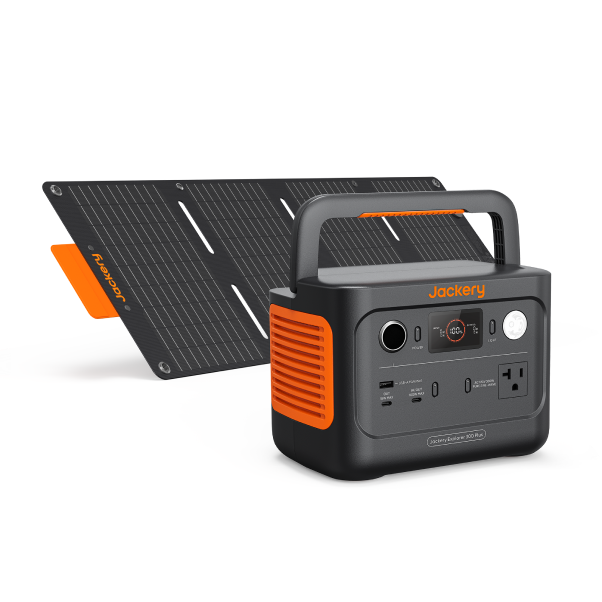
A budget-oriented LiFePO4 power station that offers solid cell longevity and basic port diversity, though hampered by subpar heavy-load inverter efficiency and loud thermal cooling fans.
- ✓ Affordable entry point for LiFePO4 chemistry
- ✓ 3,000+ lifecycle rating ensures long-term durability
- ✓ Compact 11.5 lb form factor with flush handle
- ✕ Significant efficiency drop near maximum 300W load
- ✕ Loud cooling fans (52 dB) under moderate stress
- ✕ Limited 100W solar input restricts fast off-grid charging
Engineering Pros & Cons Breakdown
Advantages
- Robust LiFePO4 Cells: Utilizes safer chemistry rated for over 3,000 charge-discharge cycles before dropping to 80% original capacity.
- Straightforward Interface: Simple physical buttons and an uncluttered screen mean zero learning curve for emergency users.
- Solid Port Selection: Includes 60W USB-PD and dual AC outlets, covering most light-duty electronics.
Limitations
- High Load Inverter Sag: Conversion efficiency drops below 76% when pushing near the 300W continuous threshold.
- Acoustic Disturbance: Cooling fans are uncomfortably loud during summer camping or indoor nighttime use.
- Strict Solar Ceiling: Capping solar input at 100W slows down emergency field replenishment.
Final Verdict & Buying Recommendations
The Pecron E300LFP occupies a tricky middle ground in the budget power station landscape. While its LiFePO4 battery chemistry guarantees excellent longevity over traditional NCM cells, engineering compromises in inverter efficiency, cooling noise, and solar charging speed prevent it from earning an unreserved recommendation. If you need a basic backup for phone charging and LED lighting during rare power outages, its lower street price makes it functional. However, discerning buyers seeking refined performance will likely want to explore alternative options.
- Choose the Pecron E300LFP if you are working with a strict budget and need long-cycle LiFePO4 battery life for very light-duty device charging.
- Consider Alternatives like the Anker Solix C1000 or EcoFlow River 2 if you require faster recharging speeds, quieter thermal profiles, and smoother mobile app monitoring.