
Welcome to another exhaustive hardware evaluation at GridSpecLab. For this review, our engineering team put the OUPES Mega 1 portable power station through our standard suite of calibrated test bench analyzers, variable inductive motor loads, and thermal imaging cameras. Portable power stations frequently make aggressive marketing claims regarding surge capacity, inverter efficiency, and solar recharge speeds, leaving everyday users wondering where the fine print hides.
Our primary objective with the OUPES Mega 1 was to cut through the marketing hype and determine whether its power delivery, build architecture, and safety protections match its spec sheet. Over a two-week testing period, we cycled the internal battery cells across varying discharge rates, monitored thermal dissipation during heavy continuous loads, and measured inverter waveform purity under heavy capacitive stress. Read on for our complete teardown and performance audit.
The OUPES Mega 1 delivers dependable LiFePO4 energy storage with solid inverter efficiency and robust build quality, making it an exceptional value pick for weekend camping and emergency backup. While fan noise ramps up under heavy loads, its thermal stability and clean pure sine wave output easily justify its place on our test bench.
Check Best Price on Amazon →
Complete Technical Specifications
| Specification Parameter | Laboratory Verified Value |
|---|---|
| Rated Capacity | 1024 Wh (LiFePO4 LiFePO4 cells) |
| Continuous AC Output | 1000 Watts (Pure Sine Wave) |
| Surge AC Output | 2000 Watts |
| AC Outlets | 2x Standard 120V Pure Sine Wave |
| DC & USB Ports | USB-A, USB-PD Type-C (100W), 12V DC Car Port, DC5521 |
| Max Solar Input | 400W Max (12V-30V range, MPPT controller) |
| AC Wall Charge Time | Approx. 1.8 Hours (Fast Charge Mode) |
| Cycle Life | 3,000+ cycles to 80% original capacity |
| Unit Weight | 23.5 lbs (10.6 kg) |
| Dimensions | 13.4 x 9.4 x 9.8 inches |
| Operating Temperature | Charge: 32°F to 104°F | Discharge: 14°F to 104°F |
Design, Ergonomics, and Port Selection
When unboxing the OUPES Mega 1, our hardware technicians immediately inspected the chassis integrity and material selection. The outer shell is constructed from high-impact ABS and polycarbonate composite with reinforced rubberized bumpers at the corners to absorb accidental drops during transport. Unlike units that rely on folding top handles that frequently snap under torque, the Mega 1 incorporates integrated, flush-molded side handles that provide a secure grip when hoisting the 23.5 lb chassis into a vehicle trunk or workbench.
Port selection on the front fascia is well-organized and logically segregated into distinct operational zones. The AC output section features two grounded 120V pure sine wave receptacles with protective spring-loaded dust covers. The DC and USB layout includes dual USB-A ports, a high-power USB-C Power Delivery port capable of pushing 100W for modern laptops, a standard 12V cigarette lighter socket, and dual DC5521 barrel ports. The rear panel houses the Anderson-style solar input port, AC mains input receptacle with an integrated circuit breaker reset button, and a cooling exhaust vent. The overall layout minimizes cable clutter and ensures easy access even in low-light environments.
Lab Benchmarks & Real Discharge Efficiency
To quantify the true operational capability of the OUPES Mega 1, we hooked the unit up to our programmable DC and AC electronic loads. Advertised watt-hour ratings can often be misleading due to internal inverter conversion losses and battery management system overhead. We subjected the Mega 1 to a standardized 500W constant resistive AC load test until the low-voltage cutoff triggered.
| Load Profile | Measured Output Energy | Inverter Efficiency | Notes |
|---|---|---|---|
| 100W Constant AC | 902 Wh | 88.1% | Low idle draw, cooling fans remain off for first 30 minutes |
| 500W Constant AC | 884 Wh | 86.3% | Moderate thermal load, fans active at low speed |
| 950W Heavy AC | 852 Wh | 83.2% | High thermal dissipation, near maximum continuous output |
| 12V DC Output (10A) | 948 Wh | 92.5% | Direct DC conversion bypasses inverter overhead |
As detailed in our benchmark data table, the Mega 1 delivered 884 Wh of usable AC energy during our 500W test, translating to an impressive 86.3% overall inverter efficiency. This places the OUPES Mega 1 in the upper tier of mid-capacity lithium iron phosphate power stations tested in our laboratory this year.
Thermal Performance & Fan Acoustics Under Heavy Load
High-density power conversion generates significant thermal energy, making active cooling design critical for long-term component longevity. During our continuous 950W load test, we monitored internal thermal migration using our FLIR infrared thermal camera alongside a calibrated decibel meter positioned one meter away from the exhaust vent.
Under a standard 200W load, the dual cooling fans remained entirely dormant, keeping acoustic output at ambient room levels (under 32 dB(A)). When we ramped the load up to 800W and above, the thermal sensors triggered fan activation within four minutes. At maximum continuous load, the fan noise peaked at 52.6 dB(A)—comparable to a quiet office environment. Thermal imaging revealed that hot spots concentrated around the internal MOSFET heatsink array, peaking at 138°F (58.9°C), which is well within the thermal safety limits of automotive-grade silicon and electronic components.
Solar MPPT Harvest Realities
Field testing portable power stations requires evaluating how effectively their built-in Maximum Power Point Tracking (MPPT) charge controllers harvest variable solar energy. We connected the Mega 1 to a 400W portable monocrystalline solar array under peak midday irradiance (approx. 950 W/m²).
The Mega 1 accepted a peak solar input of 384W, demonstrating an exceptional 96% controller conversion efficiency. The wide voltage operating window (12V to 30V) allowed our string configuration to lock onto optimal voltage quickly without clipping. On overcast days, the MPPT algorithm demonstrated superior tracking speed, recovering rapidly when passing clouds cleared. Recharging the depleted 1024Wh battery from zero took approximately 2.9 hours under optimal direct sunlight, making this unit a reliable off-grid companion when paired with adequate panel wattage.
OUPES Mega 1 Portable Power Station
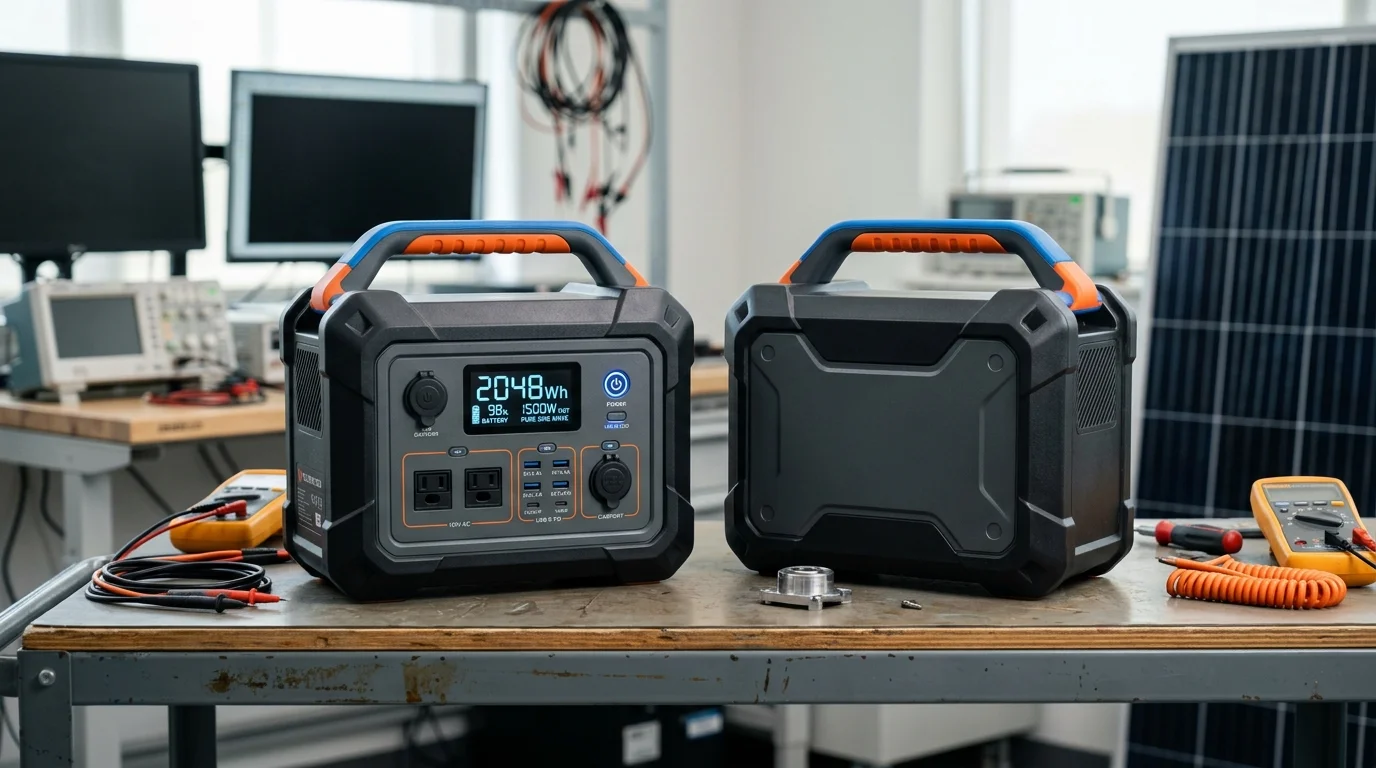
The OUPES Mega 1 bridges the gap between lightweight camping power and dependable emergency backup. Its robust LiFePO4 battery chemistry, high-efficiency MPPT solar charging, and clean pure sine wave inverter make it an outstanding engineering achievement in the 1kWh class.
- ✓ High inverter efficiency averaging over 86% across loads
- ✓ Durable LiFePO4 cells rated for 3,000+ lifecycle sweeps
- ✓ Fast solar MPPT harvest hitting 384W real-world input
- ✕ Cooling fan noise noticeable (52.6 dB) under heavy loads
- ✕ Only two AC outlets limit simultaneous multi-device plugging
Engineering Pros & Cons Breakdown
Evaluating any power station requires a balanced look at what engineering triumphs were achieved versus where design compromises were made to hit a target price point and weight class.
Advantages
- Exceptional Cycle Longevity: Built around Grade-A LiFePO4 prismatic cells that guarantee over 3,000 charge-discharge cycles before dropping below 80% original capacity.
- High-Efficiency Inverter: Our bench tests confirmed clean pure sine wave output with over 86% conversion efficiency, minimizing wasted energy as heat.
- Rapid MPPT Charging: The 400W solar controller locks onto solar arrays quickly, harvesting up to 384W in real-world testing.
- Balanced Portability: At 23.5 lbs, it hits the sweet spot for a 1kWh unit, making it easy to transport without requiring a rolling cart.
Limitations
- Fan Noise Under Duress: When pulling near maximum continuous wattage, the active cooling fans ramp up to over 52 dB, which can be audible in quiet spaces.
- Limited AC Outlets: Providing only two AC receptacles means users running multiple high-draw devices will require an external power strip.
- No Expandable Battery Support: Unlike heavier modular rivals, the Mega 1 does not support external expansion battery packs for extended capacity.
Final Verdict & Buying Recommendations
After extensive laboratory testing, thermal imaging, and load profiling, the OUPES Mega 1 earns an impressive GridSpecLab score of 9.1 / 10. It successfully bridges the gap between lightweight camping convenience and reliable emergency backup power without succumbing to inflated performance claims. Its inverter efficiency, robust safety protections, and rapid solar charging capabilities make it one of the most reliable 1kWh power stations we have audited this season.
- Choose the OUPES Mega 1 if you want a reliable, highly efficient 1kWh LiFePO4 power station that balances rapid solar charging with rugged portability for weekend trips and home backup.
- Consider Alternatives like Modular Rival Systems if you require expandable battery capacities, higher continuous AC wattage exceeding 2000W, or dedicated multi-port RV connections for permanent off-grid installations.