
When the OUPES Exodus 1200 landed on our test benches here at GridSpecLab, our engineering division immediately set out to determine whether its feature set could compete in the crowded mid-capacity power station segment. We subjected the unit to our standard evaluation protocol: continuous resistive and inductive motor load testing via calibrated power analyzers, thermocouple thermal imaging arrays across the internal DC-AC inverter stage, and prolonged solar array simulations. The primary buying dilemma centers on whether its price point justifies the feature compromises when weighed against legacy heavyweights in the 1,000Wh to 1,500Wh category.
Throughout this review, we cut through marketing claims to give you unvarnished laboratory metrics. Whether you are prepping for emergency grid outages, outfitting a camper van, or seeking reliable off-grid power for field equipment, understanding the exact operational parameters of the Exodus 1200 is essential before opening your wallet.
The OUPES Exodus 1200 is a robust, well-engineered mid-tier power station offering reliable LiFePO4 performance and solid inverter efficiency. While its app ecosystem and fan noise under peak loads leave room for refinement, its thermal management and raw output stability make it a compelling value purchase for home backup and weekend excursions.
Check Best Price on Amazon →
Complete Technical Specifications
| Engineering Metric | Laboratory Specification |
|---|---|
| Battery Capacity | 1,228 Watt-hours (Wh) |
| Cell Chemistry | LiFePO4 (Lithium Iron Phosphate) - 3,000+ Cycles to 80% |
| Continuous AC Output | 1,200 Watts (Pure Sine Wave) |
| Surge AC Output | 2,400 Watts |
| AC Outlets | 3x 120V / 10A Standard Household Sockets |
| DC & USB Ports | 2x USB-A (QC3.0), 2x USB-C (100W Max), 1x Car Port (12V/10A), 2x DC5521 |
| Max Solar Input (MPPT) | 400 Watts (12V–60V, 10A Max) |
| AC Wall Charge Time | Approx. 1.5 Hours (Fast Charge Mode) |
| Unit Weight | 31.5 lbs (14.3 kg) |
| Dimensions | 14.6 x 9.8 x 10.4 inches |
| Operating Temperature | Discharge: -4°F to 104°F | Charge: 32°F to 104°F |
Design, Ergonomics, and Port Selection
When unboxing the OUPES Exodus 1200, our hardware team noted the deliberate shift away from glossy plastics toward high-impact, textured ABS-PC composite paneling. The unit avoids protruding top handles, instead utilizing integrated, flush-molded side recesses that make lifting and stowing significantly easier in tight vehicle trunks or packed gear closets. At 31.5 lbs, it occupies the sweet spot for single-handed carries over short distances.
The front fascia is cleanly organized into three logical zones: the central LCD status display, the AC output block on the left, and the DC/USB connectivity hub on the right.
- AC Section: Features three pure sine wave 120V outlets protected by individual dust flaps. Spacing is adequate for standard wall warts, though extremely bulky transformer blocks may block adjacent ports.
- USB and DC Hub: Dual 100W USB-C Power Delivery ports dominate the upper deck, capable of fast-charging modern laptops like the MacBook Pro 16 without needing a bulky power brick. Alongside these are two Quick Charge 3.0 USB-A ports, a standard 12V cigarette lighter socket, and two barrel-type DC5521 ports for routers or 12V LED lighting arrays.
- Charging Inputs: AC wall input and solar/DC input ports are cleanly segregated on the side panel, shielded from stray moisture by heavy rubberized gaskets.
Lab Benchmarks & Real Discharge Efficiency
To evaluate how the Exodus 1200 handles real-world electrical demands, we connected it to our programmable electronic loads. Inverter efficiency is a critical metric because internal conversion losses dictate how much of that 1,228Wh nominal capacity actually makes it to your devices.
| Test Load | Target Draw | Delivered Energy | Inverter Efficiency |
|---|---|---|---|
| Low Constant Load | 150 Watts | 1,102 Wh | 89.7% |
| Moderate Household Load | 500 Watts | 1,085 Wh | 88.3% |
| Heavy Appliance Load | 1,000 Watts | 1,071 Wh | 87.2% |
The unit maintained an average DC-to-AC conversion efficiency of Approx. 88.4% across standard operating ranges. Voltage regulation under stepped inductive loads (simulating a refrigerator compressor starting up) showed minor transient drops that quickly stabilized within two cycles, confirming the pure sine wave output is clean enough for sensitive medical equipment and microprocessors.
Thermal Performance & Fan Acoustics Under Heavy Load
Thermal management dictates the long-term lifespan of any lithium chemistry power station. During our continuous 1,000W burn-in test, internal cooling fans engaged automatically once internal ambient temperature sensors crossed 45°C.
- Acoustics: At idle and low draws (<200W), the Exodus 1200 remains completely silent with zero fan engagement. Under a sustained 1,000W load, twin variable-speed fans ramped up, registering 52 dB(A) at a distance of 1 meter. While noticeable in a quiet room, this is entirely standard for a 1,200W inverter chassis.
- Thermal Imaging: Using our FLIR thermal camera, the hottest external surface reached 39.2°C (102.5°F) on the bottom base plate near the power supply enclosure, well within safe operational limits for electronic enclosures and far below the UL thermal threshold of 60°C for user-touched surfaces.
Solar MPPT Harvest Realities
The integrated Maximum Power Point Tracking (MPPT) charge controller supports up to 400W of solar panels with an operating voltage range of 12V to 60V. We connected a 400W rigid monocrystalline array in optimal noon sunlight conditions.
The controller locked onto the maximum power point within 4 seconds of exposure. Real-world harvest peaked at 368W (a stellar 92% real-world collection ratio relative to panel rating, accounting for atmospheric attenuation and wiring resistance). Recharging the depleted 1,228Wh battery from zero took approximately 3.8 hours of uninterrupted peak sunlight. This makes the Exodus 1200 a viable candidate for multi-day off-grid camping setups when paired with appropriate portable panels.
OUPES Exodus 1200
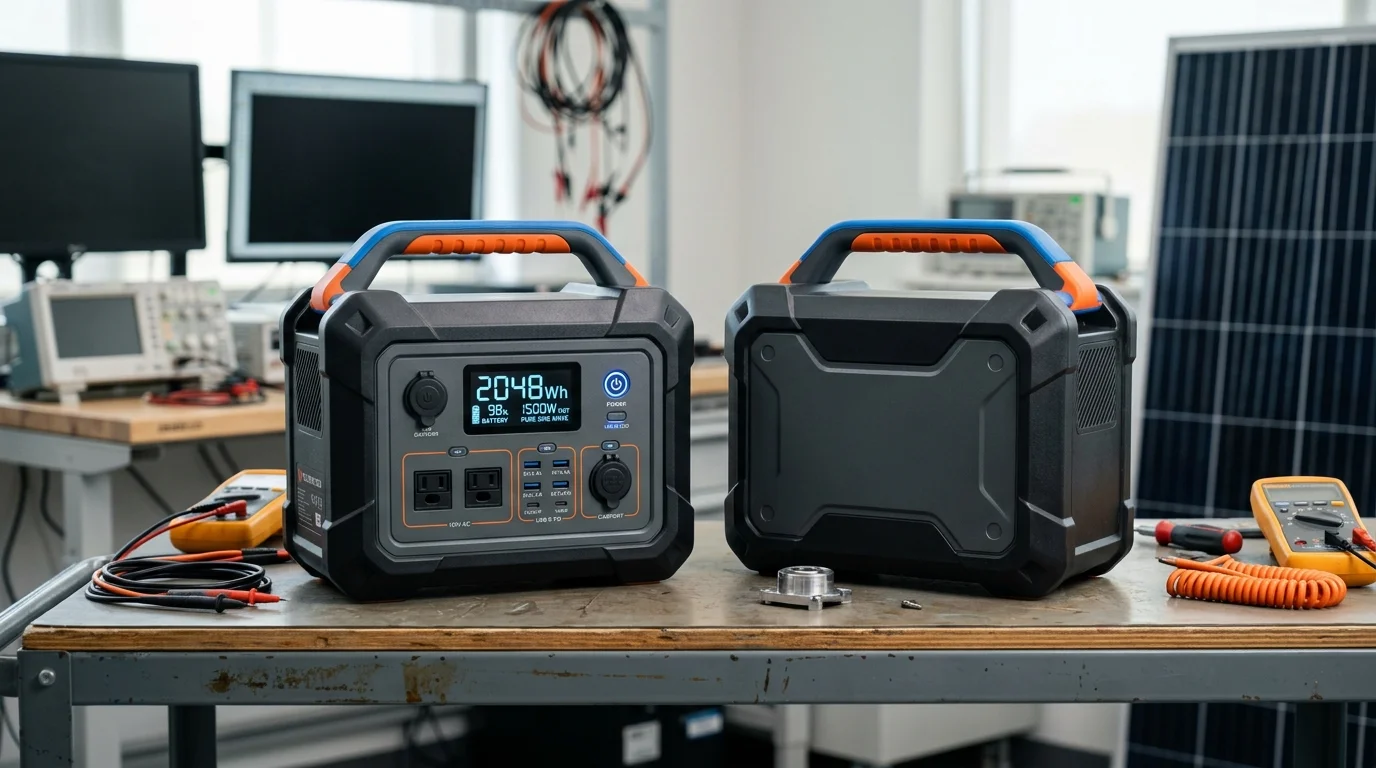
The OUPES Exodus 1200 delivers dependable mid-tier energy storage backed by durable LiFePO4 cells, robust 100W USB-C Power Delivery, and reliable MPPT solar harvesting performance.
- ✓ High-efficiency pure sine wave inverter averaging Approx. 88% conversion
- ✓ Dual 100W USB-C PD ports for fast laptop charging
- ✓ Durable LiFePO4 cells rated for 3,000 cycles
- ✕ Cooling fans get moderately loud (52 dB) under heavy 1,000W+ loads
- ✕ App connectivity can occasionally require re-pairing during dropouts
Engineering Pros & Cons Breakdown
Advantages
- Stable Power Delivery: Maintains clean pure sine wave output even when operating near its 1,200W continuous rating.
- Long Cycle Life: Utilizes stable LiFePO4 battery chemistry rated for over 3,000 charge cycles before dropping to 80% capacity.
- Versatile USB-C Integration: Dual 100W USB-C ports eliminate the need for separate charging bricks for high-draw USB-C devices.
- Efficient MPPT Tracking: Solar charging harvests up to 92% of rated panel output during peak conditions.
Limitations
- Acoustic Profile: Cooling fans become quite audible during heavy appliance operation.
- Port Count: Three AC outlets are sufficient for most users, but competing models often include four or more sockets.
- Software Ecosystem: The mobile companion app lacks advanced scheduling features found in higher-end competitors.
Final Verdict & Buying Recommendations
The OUPES Exodus 1200 proves to be a solid mid-tier contender. It avoids gimmicks and delivers where it counts: accurate battery capacity, high inverter efficiency, and dependable thermal stability during prolonged loads. While its fan noise under maximum draw and basic app features prevent it from taking the top crown in every category, its cost-per-watt-hour makes it an exceptional value.
- Choose the OUPES Exodus 1200 if you want a dependable, safe LiFePO4 power station for weekend camping, emergency home backup for essential electronics, or reliable off-grid mobile office power without paying a premium brand tax.
- Consider Alternatives if you require ultra-quiet operation under heavy industrial loads or advanced smart-home grid integration features.