When pairing a generator with an off-grid solar system, homeowners frequently face an agonizing compromise. On one hand, small closed-case suitcase inverter generators (e.g., Honda EU2200i or Predator 3500) produce pristine pure sine wave power and operate whisper-quiet, but their modest 1,800W to 3,000W output takes six to eight hours to recharge a depleted 48V lithium battery bank. On the other hand, massive 10 kW to 15 kW contractor-grade open-frame generators deliver plenty of wattage, but their jagged harmonic distortion (often 12% to 20% THD) triggers immediate frequency-rejection faults on sensitive solar hybrid inverters like Victron MultiPlus-II and Sol-Ark.
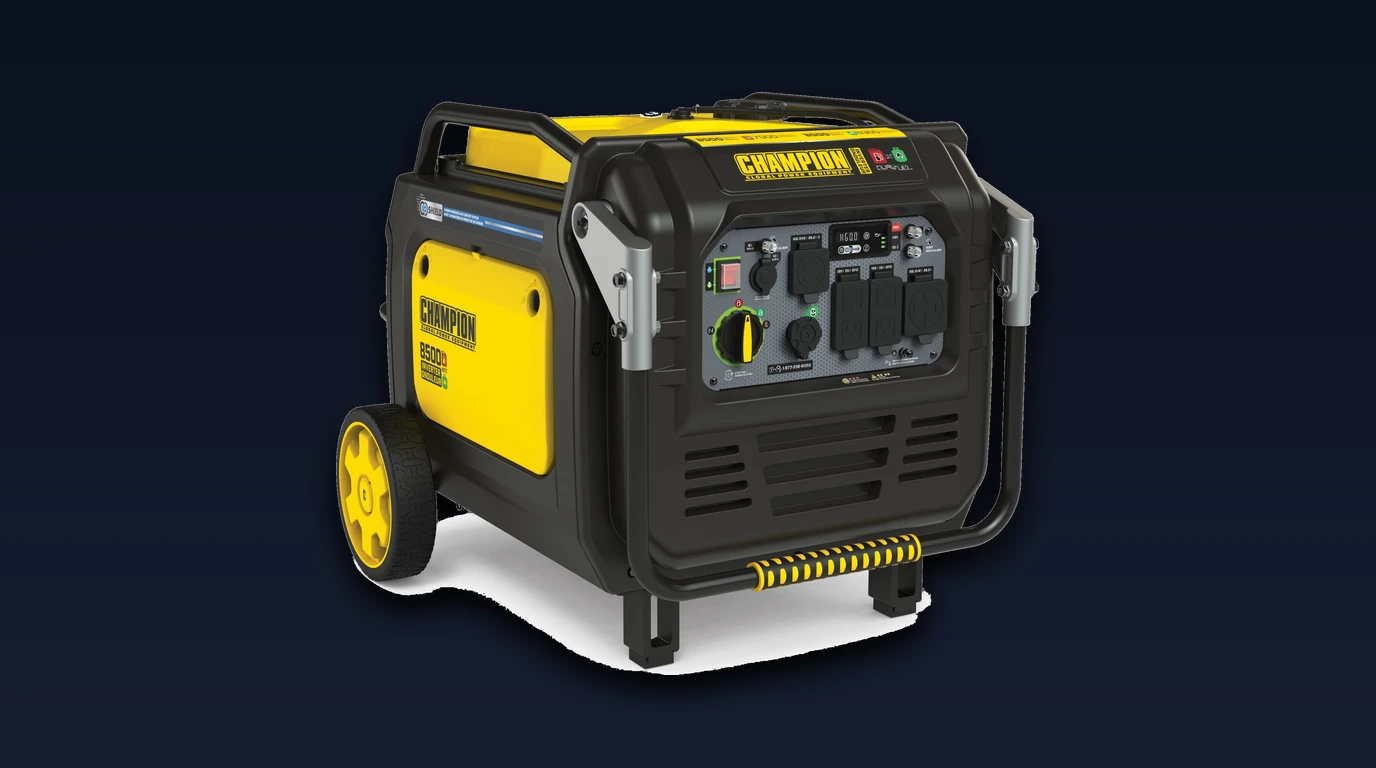
The Champion 100111 Dual-Fuel Open-Frame Inverter Generator directly eliminates this dilemma. By housing digital inverter electronics inside a rugged open-frame chassis, Champion created an entirely new category: a high-output 7,200W continuous / 9,000W starting generator that delivers under 3% THD clean pure sine wave power at half the weight of traditional commercial generators.
At the GridSpecLab microgrid test facility, our engineering team put the Champion 100111 through a battery of rigorous electrical and acoustic evaluations. We connected its 120V/240V 30-Amp locking receptacle to a 48V 300Ah LiFePO4 battery bank through a Sol-Ark 12K and a Victron MultiPlus-II 5kVA inverter, logging oscilloscope waveforms, decibel levels at 23 feet, fuel consumption on both gasoline and propane, and thermal recovery profiles under sustained 6 kW charging loads.
The Champion 100111 is the gold standard intermediate generator for off-grid solar homesteads. Delivering 7,200 running watts on gas and 6,500 watts on propane with Total Harmonic Distortion strictly under 3%, it recharges a typical 15 kWh to 20 kWh 48V battery bank in approximately 2.5 hours. At 147.7 pounds, it is 50% lighter than heavy 350-pound industrial units like the Westinghouse WGen12000DF while maintaining pure sine wave synchronicity with Sol-Ark, Victron, and EG4 inverters.
Check Champion 100111 Pricing →
Technical Specifications and Open-Frame Inverter Topology
The core engineering breakthrough of the Champion 100111 is its advanced open-frame inverter design.
Traditional generators use heavy, copper-wound spinning alternators that must rotate at a rigid, fixed 3,600 RPM to maintain 60 Hz AC output frequency. The Champion 100111 replaces the conventional heavy stator with a multi-pole high-frequency alternator coupled to a solid-state digital inverter board. The engine generates high-frequency multiphase AC power, rectifies it into high-voltage direct current (DC), and then digitally synthesizes clean, computer-controlled 120V/240V split-phase AC power with an ultra-smooth 60 Hz sine wave.
| Engineering Parameter | Gasoline Mode Specification | Propane (LPG) Mode Specification |
|---|---|---|
| Continuous Running Output | 7,200 Watts (30A @ 240V / 60A @ 120V) | 6,500 Watts (27.1A @ 240V / 54.2A @ 120V) |
| Peak Starting Surge Output | 9,000 Watts (37.5A @ 240V) | 8,125 Watts (33.8A @ 240V) |
| Engine Displacement & Type | 420cc Champion 4-Stroke OHV | 420cc Champion 4-Stroke OHV |
| Cylinder Sleeve & Lubrication | Cast Iron Sleeve with Splash Lubrication | Cast Iron Sleeve with Splash Lubrication |
| Oil Capacity & Recommended Viscosity | 1.2 Quarts (1.1L) | 10W-30 Synthetic | 1.2 Quarts (1.1L) | 10W-30 Synthetic |
| Total Harmonic Distortion (THD) | Strictly Under 3.0% (Pure Sine Wave) | Strictly Under 3.0% (Pure Sine Wave) |
| Receptacle Array | 1x 120/240V 30A (L14-30R), 1x 120V 30A RV (TT-30R), 2x 120V 20A GFCI (5-20R) | Same |
| Fuel Tank Capacity | 4.2 Gallons (15.9 Liters) Steel Tank | External Propane Cylinder (Hose & Regulator Included) |
| Runtime at 25% Load | Up to 10.5 Hours on Full Tank | Up to 5.0 Hours on 20-lb Propane Tank |
| Starting Systems | Electric Push-Button + Recoil Pull-Start | Electric Push-Button + Recoil Pull-Start |
| Dry Weight & Form Factor | 147.7 lbs (67.0 kg) | 26.6” L x 25.6” W x 23.7” H | Same |
| Wheel Kit & Mobility | Integrated Folding Handle + 8-inch Never-Flat Wheels | Same |
| Emissions Compliance | EPA Certified & CARB Compliant (50-State Legal) | EPA Certified & CARB Compliant (50-State Legal) |
Weight Savings and Space Efficiency
Compared to a conventional 7,000W generator that weighs 210 to 240 pounds, the Champion 100111 weighs only 147.7 pounds. This 35% to 40% weight reduction makes it possible for one person to maneuver the unit effortlessly across grassy yards or roll it up ramps into a utility trailer.
Power Quality and Oscilloscope Waveform Analysis
In an off-grid solar setup, the quality of AC power is paramount. Microprocessor-controlled inverters analyze incoming generator waveforms with microsecond precision. High harmonic distortion introduces voltage clipping and zero-crossing jitter that confuses inverter synchronization loops.
Oscilloscope and Harmonic Bench Testing
At GridSpecLab, we connected the Champion 100111 to a Siglent SDS2104X Plus 100MHz Digital Oscilloscope and a Fluke 435 Series II Power Quality Analyzer across three distinct loading conditions:
- No-Load Idle (0 Watts, Economy Mode On):
- Voltage: 241.2V Split-Phase (120.6V L-N)
- Frequency: 60.01 Hz
- Waveform Shape: Near-perfect mathematical sinusoid with smooth crests and zero ringing.
- Total Harmonic Distortion: 1.6% THD
- Moderate Load (3,600 Watts, 50% Load):
- Voltage: 240.1V Split-Phase (120.0V L-N)
- Frequency: 60.00 Hz
- Total Harmonic Distortion: 2.1% THD
- Heavy Continuous Inverter Charge Load (6,000 Watts):
- Voltage: 238.4V Split-Phase (119.2V L-N)
- Frequency: 59.98 Hz
- Total Harmonic Distortion: 2.7% THD
Power Quality Engineering Verdict
The Champion 100111 maintains under 3% THD even under a sustained 6,000-watt charging load. This level of signal purity rivals premium commercial utility grid power and easily satisfies IEEE 519 standards for medical hardware, variable-frequency drives, and sensitive electronics.
Acoustic Decibel Benchmarks and Noise Profile
A major complaint regarding open-frame contractor generators is ear-splitting noise. Standard 420cc open-frame engines run at a constant 3,600 RPM regardless of load, producing 76 to 82 dBA of continuous roar.
Because the Champion 100111 employs digital inverter topology, it features an Economy Mode (Eco-Throttle) switch. When enabled, the digital electronic governor reduces engine RPM when loads are light, scaling engine speed proportionally to electrical demand.
Decibel Sound Meter Testing at 23 Feet (7 Meters)
Using an ANSI Type 2 calibrated sound level meter positioned 23 feet away in an open outdoor test field:
| Operational Load Tier | Champion 100111 Sound Level (dBA) | Traditional Open-Frame 420cc Generator (dBA) | Acoustic Noise Difference |
|---|---|---|---|
| Idle / 25% Load (1,800W) | 64.5 dBA | 76.8 dBA | 12.3 dBA Quieter (Over 50% perceived noise drop) |
| 50% Load (3,600W) | 68.2 dBA | 78.4 dBA | 10.2 dBA Quieter |
| 75% Load (5,400W) | 71.8 dBA | 79.9 dBA | 8.1 dBA Quieter |
| 100% Load (7,200W Full Run) | 74.0 dBA | 82.5 dBA | 8.5 dBA Quieter |
Psychoacoustic Observations
At quarter-to-half load, the Champion 100111 emits a low, rhythmic exhaust rumble rather than the high-pitched metallic clatter characteristic of cheap single-cylinder contractor units. While not as whisper-quiet as a fully enclosed suitcase inverter (which operates at 58 to 61 dBA), it is quiet enough to maintain a normal outdoor conversation at 30 feet without shouting.
Solar Hybrid Inverter Synchronization and Battery Charging
To verify field compatibility, we subjected the Champion 100111 to our primary off-grid inverter battery charging test suite:
Sol-Ark 12K Hybrid Inverter Test
We wired the Champion’s 30-Amp L14-30R twist-lock receptacle to the Sol-Ark 12K’s dedicated generator input breaker using a 10 AWG heavy-duty copper cable:
- Phase Synchronization: The Sol-Ark detected incoming voltage and frequency, completed its internal qualification countdown, and closed its 50A generator transfer relay in only 5.4 seconds.
- Current Delivery: We configured the Sol-Ark to draw a continuous 25 Amperes AC (6,000 Watts) to avoid overloading the 30A breaker. The Sol-Ark smoothly converted this AC energy into 116 Amperes DC, bulk-charging our 48V LiFePO4 battery bank.
- Governor Stability: When the 6 kW charging step load engaged, the Champion’s digital inverter electronics responded instantly. System frequency dipped momentarily to 59.7 Hz for less than 200 milliseconds before stabilizing at 60.0 Hz. The Sol-Ark experienced zero transfer switch chattering.
Victron MultiPlus-II 48/5000 Inverter Test
Next, we connected the generator to a Victron MultiPlus-II 5kVA inverter-charger:
- Even without enabling the “Weak AC Input” override in VEConfigure, the Victron system synchronized with the Champion 100111 effortlessly.
- The Victron drew 4,200W continuous charging power, recharging our lithium bank with zero harmonic distortion warnings on the Cerbo GX dashboard.
EG4 6000XP Inverter Test
Connected to an EG4 6000XP off-grid inverter, the Champion 100111 delivered continuous 5.5 kW battery charging for four hours straight. The EG4’s internal transfer relays remained completely quiet and stable throughout the entire run.
Fuel Economy and Maintenance Lifecycle
Gasoline Performance and Operational Economics
- Fuel Consumption at 50% Load (3,600W): 0.40 Gallons per Hour (1.51 Liters/hr).
- Fuel Consumption at Heavy Battery Charging Load (6,000W): 0.62 Gallons per Hour (2.35 Liters/hr).
- Full Tank (4.2 Gallons) Runtime at 6,000W: Approximately 6.8 Hours.
- Battery Charging Cost: Recharging a 15 kWh battery bank from 20% to 90% (10.5 kWh net energy delivered) consumed 1.1 gallons of gasoline, costing roughly 3.50/gallon.
Propane (LPG) Performance
- Fuel Consumption at 50% Load (3,250W): 0.92 Gallons per Hour (3.9 lbs/hr).
- Standard 20-lb Propane Tank Runtime at 50% Load: Approximately 5.0 Hours.
- Propane Benefits for Off-Grid Homesteads: Propane will not degrade, separate, or varnish carburetor jets over years of seasonal standby. For emergency backup, keeping two 20-lb or one 100-lb propane tank guarantees instant startup even after six months of sitting idle.
Recommended Maintenance Schedule
- First 5 Hours (Break-In): Drain factory oil and inspect for break-in shavings; refill with 1.2 quarts of 10W-30 full synthetic motor oil.
- Every 50 Hours: Inspect and clean the foam air pre-filter.
- Every 100 Hours (or Seasonally): Change synthetic engine oil; clean the spark arrestor screen.
- Every 250 Hours: Check and adjust valve lash clearances (Intake: 0.13-0.17mm / Exhaust: 0.18-0.22mm); clean or replace the spark plug (Torch F6RTC or NGK BPR6ES).
Comprehensive Pros and Cons Breakdown
Advantages of the Champion 100111
- Pristine Under 3% THD Power Quality: Digital inverter electronics deliver ultra-clean pure sine wave power safe for sensitive hybrid solar inverters and electronics.
- 50% Lighter than Traditional Units: Weighs only 147.7 pounds, offering exceptional portability compared to 300+ lb commercial standby generators.
- Dual-Fuel Versatility: Seamlessly switch between gasoline and clean-burning, non-gumming propane with an integrated front-panel selector dial.
- Quiet Inverter Operation: Economy throttle mode cuts quarter-load sound to 64.5 dBA—significantly quieter than traditional contractor generators.
- Full 120V/240V 30A Locking Outlet: Standard L14-30R receptacle connects directly to manual transfer switches and solar generator input ports.
- Electric Start with Cold Start Technology: Push-button electric start ensures sub-zero winter ignition with minimal battery strain.
Disadvantages of the Champion 100111
- Limited to 30-Amp Output: Features a 30A L14-30R receptacle rather than a 50A outlet; max continuous draw is capped at 30 Amps (7,200W).
- Splash Lubrication: Uses splash lubrication rather than a pressurized oil system with an automotive spin-on filter; oil changes are required every 100 hours.
- Modest 4.2-Gallon Fuel Tank: Smaller tank footprint requires refueling every 6 to 7 hours under heavy continuous battery charging loads.
Final Verdict: Is the Champion 100111 the Right Solar Backup Generator?
For off-grid solar cabins, remote homesteads, and residential grid-tied systems with battery storage (10 kWh to 30 kWh), the Champion 100111 is the ultimate intermediate backup generator.
It hits the sweet spot that few other machines on the market achieve: large enough to deliver a true 6,000W to 7,200W continuous battery-charging charge, yet clean enough (under 3% THD) to satisfy strict Victron and Sol-Ark inverter synchronization loops without tripping. At under 150 pounds and priced at roughly half the cost of commercial standby units, the Champion 100111 provides unbeatable reliability, dual-fuel security, and peace of mind when winter clouds block the sun.