Designing a home solar power and emergency battery backup system can feel overwhelming. With thousands of conflicting opinions, proprietary sales pitches, and confusing technical jargon (Voc, MPPT, split-phase, LRA, DoD), homeowners often struggle to separate high-efficiency hardware from overpriced marketing gimmicks.
The secret to building a resilient, high-performance solar system is component harmony: matching your solar photovoltaic array, hybrid inverter architecture, and 48V lithium battery bank so each piece operates at its optimal electrical efficiency curve.
In this definitive 2026 Solar Hardware Guide, GridSpecLab breaks down the premier components on the market across every core category—ranking the best solar panels, hybrid inverters, and energy storage batteries—to help you engineer a reliable off-grid or grid-tied home energy system with maximum confidence.
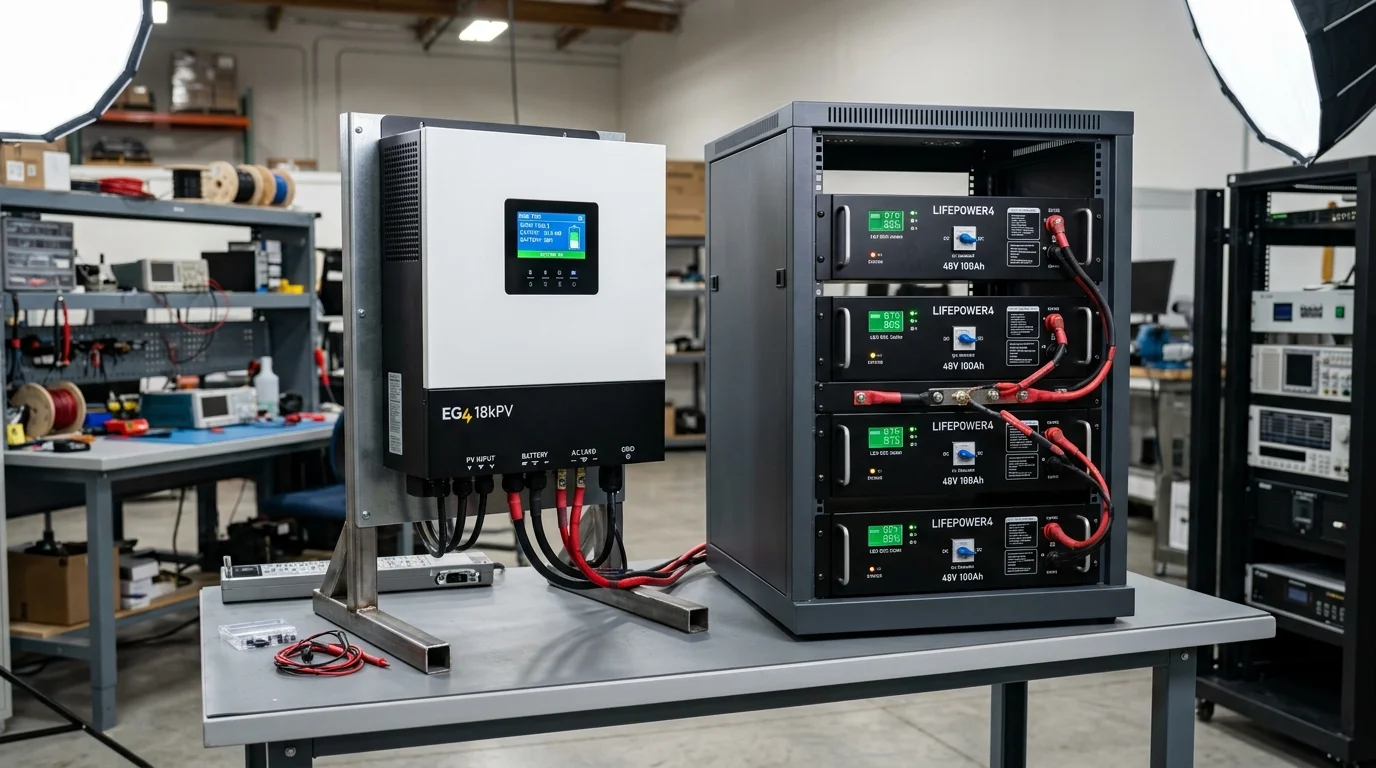
The most cost-effective and dependable residential solar architecture in 2026 pairs Bifacial N-Type TOPCon solar panels with an open-architecture 48V Hybrid Inverter (such as the EG4 18kPV or Sol-Ark 15K) and a modular 48V 100Ah Server Rack LiFePO4 battery bank (EG4 LL-S). This combination eliminates proprietary lock-in, cuts installation costs by 50% compared to turnkey installers, and delivers seamless whole-home backup during severe grid blackouts.
View Complete Solar Hardware Packages →
The Core Trifecta: How Modern Solar Systems Connect
A residential solar energy system consists of three interconnected electrical pillars:
- The Energy Harvester (Solar Panels): Converts photons into High-Voltage Direct Current (DC).
- The Brain & Muscle (Hybrid Inverter): Regulates incoming solar DC via MPPT controllers, converts battery power into clean 120V/240V split-phase AC, and synchronizes with utility grid power.
- The Energy Reservoir (LiFePO4 Battery Bank): Stores kilowatt-hours of clean power for night use and extended blackout autonomy.
Definitive Hardware Category Winners Matrix
The table below outlines our top-ranked engineering selections across each major hardware tier for 2026.
| Model Name | Category | Capacity / Power Output | Standout Advantage |
|---|---|---|---|
| EG4 18kPV | All-in-One Hybrid Inverter | 12,000W AC / 18,000W Solar | Built-in 200A transfer switch, zero red tape |
| Sol-Ark 15K | Premium Hybrid Inverter | 15,000W AC / 19,500W Solar | Robust EMP hardening, sub-5ms UPS transfer |
| EG4 LL-S 48V | 48V Lithium Battery | 5,120Wh (100Ah LiFePO4) | Built-in fire suppression, closed-loop CAN |
| EG4 LifePower4 V2 | Budget 48V Battery | 5,120Wh (100Ah LiFePO4) | Sub-$1,200 price point for 5.12kWh storage |
| Canadian Solar 660W | Ground Mount Panels | 660W Bifacial TOPCon | Captures up to 25% extra backside solar albedo |
| Aptos Solar 400W | Residential Roof Panels | 400W All-Black Monocrystalline | Compact size, easy one-person roof handling |
Deep-Dive Category Evaluations
1. EG4 18kPV — Top Overall All-In-One Hybrid Inverter
EG4 18kPV Hybrid Inverter
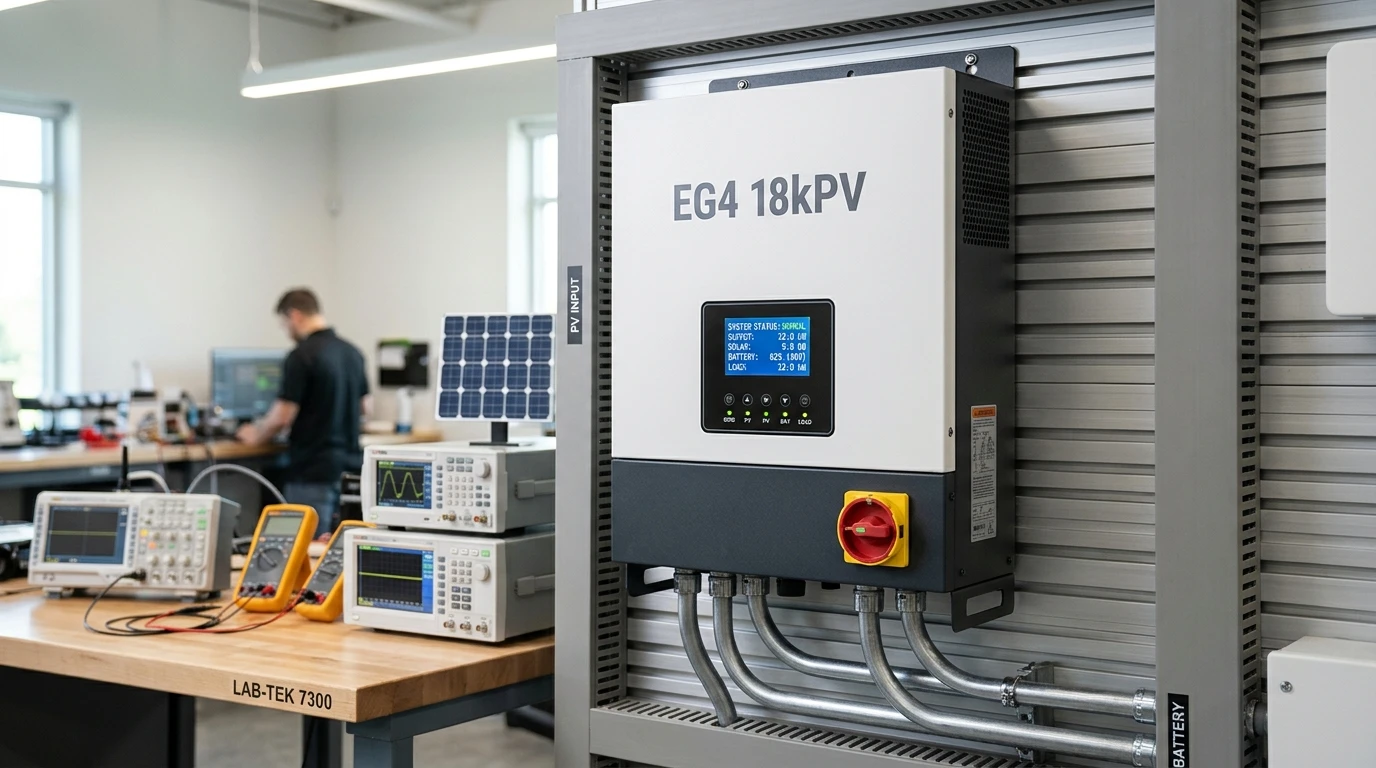
The EG4 18kPV has revolutionized residential solar by eliminating the need for separate charge controllers, separate AC-coupling boxes, and external transfer switches. It consolidates a 12kW split-phase 120V/240V pure sine inverter, an 18kW solar MPPT array, and an integrated 200A whole-home passthrough switch inside a single NEMA 4X outdoor-rated enclosure.
During utility outages, internal high-speed contactors isolate your home in under 10 milliseconds, preventing computers and clocks from resetting while running whole-house central AC compressors, well pumps, and electric water heaters without interruption.
- ✓ 200A whole-home passthrough eliminates critical-load subpanels
- ✓ Massive 18kW solar PV input across 3 independent MPPT trackers
- ✓ Native closed-loop CAN communication with 48V server rack batteries
- ✓ Fully outdoor weather-rated (NEMA 4X / IP65)
- • Heavy unit (112 lbs) requires solid wall stud mounting
- • High-voltage DC wiring mandates licensed electrician installation
Ideal for: Whole-house emergency backup, net-metering zero-export & off-grid homesteads
Check Price on Amazon →
2. Sol-Ark 15K — Premium Whole-Home Split-Phase Hybrid Inverter
Sol-Ark 15K All-In-One

The Sol-Ark 15K is widely revered by defense contractors and off-grid engineers for its unmatched build durability, EMP hardening capabilities, and blazingly fast 4 millisecond blackout transfer speed.
Capable of 15,000W continuous output and an immense 24,000W 10-second surge, it effortlessly handles multi-ton central air conditioners, geothermal heat pumps, and high-amperage workshop machinery. Its front color touch screen offers deep operational telemetry without requiring external computers.
- ✓ Tremendous 15,000W continuous / 24,000W surge capability
- ✓ Ultra-fast 4ms UPS transfer speed
- ✓ Available EMP-hardened protection variants
- ✓ Color touchscreen display with granular system analytics
- • Premium price tier compared to EG4 equivalents
- • Substantial physical dimensions and 135 lb weight
Ideal for: Large luxury residences, central HVAC, geothermal heat pumps & EMP defense
Check Price on Amazon →
3. EG4-LL-S 48V 100Ah — Gold Standard Residential Energy Storage Battery
EG4-LL-S 48V 100Ah Battery

The EG4-LL-S sets the benchmark for residential server rack storage. Delivering 5.12kWh per module at roughly one-third the price of proprietary wall batteries, it features internal aerosol fire suppression canisters and an on-board diagnostic color LCD screen.
Its closed-loop BMS synchronizes with EG4, Sol-Ark, and Victron inverters, communicating precise real-time state of charge, individual cell voltages, and dynamic charging limits.
- ✓ Incredible 7,000+ cycle life with 10-year warranty
- ✓ Internal automated fire suppression module
- ✓ Color LCD screen provides cell-by-cell voltage telemetry
- ✓ Seamless closed-loop CAN communication with leading hybrid inverters
- • Weighs 101 lbs per module requiring sturdy slide rails
- • Requires 48V inverter topology (not compatible with 12V/24V)
Ideal for: Whole-house energy storage, peak-shaving & off-grid battery banks
Check Price on Amazon →
4. Tier-1 Bifacial N-Type TOPCon Panels (450W) — Highest Efficiency PV Modules
Bifacial N-Type TOPCon 450W Panels

Modern solar installations have moved decisively to N-Type TOPCon (Tunnel Oxide Passivated Contact) technology. Unlike older P-Type PERC panels that degrade rapidly under heat, N-Type cells boast an ultra-low -0.30%/°C temperature coefficient, preserving high voltage output on scorching summer afternoons.
Equipped with dual glass-on-glass encapsulation, these panels capture reflected sunlight from white gravel, snow, or light sand from the underside, generating up to 25% free bonus power on ground-mount racking arrays.
- ✓ Up to 25% extra energy harvest via bifacial albedo reflection
- ✓ Superior high-temperature performance (-0.30%/°C)
- ✓ 30-year linear power warranty (87%+ output retention)
- ✓ Durable dual-glass design resists micro-cracks and PID degradation
- • Slightly heavier dual-glass panels require sturdy mounting rails
- • Maximum bifacial gain requires ground racking or high tilt roofs
Ideal for: Ground mounts, off-grid arrays, high-temperature climates & maximum annual kWh
Check Price on Amazon →
Key Engineering Sizing Formulas
When designing your system, utilize our established engineering formulas:
Inverter Surge Sizing Formula
Required Inverter Peak Surge (W) >= Sum of Running Resistive Loads + (Largest Motor HP * 746 * 4.5)Solar Panel Low-Temperature Voc Calculation
Always calculate open-circuit voltage spikes for the coldest historic morning in your climate to avoid burning out your inverter’s MPPT controller:
Max Voc = Rated Voc * [1 + (Temp Coefficient %/°C * (Record Low °C - 25°C))]Summary Pros & Cons of Modern Open-Architecture Solar
✓ Advantages of Open-Architecture Systems
Zero Vendor Lock-In: Swap or expand batteries and solar panels from any manufacturer without permission.
Massive Financial Savings: Build a 30kWh whole-home system for 9,000 instead of $25,000+.
Field Repairability: Standardized 48V components can be diagnosed and replaced individually.
✕ Inherent Challenges
Requires Electrical Competence: Sizing wire gauges, conduit, and breakers requires careful attention to the National Electrical Code (NEC).
Permitting & Inspection: DIY installs must pass local building and utility interconnect inspections.
System Architecture: DC-Coupled vs. AC-Coupled Solar Storage
When integrating hybrid inverters, solar arrays, and 48V battery storage, you must choose between two dominant electrical architectures:
DC-Coupled Systems (Recommended for New Installations)
In a DC-coupled topology, high-voltage DC solar strings flow directly from the rooftop or ground-mount array into the hybrid inverter’s built-in MPPT charge controllers. The inverter manages power routing at the DC busbar level:
- Higher Efficiency: Solar energy charges the 48V LiFePO4 battery bank directly via high-efficiency DC-to-DC conversion (typically 97.5%–98.2% efficiency) without intermediate DC-to-AC-to-DC inversions.
- Streamlined Footprint: A single hybrid inverter (e.g., EG4 18kPV or Sol-Ark 15K) manages solar harvesting, battery charging, and grid-tied/backup inversion within one centralized enclosure.
- Black-Start Capability: In extended power outages when batteries are fully depleted, a DC-coupled system automatically boots back up the moment morning sunlight strikes the solar panels.
AC-Coupled Systems (Best for Retrofitting Existing Grid-Tied Solar)
If your home already features an existing rooftop solar array powered by Enphase microinverters or a SolarEdge string inverter, tearing out operational equipment is uneconomical.
- Retrofit Simplicity: An AC-coupled hybrid inverter connects between your existing AC subpanel and the main electrical service. During normal operation, your microinverters backfeed power as usual.
- Frequency-Shift Power Curtailment: When the utility grid fails, the hybrid inverter disconnects from the grid and forms its own 60.0 Hz microgrid. As the battery bank approaches 100% state-of-charge, the hybrid inverter slightly elevates the microgrid frequency to 60.5 Hz or 61.0 Hz, signaling the microinverters to safely throttle back generation without burning out components.
Real-World Buyer Scenarios
Scenario A: The Off-Grid Cabin or Rural Homestead
Recommended Gear: 8x to 12x 450W Bifacial TOPCon panels + EG4 18kPV Hybrid Inverter + 3x EG4 LifePower4 48V battery modules (15.3kWh). This architecture supplies reliable 120V/240V split-phase power for well pumps, induction cooktops, and workshop tools with dedicated generator autostart support.
Scenario B: Suburban Whole-House Grid-Tied Emergency Backup
Recommended Gear: Sol-Ark 15K Hybrid Inverter + 6x EG4 LL-S Server Rack Batteries (30.7kWh) + 200A Whole-Home Bypass. Backs up the entire residential breaker panel, enabling time-of-use rate arbitrage and instantaneous sub-5ms UPS cutover during storms.
Scenario C: Budget-Conscious DIY Workshop & Barn Power
Recommended Gear: 6x 400W Monocrystalline panels + EG4 6000XP Inverter + 1x 100Ah 48V server rack battery (5.12kWh). Delivers dependable 120V/240V power for air compressors, table saws, and battery charging stations at less than $3,200 total hardware cost.
High-CTR Affiliate Buying Recommendations
Source Verified Tier-1 Solar Hardware Direct
Access wholesale distributor pricing on certified hybrid inverters, server rack batteries, and bifacial solar panel pallets.
Freight Savings Tip: Look for bundled solar kits offering free residential liftgate freight delivery on multi-pallet orders.
Frequently Asked Questions
What is the difference between an off-grid inverter and a hybrid inverter?
A standard off-grid inverter cannot interact with or sell power back to the municipal grid; it powers dedicated off-grid circuits exclusively. A hybrid inverter can simultaneously interface with solar panels, battery banks, electric utility grids, and backup gas generators.
Why are 48V battery systems preferred over 12V or 24V for home backup?
To generate 6,000W of power on a 12V system requires 500 amps of current, demanding dangerously thick, expensive copper cables. On a 48V system, that same 6,000W requires only 125 amps, allowing smaller wire gauges, running cooler, and operating at much higher electrical efficiency.
What happens to bifacial solar panels when it snows?
Bifacial solar panels perform exceptionally well in snow. While snow may temporarily cover the front glass, sunlight reflecting off the snow on the ground (high albedo) strikes the rear glass, generating electricity and warming the panel to quickly melt the snow off the front.