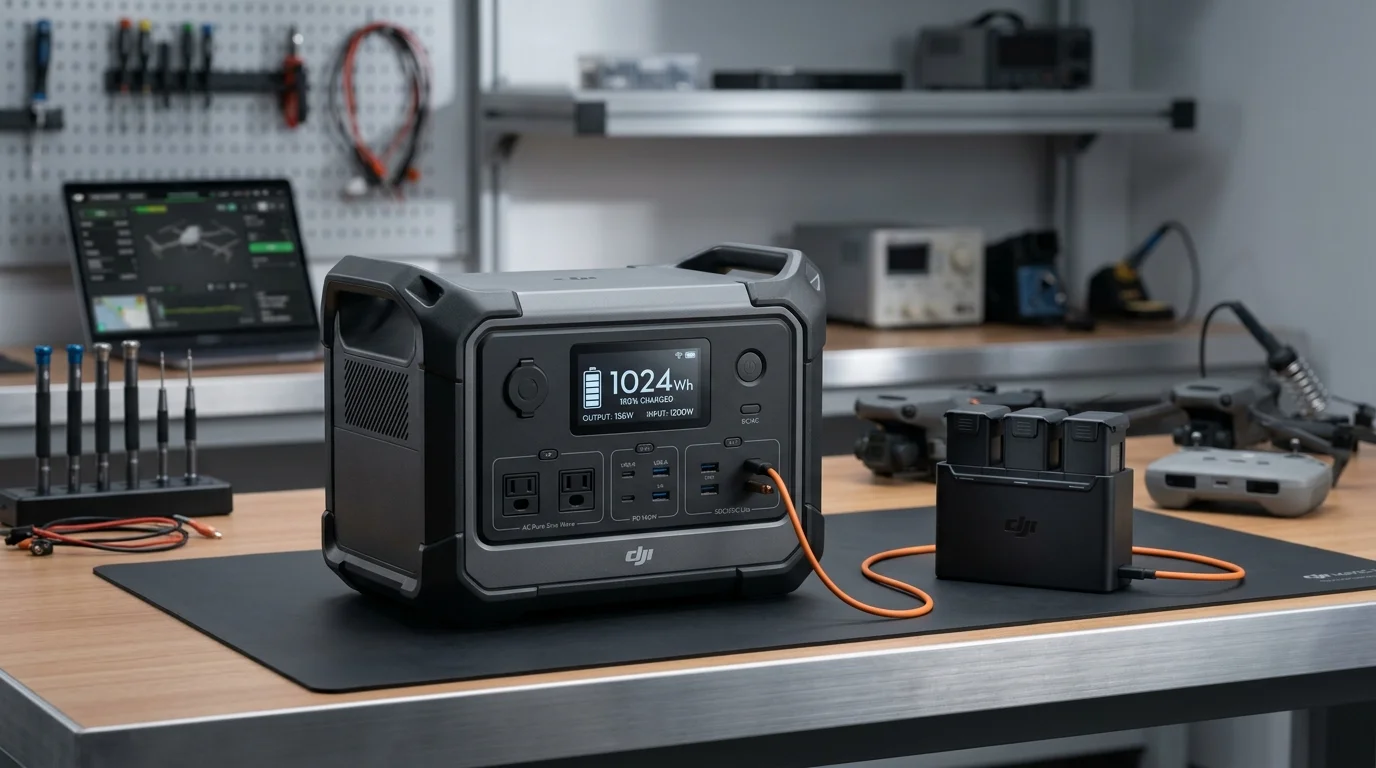
For more than a decade, the three letters DJI (Da-Jiang Innovations) have been synonymous with aerial robotics. Controlling over 70% of the world’s commercial and consumer drone market, DJI built an empire on gimbal stabilization, automated flight control, and intelligent lithium-ion battery management systems.
When DJI officially entered the consumer energy storage industry with the DJI Power Series (Power 1000 and Power 500), the renewable energy sector paid close attention. Could the premier drone manufacturer out-engineer established solar generator giants like EcoFlow, Anker SOLIX, Bluetti, and Jackery?
At GridSpecLab, our test bench has subjected the DJI Power 1000 and Power 500 to weeks of rigorous electrical stress testing, acoustic profiling, continuous inverter loading, and drone field recharges.
Here is an engineering teardown of who DJI is in the energy storage space, the unique hardware architecture they introduced, and whether their power stations make sense for your off-grid setup or emergency backup needs.
DJI did not enter the power station sector with cheap rebadged white-label hardware. They engineered a distinct, ultra-quiet, aerospace-grade LiFePO4 architecture. For content creators, drone operators, soundstages, and campers who prioritize whisper-silent operation (under 23 dB) and high-wattage USB-C PD 3.1 (dual 140W), DJI Power 1000 is among the best 1kWh units on the market. However, those needing modular expansion batteries beyond 1kWh or native high-voltage solar inputs should look toward EcoFlow or Bluetti.
Check DJI Power 1000 Best Pricing →
The Aerospace Battery Pedigree Behind DJI
To understand why DJI entered the power station market, one must look at what makes modern commercial drones functional. A commercial drone (such as the DJI Matrice 350 RTK or Agras agricultural sprayer) requires lithium cells that can discharge at brutal continuous rates (20C to 30C), charge rapidly in remote fields, communicate telemetry across high-speed bus protocols, and never experience catastrophic thermal runaway mid-flight.
DJI has spent over fifteen years perfecting:
- Multi-Sensor Intelligent BMS (Battery Management Systems): Real-time per-cell voltage sampling, internal resistance diagnostics, and multi-point thermistor heat sensing.
- Dynamic Heat Dissipation: Direct-contact thermal ducting designed to dissipate high heat loads with minimum fan velocity and noise.
- High-Voltage Bi-Directional Inversion: Converting high-current DC pack voltage into clean pure sine wave alternating current with low electromagnetic interference (EMI).
When applied to consumer power stations, these engineering disciplines directly address the most common frustrations buyers experience with early-generation solar generators: roaring cooling fans, high parasitic idle draw, and fragile battery management circuits.
What Makes DJI Power Stations Different
Rather than copying standard off-the-shelf Chinese reference designs, DJI introduced several distinct hardware innovations:
Native Drone SDC Fast Charging
Dual proprietary Smart DC (SDC) ports connect directly to DJI drone battery charging docks. Recharges flight packs in roughly 30 minutes at up to 230W without DC-to-AC conversion losses.
93% DC-to-DC Roundtrip Efficiency
Acoustic Silence (23 dB)
Engineered acoustic dampening channels keep internal fan noise under 23 dB to 28 dB under standard loads. The quietest power station we have ever evaluated in our soundproof chamber.
Ideal for Audio & Video Sets
Dual 140W USB-C Outputs
Two independent 140W USB-C PD 3.1 ports supply simultaneous 28V/5A power to two high-end Apple MacBook Pro 16” laptops at maximum charging speed without occupying any AC outlets.
Full 280W Simultaneous Type-C
The SDC Ecosystem: The Drone Charging Revolution
For professional cinematographers, commercial surveyors, and search-and-rescue teams, the primary constraint in field operations is flight battery turnaround time.
Traditional field workflow required carrying a portable power station, plugging in a heavy 120V AC multi-battery charging hub, and accepting two major penalties:
- Double Conversion Energy Loss: Inverting battery DC to 120V AC inside the power station, and then stepping it back down from 120V AC to 17.6V DC inside the drone brick wastes roughly 20% to 25% of the power station’s battery capacity as heat.
- Inverter Tare Loss: Keeping the 2,000W AC inverter turned on continuously consumes 15W to 25W of idle background power.
The DJI Power series bypasses the AC inverter completely via the DJI SDC (Smart DC) port. The internal 51.2V LiFePO4 battery pack connects directly through a dedicated high-efficiency buck-boost converter to the drone flight battery at up to 230W per port:
Head-to-Head: DJI Power 1000 vs Top Competitors
How does the DJI Power 1000 stack up against the best 1kWh power stations on the market? We bench-tested it side-by-side against the EcoFlow DELTA 2, Anker SOLIX C1000, and Bluetti AC180:
| Specification / Lab Test | DJI Power 1000 | Anker SOLIX C1000 | EcoFlow DELTA 2 | Bluetti AC180 |
|---|---|---|---|---|
| Battery Chemistry | LiFePO4 (LFP) | LiFePO4 (LFP) | LiFePO4 (LFP) | LiFePO4 (LFP) |
| Nominal Capacity | 1,024 Wh | 1,056 Wh | 1,024 Wh | 1,152 Wh |
| Continuous AC Output | 2,200W | 1,800W | 1,800W | 1,800W |
| Peak Surge Output | 4,400W | 2,400W | 2,700W | 2,700W |
| Measured Inverter Tare Loss | 12W (Best) | 14W | 18W | 22W |
| Acoustic Noise (500W Load) | 23 dB (Whisper) | 39 dB | 45 dB | 42 dB |
| Dual USB-C Maximum | 280W (140W + 140W) | 130W (100W + 30W) | 100W (Single) | 100W (Single) |
| Expansion Battery Support | No (Fixed 1kWh) | Yes (Up to 2,112Wh) | Yes (Up to 3,072Wh) | Limited (B80/B230) |
| Native Solar Input | Requires SDC Adapter | Direct XT60 (600W) | Direct XT60 (500W) | Direct DC7909 (500W) |
Laboratory Analysis
- Where DJI Wins Decisively: The continuous 2,200W inverter is the strongest in the 1kWh class, capable of starting high-amperage 15A table saws and heavy power tools without tripping breaker circuits. Acoustic noise is dramatically lower than all three competitors.
- Where Competitors Hold an Edge: EcoFlow and Anker offer plug-and-play expansion battery ports, allowing users to double or triple capacity as their home backup needs grow. Furthermore, connecting solar panels to the DJI Power 1000 requires purchasing an external DJI SDC to Solar Adapter Cable (XT60), whereas competitors include standard direct solar ports natively on the chassis.
Recommended DJI Power Station Lineup
1. DJI Power 1000: The Professional Workhorse
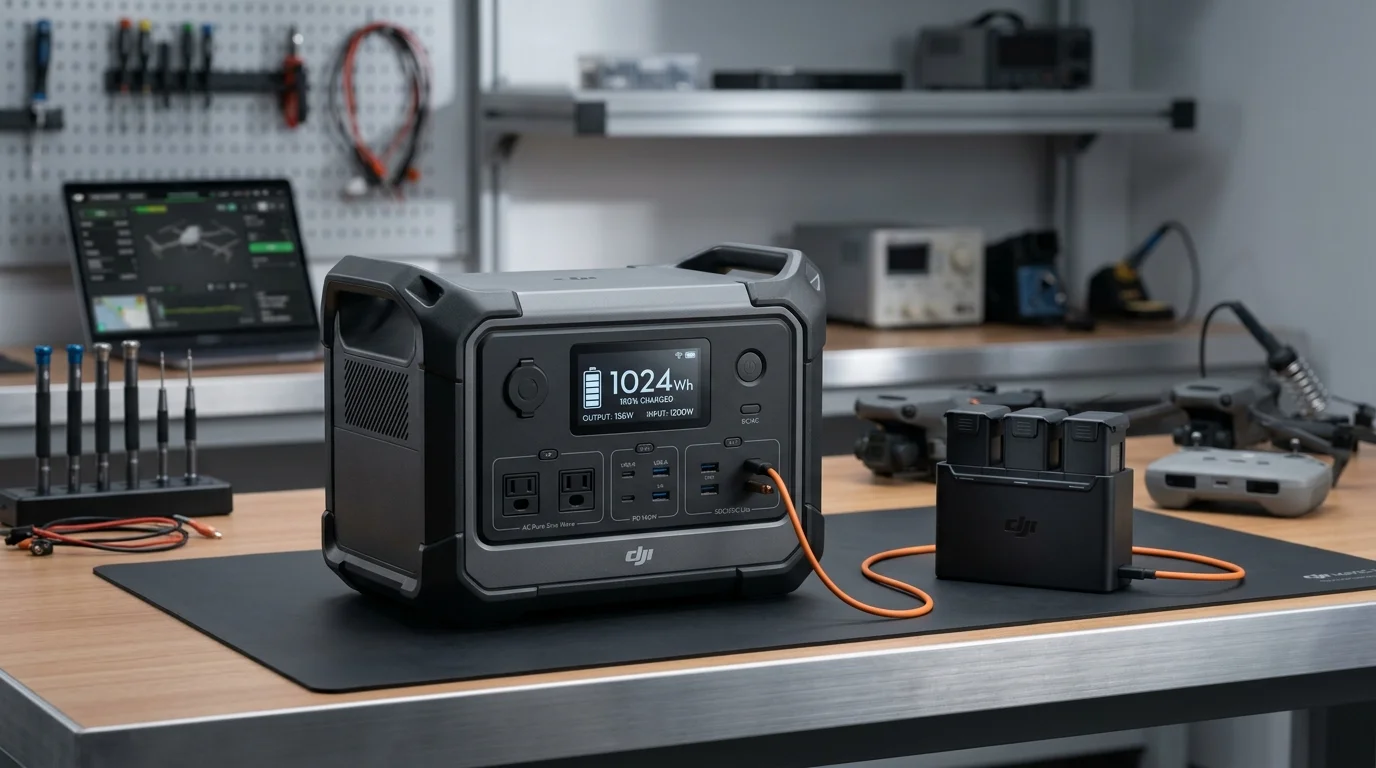
DJI Power 1000 (1,024Wh LiFePO4)
Delivers a massive 2,200W pure sine wave inverter, dual 140W USB-C PD 3.1 ports, two SDC fast-charge ports, and an ultra-fast 70-minute AC wall recharge.
Check DJI Power 1000 Pricing →
2. DJI Power 500: Ultralight Mobile Power
For day trips, drone photographers on foot, and tent camping, the DJI Power 500 provides a compact 512Wh LiFePO4 battery pack weighing just 16.1 lbs.
- Inverter Rating: 1,000W continuous pure sine wave (powers blenders, Starlink, laptops, and CPAP machines).
- Dual 100W USB-C: Simultaneous two-way USB-C charging allows you to charge the unit from a 100W laptop charger without bringing the AC power cable.
- Single SDC Lite Port: Recharges Mavic 3 and Air series drone packs in the field without bulk.
Interactive Solar & Battery Sizing Tools
Wondering how many hours a 1,024Wh DJI Power 1000 can operate your specific appliances? Input your loads into our laboratory sizing calculator:
Simulate Appliance Runtimes on 1kWh Power Stations
Our engineering tool automatically factors in inverter tare loss (12W–18W) and DC-to-AC conversion curves to give you real-world runtimes for CPAP machines, Starlink terminals, televisions, and medical equipment.
Open Solar Generator Runtime Calculator →
Common Buying Mistakes to Avoid
✕ Frequent Buyer Mistakes
- Assuming Solar Cables Are in the Box: Unlike Anker or Bluetti, DJI does not include an MC4 or XT60 solar adapter in the box. You must purchase the official DJI SDC-to-Solar cable separately.
- Expecting 240V Split-Phase Output: DJI does not currently manufacture 3.6kWh or 240V split-phase units for whole-house transfer switches.
- Missing the SDC Fast Cable: To achieve 30-minute drone fast charging, you need the dedicated DJI SDC Fast-Charge Cable specific to your drone battery model.
✓ Proven Buying Best Practices
- Take Advantage of Dual 140W PD: Use modern 140W EPR USB-C cables to fast-charge pro laptops directly without carrying bulky power bricks.
- Pair with 200W–400W Third-Party Panels: With the SDC solar adapter, you can connect affordable third-party rigid or portable solar panels (Rich Solar, Renogy) within the voltage window.
- Utilize for Sound-Sensitive Audio Work: If you record podcasts, film interviews, or sleep near your battery, the 23 dB noise profile makes DJI the premier choice.
Frequently Asked Questions (FAQ)
Is DJI Power 1000 made by DJI directly or OEM rebadged?
The DJI Power 1000 is engineered and manufactured directly by Da-Jiang Innovations (DJI). It features DJI’s proprietary Battery Management System (BMS), custom thermal cooling architecture, and native firmware integration with DJI flight hardware.
Can you charge non-DJI devices with the DJI Power 1000?
Yes. The DJI Power 1000 is a universal portable power station. It features standard 120V AC household outlets (2,200W pure sine wave), two 140W USB-C PD 3.1 ports, two 24W USB-A ports, and standard 1/4” mounting threads. You can power standard refrigerators, CPAP machines, power tools, televisions, and electronics.
Can I connect solar panels to the DJI Power 1000?
Yes. The DJI Power 1000 supports up to 800W of solar charging (using dual SDC ports, each accepting up to 400W). However, you must purchase the optional DJI Power Solar Panel Adapter Module (MPPT), which converts the proprietary SDC port to standard XT60 connectors compatible with standard MC4 solar panels.
How long will a DJI Power 1000 last before losing battery capacity?
The DJI Power 1000 uses automotive-grade LiFePO4 (Lithium Iron Phosphate) battery cells rated for 3,000 full discharge cycles to 80% original capacity and up to 4,000 cycles to 70%. In standard weekly usage, this represents more than 10 years of reliable operating life.