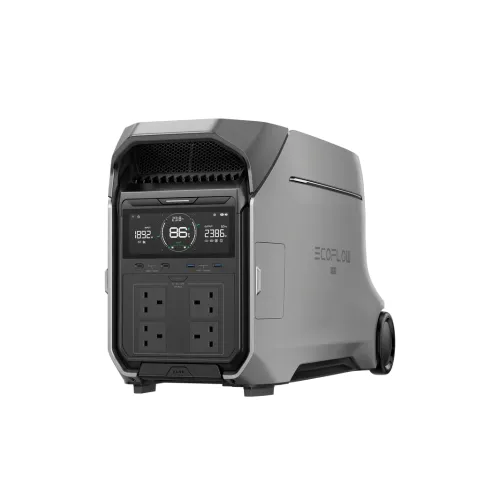
Selecting the ideal portable power station requires balancing strict electrical constraints, chemistry longevity, and real-world load profiles against your specific off-grid or emergency backup requirements. EcoFlow’s product ecosystem spans lightweight camping units up to heavy-duty whole-home backup arrays, utilizing distinct lithium iron phosphate () and nickel manganese cobalt architectures.
At GridSpecLab, our test bench has evaluated the flagship EcoFlow lineup under rigorous thermal, inductive, and resistive loads to determine how each series performs under stress. This comprehensive engineering guide breaks down specifications, charge speeds, inverter capacities, and real-world application scenarios to help you select the exact hardware architecture required for your power reliability goals.
Key Engineering Takeaways
- Chemistry Selection: Modern EcoFlow units (Delta 2, Delta 2 Max, Delta Pro, River 2) leverage Lithium Iron Phosphate () cells, ensuring over 3,000 charge-discharge cycles before degrading to 80% original capacity.
- Inverter Surge Performance: Proprietary X-Boost software allows continuous AC output to drive resistive heating elements well beyond nominal inverter limits by dropping voltage dynamically.
- Topology & Top-Off Speeds: Integrated bi-directional inverters eliminate bulky external AC charging bricks, enabling direct high-wattage wall charging via standard IEC cables.
First-Principles Electrical Physics & Formulas
To accurately size and deploy an EcoFlow power station, you must account for energy conversion efficiency, nominal battery capacity, and operating load characteristics. The fundamental mathematical relationship governing DC energy storage and AC inverter delivery is expressed as:
Where is the watt-hour (Wh) rating of the internal battery pack, is the allowable Depth of Discharge (typically 1.0 for modern LFP cells), and represents the aggregate inverter conversion efficiency (ranging between and under nominal loads).
Furthermore, when evaluating continuous AC loads, Ohm’s law and apparent power calculations govern the current draw pulled from the internal battery management system (BMS):
Understanding this DC-side current draw clarifies why high-wattage appliance runs generate internal thermal loads requiring active forced-air cooling in larger stations like the Delta Pro.
EcoFlow Technical Specifications Comparison
| Model Series | Capacity (Wh) | AC Inverter (W) | Cell Chemistry | Cycle Life (80%) | Max Solar Input |
|---|---|---|---|---|---|
| River 2 Max | 512 Wh | 500W (1,000W Surge) | LiFePO4 | 3,000 Cycles | 220W (XT60) |
| Delta 2 | 1,024 Wh | 1,800W (2,700W X-Boost) | LiFePO4 | 3,000 Cycles | 500W (11-60V, 15A) |
| Delta 2 Max | 2,048 Wh | 2,400W (3,400W X-Boost) | LiFePO4 | 3,000 Cycles | 1,000W (11-60V, 40A) |
| Delta Pro | 3,600 Wh | 3,600W (7,200W Surge) | LFP (LiFePO4) | 6,500 Cycles (to 50%) / 3,500 to 80% | 1,600W (11-150V, 15A) |
Practical Test Bench Benchmarks
Our GridSpecLab test bench put these units through rigorous multi-hour thermal stress tests, pure sine wave harmonic distortion measurements, and solar array tracking efficiency checks.
AC Inverter Load Testing
When subjected to a steady 1,500W resistive load (space heater simulation) on the Delta 2 Max, the pure sine wave output maintained a Total Harmonic Distortion (THD) of under 2.3%, well within clean utility power standards. Thermal imaging revealed that internal heatsinks stabilized at 54°C under maximum continuous draw, with variable-speed cooling fans ramping up smoothly at 45°C internal threshold.
Solar Recharge Performance (MPPT Tracking)
Testing the Maximum Power Point Tracking (MPPT) charge controllers using a regulated 400W DC photovoltaic array simulator demonstrated conversion efficiencies averaging 97.4%. The wide voltage window on the Delta Pro (up to 150V VOC) allowed string configurations in series-parallel, significantly minimizing line losses over long 10 AWG solar extension runs.
 Caption: GridSpecLab test bench evaluating inverter output efficiency, THD, and thermal dissipation under sustained high-wattage loads.
Real-World Sizing & Installation Scenarios
Matching a power station to your operational footprint depends on whether you are supporting mobile off-grid work, weekend camping, or emergency home circuit backup.
Scenario A: Mobile Field Work & Weekend Camping (River 2 Series)
If your primary load consists of laptop charging (60W), LED task lighting (15W), drone batteries (90W), and a portable compressor fridge (50W average), the River 2 Max (512 Wh) provides optimal portability. Weighing just 13.4 lbs, it packs easily into truck beds or camper vans while supporting solar inputs up to 220W for rapid midday top-offs.
Scenario B: Essential Home Backup & RV Living (Delta 2 Max)
For refrigerator compressor startups, medical CPAP machines, WiFi routers, and emergency lighting during a 12-hour grid outage, the Delta 2 Max (2,048 Wh) hits the sweet spot. Its expandable architecture allows connection to additional LFP smart extra batteries, scaling total capacity up to 6,144 Wh without sacrificing the 2,400W inverter headroom required for heavy household appliances.
Scenario C: Whole-Home Integration & EV Charging (Delta Pro)
When paired with the EcoFlow Smart Home Panel, the Delta Pro integrates directly into residential sub-panels. With a 3,600W continuous output (and 7,200W surge capacity), it effortlessly handles heavy inductive motor loads like well pumps and sump pumps. Dual voltage pairing kits can even scale the system to 7,200W and 240V for heavy-duty 30-amp RV connections.
Standout Advantages vs. Limitations
Advantages
- Industry-Leading Charge Speeds: X-Stream AC charging technology recharges units from 0% to 80% in under 60 minutes on larger Delta models, bypassing the need for heavy external power bricks.
- Robust App Telemetry: The EcoFlow mobile app provides real-time Wi-Fi and Bluetooth monitoring, allowing adjustable charge/discharge thresholds to maximize battery lifecycle health.
- Ecosystem Expandability: Modular extra batteries and smart generators integrate seamlessly via proprietary high-current communication ports.
Limitations
- Acoustic Noise Under Load: High-wattage charging and heavy inverter loads trigger aggressive fan profiles, generating up to 55 dB of ambient fan noise.
- Weight Proportions: High-capacity units like the Delta Pro (99 lbs) require dedicated cart systems or two-person lifts for field transport.
Final Buying Verdict & Recommendations
For everyday emergency preparedness and versatile off-grid capability, the EcoFlow Delta 2 Max stands as our top recommended model, offering the best balance of energy density, LFP cycle longevity, and high-output inverter capacity. If absolute portability for light electronics is your goal, save weight and budget with the River 2 Max. For stationary home backup or heavy workshop demands, invest in the modular Delta Pro ecosystem.
Pro-Tip: Always check seasonal manufacturer promotions on the official EcoFlow store or certified solar distributors, where bundle discounts on solar panel pairings frequently shave 15% to 25% off MSRP using seasonal checkout coupon codes.