Installing a residential solar energy system is marketed as a simple, feel-good decision: sign on the dotted line, reduce your electric bill to zero, and enjoy clean energy independence for the next three decades.
The reality, however, is far more complex. Over the past decade, our engineering and testing team at GridSpecLab has audited hundreds of residential and off-grid solar installations. Time after time, we see well-intentioned homeowners stumble into the exact same expensive pitfalls: predatory financing contracts, undersized inverters, missed tax credits, and catastrophic hardware failures caused by basic math errors.
If we had to start over today with the knowledge gained from hundreds of teardowns, hardware audits, and real-world system benchmarks, our approach would be drastically different.
Here are the six most expensive mistakes we wish every homeowner knew before signing a solar proposal or buying their first piece of hardware—and the exact engineering steps to protect your investment.
The Core Rule: Never sign a solar lease or Power Purchase Agreement (PPA) with an annual escalator; always own your hardware outright to capture the 30% Residential Clean Energy Credit (Section 25D) and preserve your home title. Never install solar on a roof older than 10 years without reroofing first. Under modern NEM 3.0 tariffs, never build a solar-only system—pair every watt of rooftop solar with dedicated LiFePO4 battery storage to capture peak time-of-use rate arbitrage.
The Financing Trap: Escalating PPAs and Dealer-Fee Solar Loans
By far the most financially devastating mistake in residential solar is agreeing to a third-party Power Purchase Agreement (PPA) or a long-term lease with an annual price escalator.
Door-to-door sales representatives pitch these arrangements as “Zero Down Free Solar”: the financing company owns the panels, installs them on your roof, and sells you the power at a rate slightly below your current utility bill.
Escalating Solar PPA / Lease
Sounds cheap on Day 1, but features an annual compound escalator (typically 2.9% to 3.5%) locked in for 25 years.
Resale Nightmare: The leasing company places a UCC-1 lien on your property title. Prospective home buyers routinely refuse to assume escalating contracts, forcing sellers to pay cash buyouts of $15,000 to $30,000 at escrow.
Direct Hardware Ownership
Purchasing pre-engineered equipment packages with cash or a standard Home Equity Line of Credit (HELOC).
Clear Advantage: Payback occurs in 5 to 7 years. For the remaining 20+ years of the system’s lifespan, your energy is 100% free with complete freedom to remodel or sell your home.
[!WARNING] Beware of “Low-APR” Solar Loans: Many installers advertise “1.99% or 2.99% APR financing” for 25 years. Look closely at the cash price versus the financed price. Lenders routinely bake in a 25% to 35% upfront dealer fee. A $20,000 solar array becomes a $28,000 loan balance before you make your first payment!
Going Solar Without Battery Storage Under NEM 3.0 Tariffs
A decade ago, Net Energy Metering (NEM 1.0 and 2.0) allowed homeowners to treat the municipal grid as a free, 100% efficient battery. When your panels overproduced at noon, the electric meter ran backward at full retail value. You drew that power back at night for free.
In 2026, those legacy net metering policies are dead in California, Arizona, Hawaii, and rapidly disappearing across Texas, Florida, and the Midwest.
The Avoided-Cost Trap
Under modern Net Billing Tariffs (NEM 3.0), utilities credit daytime solar export based on the wholesale “avoided cost” of energy:
- What the utility charges you at 7:00 PM: 42¢ to 58¢ per kWh (Peak TOU rate).
- What the utility pays you for excess solar at 1:00 PM: 3¢ to 6¢ per kWh (Off-peak export credit).
Solar-Only vs. Solar + LiFePO4 Storage Financial Reality
You generate 35 kWh during the day while at work. Your home uses 10 kWh; 25 kWh is exported to the grid at 4¢/kWh, earning $1.00 in credit. In the evening, you consume 20 kWh from the grid at 48¢/kWh, costing $9.60.
Net Daily Cost: $8.60 (Payback: 14+ Years)You generate 35 kWh. Your home uses 10 kWh; the remaining 15 kWh charges your battery to 100%. At 5:00 PM, your home automatically disconnects from the grid and runs entirely off stored battery power through peak hours.
Net Daily Cost: $0.00 (Payback: 6.2 Years)Under current utility rules, installing solar panels without a battery is an obsolete strategy. Storage is no longer an optional luxury for off-grid survivalists; it is the fundamental economic engine of residential solar ROI.
The Roof Age Blindspot: Detach-and-Reset Nightmares
Solar panels are engineered to produce clean electricity for 25 to 30 years. Modern architectural asphalt shingles, however, rarely last more than 20 to 25 years—and in hot southern climates, their lifespan is closer to 15 to 18 years.
What happens when you install a 30-panel solar array on a roof that is already 12 years old?
Eight years later, a storm triggers a roof leak. You call a roofing contractor, who inspects the roof and announces that the entire slope must be stripped and reshingled.
Then comes the shocking realization: roofers will not touch a roof with solar panels installed.
You must hire a licensed solar electrical contractor to:
- De-energize the array and pull utility permits.
- Unclamp and label all 30 panels, microinverters, and optimizers.
- Store the fragile panels securely in your garage for 1 to 2 weeks.
- Remove all aluminum racking rails and unseal all flashings.
- Reinstall the entire array from scratch with brand new roof flashings after the roofers finish.
Typical industry cost for a 10kW detach-and-reset: $4,000 to $7,500 out-of-pocket (not covered by homeowners insurance or manufacturer warranties).
[!TIP] The Golden Roof Rule: If your asphalt shingle roof is more than 8 to 10 years old, replace the roof before or simultaneously with your solar installation. In many cases, replacing the roof section directly beneath the solar array can be bundled into your clean energy project financing and may qualify for federal tax credits when properly structured.
Electrical Engineering Traps: Cold-Weather Voc Destruction
Every solar panel datasheet prominently features an Open-Circuit Voltage () rating. A typical 400W panel might list a of 40.0 Volts.
New installers frequently connect three of these panels in series () into an inverter or charge controller with a maximum input rating of 130 Volts. They assume they have a safe 10-volt safety buffer.
This assumption causes inverters to blow up every winter.
The Temperature Coefficient of Voltage
Datasheet ratings are measured at Standard Test Conditions (STC), which specifies a cell temperature of 25°C (77°F).
However, semiconductor physics dictates that solar panel voltage rises as temperature drops. Most monocrystalline panels carry a temperature coefficient of open-circuit voltage () of approximately -0.28% to -0.32% per degree Celsius.
On a crisp, clear winter morning when ambient temperatures drop to -15°C (5°F), cell voltage spikes by roughly 12.8%:
- A single panel’s rises from 40.0V to 45.1 Volts.
- A 3-panel series string rises from 120.0V to 135.3 Volts.
The instant the morning sun strikes the snow-covered panels, string voltage shoots past the controller’s 130V limit. The internal MOSFET transistors instantly rupture in a flash of smoke.
Always calculate maximum string voltage against the record-low historical temperature of your geographic location, maintaining at least a 15% voltage safety cushion. Use our Solar Cold Temperature Voltage Calculator to verify your string sizing before wiring.
Undersizing Roof Penetration Conduit for Future Expansion
When homeowners install solar, they almost always calculate their energy needs based on their current lifestyle: a couple with two children living in a home with a gas water heater and gasoline-powered cars.
Fast forward five years:
- They purchase a Tesla Model Y or Ford F-150 Lightning (demanding an extra 350 to 500 kWh per month).
- They replace an aging gas furnace with an ultra-efficient cold-climate heat pump.
- They install an induction stove and a hybrid heat pump water heater.
Suddenly, electricity consumption has doubled, but the homeowner discovers they cannot add more solar panels because the installer ran a tiny 3/4-inch conduit through the attic and down the exterior stucco wall.
Pulling additional high-gauge wiring through a 3/4-inch pipe violates National Electrical Code conduit fill limits (NEC Chapter 9, Table 1). Adding panels requires hiring an electrician to drill new stucco penetrations, trench landscaping, and run a secondary conduit run across the home for $2,000+.
The Pro Solution: Always demand a minimum 1-inch or 1.25-inch conduit run from your roof array down to your electrical panel, and install an electrical distribution panel with at least 200A busbar capacity with space for dual backfeed breakers.
Top Recommended Turnkey Equipment Packages
To bypass predatory installer markups and avoid engineering oversights, we recommend pre-engineered turnkey packages that pair matched inverters, generous MPPT voltage windows, and high-density LiFePO4 storage:
1. Turnkey Pre-Wired Home Solar Kit: ShopSolar Grid-Tied / Hybrid Kit

ShopSolar Complete Home Solar Packages (5kW – 15kW)
Eliminates predatory financing traps. Every kit includes Tier-1 bifacial panels, matched hybrid split-phase inverters, pre-assembled breaker disconnects, and permit-ready single-line wiring schematics.
Explore ShopSolar Complete Packages →
2. High-Surge Whole-Home Inverter: EG4 18kPV
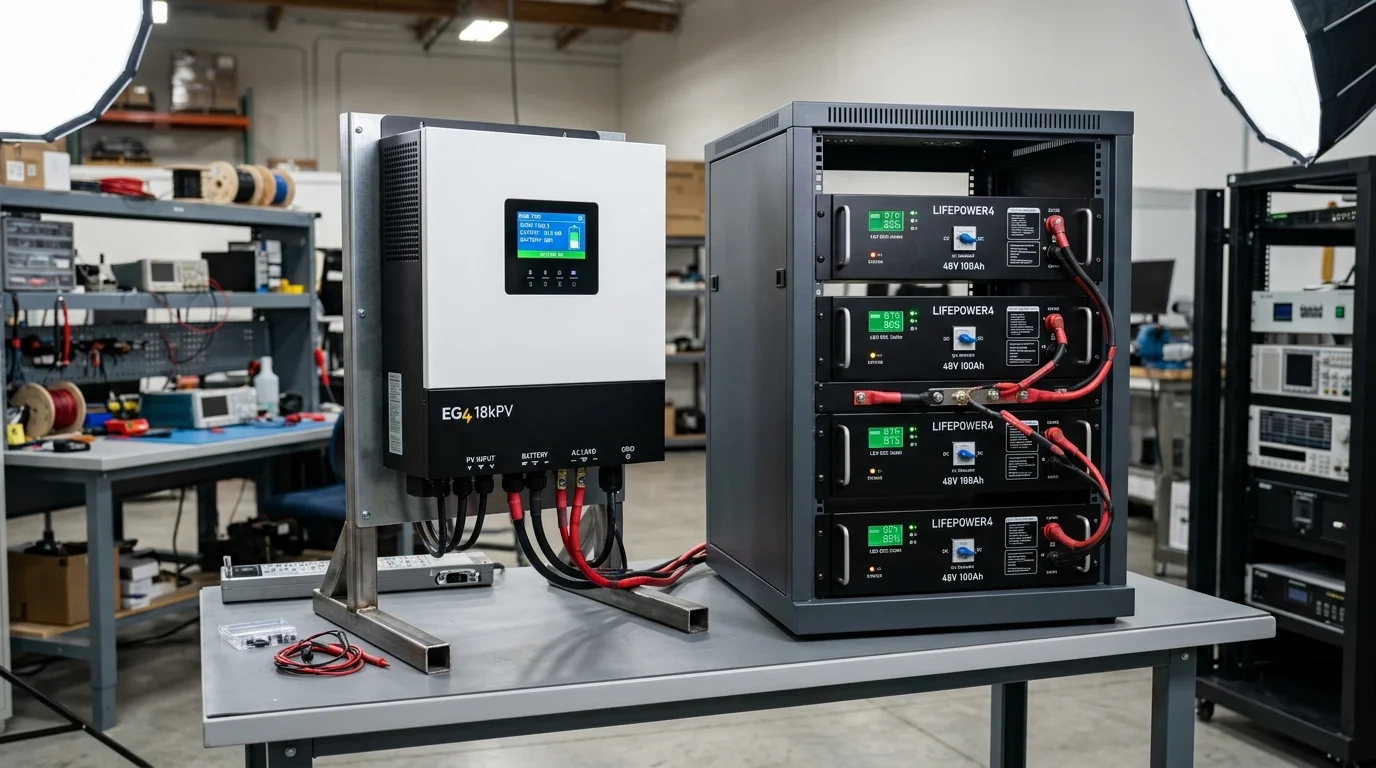
EG4 18kPV Hybrid Inverter (120V/240V Split-Phase)
Features three independent MPPT trackers with ultra-wide 600V DC input windows to eliminate cold-weather voltage trips. Seamlessly integrates grid-tie, off-grid backup, generator auto-start, and closed-loop battery communication.
View EG4 18kPV Pricing →
Interactive Sizing and Runtime Calculators
Verify your system specs and prevent design errors with our engineering tools:
- Solar Generator Runtime Calculator: Calculate true runtime under variable household loads.
- Solar Cold Temperature Voltage Calculator: Calculate maximum open-circuit voltage spikes on sub-freezing mornings to protect inverters.
- Sump Pump LRA Surge Calculator: Determine if your emergency inverter can handle heavy motor inrush current.
Frequently Asked Questions (FAQ)
What happens if I want to sell my home with a leased solar system?
If you have a leased or PPA solar system, you must either convince the home buyer to assume the remaining lease payments (which requires credit approval from the solar leasing company) or pay off the entire remaining 25-year contract in cash at closing. In competitive housing markets, buyers frequently demand that sellers pay off the lease before closing escrow.
Do solar panels still work during a power outage if I don’t have a battery?
No. Standard grid-tied solar systems automatically shut down within milliseconds of a grid failure under UL 1741 anti-islanding regulations. This safety feature prevents your panels from backfeeding high voltage into downed utility wires while lineworkers make repairs. To have electricity during a blackout, you must have a battery storage system paired with an automatic transfer switch or isolation gateway.
How much does it cost to replace an asphalt shingle roof before installing solar?
A typical residential roof replacement for a 2,000-square-foot home costs between $8,000 and $16,000 depending on pitch, architectural shingle grade, and geographic location. While this is a significant upfront expense, doing it before installing solar saves you from paying $5,000+ in detach-and-reset fees a few years later.
Can I install solar myself to save money?
Yes. Turnkey DIY packages from suppliers like ShopSolar provide pre-wired inverter panels and permit-ready CAD schematics, allowing handy homeowners to mount panels and run conduit safely. However, the final AC landing into your main service panel and the utility interconnection application should be completed or inspected by a licensed electrician.
