When shopping for an emergency home backup battery, the most common and costly mistake is guesswork.
Under-sizing your system results in frustration: the moment your refrigerator compressor kicks on while the microwave is running, the inverter trips on overload, plunging your family into darkness. Conversely, over-sizing leads to thousands of dollars spent on heavy, immobilized lithium batteries that sit unused in a garage corner.
Properly sizing a power station is not simply a matter of picking the biggest number on a store shelf. It requires balancing three distinct engineering constraints:
- Continuous Inverter Output (Watts): The combined running wattage of all devices operating at the exact same instant.
- Peak Surge Capacity (Watts): The short-duration burst power needed to overcome motor startup resistance (Locked Rotor Amps).
- Battery Storage Capacity (Watt-hours): The total electrical reservoir needed to sustain those loads across a defined blackout window (e.g. 24, 48, or 72 hours).
In this engineering sizing guide, we break down the exact mathematical formulas, appliance power consumption audits, parasitic tare loss calculations, and real-world sizing tiers to help you select the perfect power station for your home.
For basic blackout survival (refrigerator, internet router, medical devices, lighting, and phone charging), a 2,000Wh battery station with a 2,000W inverter is the entry-level baseline. To power critical home circuits through a manual transfer switch or smart subpanel (including a 1/2 HP sump pump, furnace blower, and kitchen appliances), step up to a 3,600Wh to 6,000Wh station with a 3,600W to 6,000W inverter. For 240V deep well pumps and central HVAC, native 120V/240V split-phase output is mandatory.
Continuous Inverter Wattage vs. Total Battery Capacity
To size a power station accurately, you must distinguish between the engine and the fuel tank:
+-------------------------------------------------------------------+
|                     PORTABLE POWER STATION                        |
|                                                                   |
|   +-----------------------------------------------------------+   |
|   |         INVERTER RATING (Watts / W)                       |   |
|   |   "The Engine": Dictates HOW MANY appliances can run      |   |
|   |   simultaneously right now (e.g. 2,400W, 3,600W, 6,000W)  |   |
|   +-----------------------------------------------------------+   |
|                                 |                                 |
|                                 v Draws Energy                    |
|   +-----------------------------------------------------------+   |
|   |         BATTERY CAPACITY (Watt-hours / Wh)                |   |
|   |   "The Fuel Tank": Dictates HOW LONG those appliances run |   |
|   |   before recharging (e.g. 2,048Wh, 3,840Wh, 6,000Wh)      |   |
|   +-----------------------------------------------------------+   |
+-------------------------------------------------------------------+
Inverter Output (Watts)
The inverter converts direct current (DC) stored in the lithium cells into alternating current (AC) matching standard household grid electricity (120V or 240V at 60Hz). If your inverter is rated for 2,400 Watts continuous, you cannot simultaneously run a 1,500W space heater and a 1,200W coffee maker (). The inverter will trigger its internal overload protection and shut off instantly.
Battery Capacity (Watt-hours)
Watt-hours measure total energy over time. One Watt-hour is one Watt of power consumed continuously for one hour. A 2,000Wh battery can theoretically run a 100-Watt full-size refrigerator for 20 hours (), assuming zero efficiency losses.
Calculating Your Home Energy Budget (The Math)
To find your required system size, perform an electrical audit using our step-by-step sizing formula:
Appliance Audit Table
List every critical device you must power during an emergency, noting its running wattage, duty cycle (fraction of each hour the appliance actively runs), and target daily runtime:
| Emergency Device | Running Power | Startup Surge | Hours / Day | Daily Energy Consumption |
|---|---|---|---|---|
| Full-Size Refrigerator (Modern Inverter) | 120W (35% duty cycle) | 800W to 1,200W | 24 Hours | 1,008 Wh / day |
| Chest Freezer | 80W (25% duty cycle) | 600W | 24 Hours | 480 Wh / day |
| 1/2 HP Sump Pump | 800W (Running) | 3,500W to 4,500W | 1 Hour total (cycling) | 800 Wh / day |
| Wi-Fi Router & Modem | 25W | 25W | 24 Hours | 600 Wh / day |
| LED Room Lights (4 fixtures) | 40W (Combined) | 40W | 6 Hours | 240 Wh / day |
| Smartphone & Laptop Charging | 90W | 90W | 3 Hours | 270 Wh / day |
| Medical CPAP (No heated humidifier) | 40W | 60W | 8 Hours | 320 Wh / day |
| Total Daily Emergency Electrical Load | 3,718 Wh / day | |||
Accounting for Inverter Inefficiency and Idle Tare Loss
In real-world conditions, a 3,718Wh daily load cannot be sustained by a 3,718Wh battery. You must account for two physical electrical losses:
- Inverter AC Conversion Efficiency (): Converting low-voltage DC into 120V AC involves heat dissipation. Inverter efficiency typically hovers between 85% and 90%.
- Parasitic Idle Tare Loss (): When a power station’s AC button is active, its internal display, cooling fans, microprocessors, and high-frequency switching FETs draw power continuously—even if zero appliances are plugged in! A typical 3,000W inverter consumes 25W to 40W of idle power. Over 24 hours, this drains:
To calculate your actual minimum required battery capacity:
Therefore, to sustain a standard critical-appliance emergency load for 24 hours without solar replenishment, a 5,000Wh to 6,000Wh battery capacity is required.
Sizing Tiers: Which Category Fits Your Needs?
Apartment & Essential Plug-In
Designed for apartments, small homes, and short 12 to 24-hour storms. Powers small 120V loads via extension cords.
- Full-size refrigerator (15 to 20 hours)
- Phones, laptops, Wi-Fi routers
- Medical CPAP machines (2 to 3 nights)
- LED lamps and electric blankets
Subpanel & Essential Circuits
The sweet spot for suburban homeowners. Connects to a transfer switch to power 6 to 10 dedicated home circuits.
- Refrigerator + deep freezer simultaneously
- 1/2 HP basement sump pump (high surge)
- Natural gas furnace blower motor
- Microwave, coffee maker, and blender
Whole-Home Split-Phase 240V
Replaces a 10kW to 15kW standby whole-house gas generator. Backs up entire 200A electrical service entrance.
- 240V deep well water pumps (1.5–2 HP)
- Central air conditioning (with soft starter)
- Electric clothes dryer & water heater
- Level 2 electric vehicle charging
Best Sized Power Stations by Sizing Tier
To match your energy calculations with proven hardware, these four lab-tested systems deliver class-leading reliability within their respective sizing tiers:
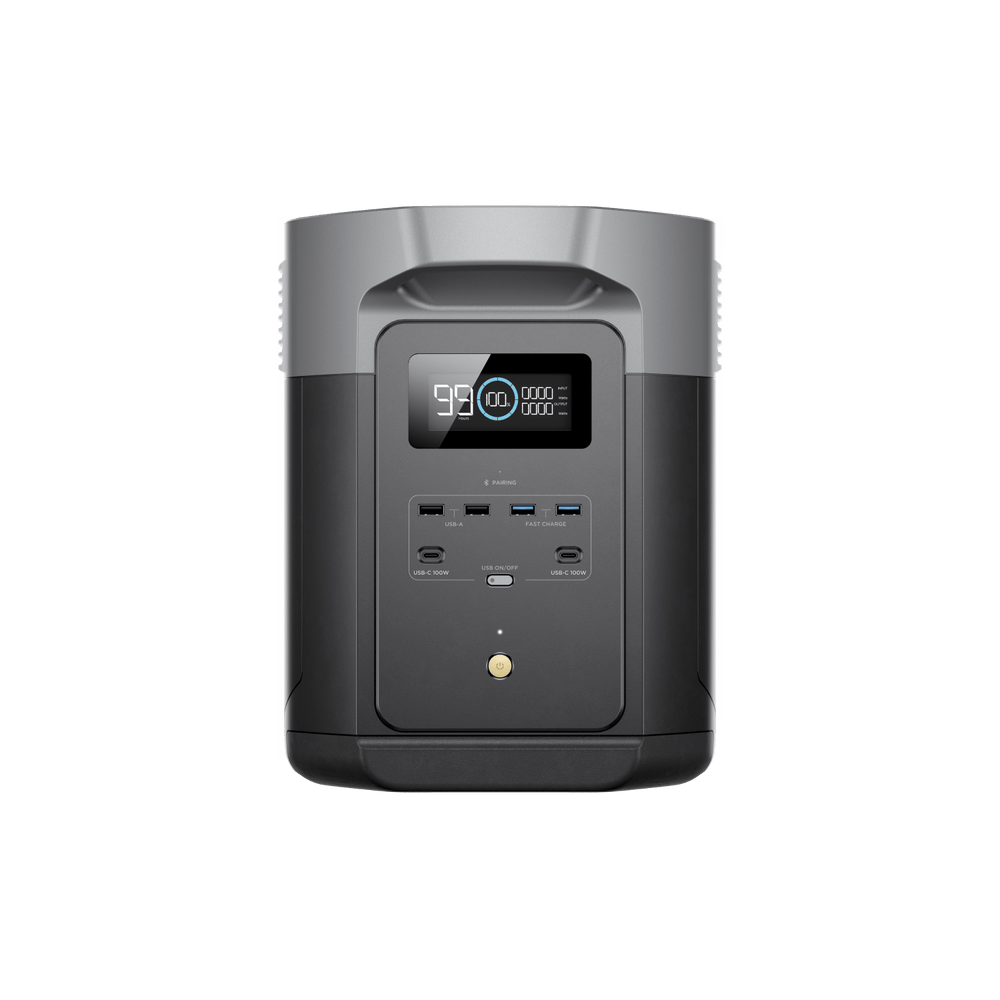
1. EcoFlow DELTA 2 Max (2,048Wh / 2,400W)
The ultimate portable workhorse for apartments and essential home circuits. Delivering 2,400W continuous pure sine wave power (4,800W surge) and 2,048Wh of durable LiFePO4 storage (expandable to 6,144Wh with extra batteries), it weighs just 51 lbs and runs whisper-quiet at under 30 dB under light load.
Check DELTA 2 Max Pricing on EcoFlow →
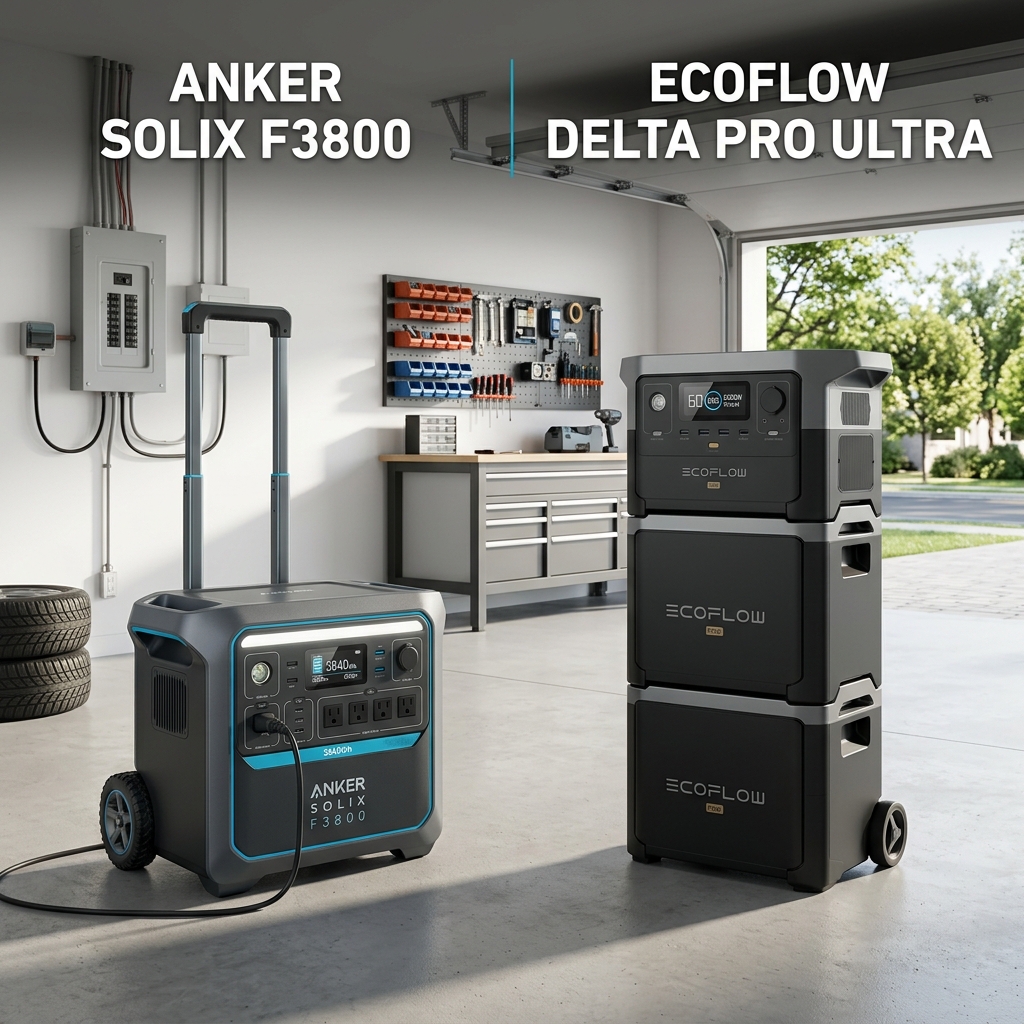
2. Anker SOLIX F3800 (3,840Wh / 6,000W)
The ideal bridge between portable convenience and whole-home power. Packing a massive 6,000W continuous inverter with native 120V/240V split-phase output and direct NEMA 14-50 and NEMA TT-30 outlets into a heavy-duty wheeled chassis, it easily powers sump pumps, refrigerators, and well pumps directly through your home breaker panel.
View Anker SOLIX F3800 Deals →

3. EcoFlow DELTA Pro Ultra (6,000Wh / 7,200W)
Engineered specifically to power entire houses without compromises. Delivering 7,200W continuous output (120V/240V split phase) and 6kWh stackable battery modules expandable up to 90kWh, its high-voltage 5.6kW solar controller connects directly to rooftop solar strings up to 450V for indefinite off-grid autonomy.
Explore DELTA Pro Ultra Packages →

4. ShopSolar Pre-Sized Whole-Home Package
If you want a permanent wall-mounted or server-rack system that completely eliminates manual cord plugging, ShopSolar packages hybrid 120V/240V split-phase inverters (EG4 18kPV / Sol-Ark) with 14.3kWh to 28.6kWh lithium battery banks on an insured freight pallet with engineering support.
Explore Complete Sized Bundles on ShopSolar →
Common Power Station Sizing Mistakes to Avoid
- Ignoring Motor Locked Rotor Amps (LRA): Many buyers assume that because their basement sump pump is labeled “800 Watts”, a 1,000W power station will easily run it. In reality, induction motors draw 4 to 6 times their operating current for a fraction of a second to start spinning from a dead stop. An 800W pump can pull a 3,500W to 4,500W spike. If your power station cannot deliver that instantaneous surge, the unit will fault out and flood your basement.
- Assuming 100% Battery Usability: No battery delivers 100% of its nameplate capacity to your appliances. High-draw inverters incur roughly 10% to 15% conversion thermal loss, and the BMS preserves the bottom 5% to 10% of battery charge to prevent cell over-discharge damage. When sizing a system, always budget for 80% to 85% usable energy.
- Forgetting Inverter Idle Parasitic Consumption: Leaving your power station’s AC inverter turned on 24 hours a day consumes between 25W and 50W of continuous background power, burning 600Wh to 1,200Wh every single day without running a load. During an outage, turn off the AC inverter output overnight if only charging DC USB phones or small devices.
- Attempting to Power 240V Appliances with 120V Adapters: A common dangerous myth is that you can use a “Y-splitter” cord to combine two 120V outlets from a standard power station to power a 240V well pump. Unless the power station natively generates 180-degree out-of-phase split-phase electricity, the voltage across the two hot pins is 0 Volts, and your 240V appliance will sit completely dead. Review our 120V vs 240V Split-Phase Guide before purchasing adapters.
Frequently Asked Questions (FAQ)
Can a 2,000Wh power station run a refrigerator for 24 hours?
Yes! A modern Energy Star full-size household refrigerator consumes between 100W and 150W while cooling, but its compressor only runs roughly 30% to 40% of each hour (cycling on and off). Over a 24-hour period, an efficient refrigerator consumes approximately 1,000Wh to 1,200Wh of total electricity. A 2,048Wh power station (like the EcoFlow DELTA 2 Max) can easily power the refrigerator for 24 to 30 hours, provided you do not leave the door open or plug in high-draw heating appliances.
Why did my power station shut off when running a microwave and coffee maker at the same time?
Because the combined continuous wattage exceeded your inverter’s output limit. A standard countertop microwave consumes roughly 1,500W to 1,800W of electrical input (even if rated for 1,000W cooking power), and a drip coffee maker consumes approximately 1,200W. Running both at the same instant draws 2,700W to 3,000W. If your power station is equipped with a 2,000W or 2,400W inverter, its internal circuit protection instantly cuts power to prevent overheating. Stagger your use of high-draw kitchen appliances during an outage.
How much solar power do I need to keep my backup battery charged during an extended blackout?
To achieve indefinite daily replenishment, size your solar panel array so that 3 to 4 hours of peak sunlight fully recharges your daily energy consumption. For example, if your home uses 4,000Wh per day: Connecting four 400W solar panels (1,600W total) allows your power station to recharge completely between 10:00 AM and 2:00 PM on sunny days.
Does inverter idle consumption really matter when sizing a battery?
Yes, dramatically! A 3,000W to 6,000W pure sine wave inverter consumes between 25W and 45W of standby power just keeping its internal copper transformers and microprocessors energized. Over 24 hours, this continuous background draw drains 600Wh to 1,080Wh from your battery bank—nearly identical to running an extra refrigerator all day! Factoring in idle tare loss is essential to ensure your battery does not die prematurely overnight.
