Every time you plug a coffee maker into a kitchen receptacle, switch on a central air conditioner, or power up a solar hybrid inverter, you are relying on Alternating Current (AC).
Yet for all its ubiquity, AC electricity remains one of the most misunderstood concepts in renewable energy. Many homeowners assume that a “120V” wall outlet supplies a steady 120 volts of electricity, or that any cheap inverter can safely power sensitive computer microchips, variable-speed furnace blowers, and medical CPAP devices.
In reality, Alternating Current is a dynamic, oscillating waveform governed by trigonometric principles. When solar panels generate electricity or lithium batteries discharge energy, they output Direct Current (DC). To make that power usable for everyday household appliances, a solar inverter must synthesize an artificial AC sine wave from scratch.
This comprehensive engineering guide explains how Alternating Current works, why the power grid adopted AC over DC, the critical differences between Pure Sine and Modified Sine waves, and how North American 120V/240V split-phase power operates.
The Core Rule: Never run modern microprocessor-controlled appliances, variable-speed compressors, or medical equipment on Modified Sine Wave inverters. Always demand a certified Pure Sine Wave inverter with under 3% Total Harmonic Distortion (THD). If you need to back up heavy 240V loads like submersible well pumps or central HVAC, ensure your inverter or power station provides 120V/240V split-phase output.
Deconstructing Alternating Current: The Physics of the Sine Wave
To understand Alternating Current, we must contrast it directly with Direct Current:
Direct Current (DC)
Electrons flow continuously in a single direction from the negative terminal to the positive terminal. Voltage remains flat and constant over time.
Key Characteristic: Ideal for chemical energy storage in LiFePO4 batteries and low-voltage digital microcircuits.
Alternating Current (AC)
Electrons oscillate back and forth in place without migrating through the wire. Polarity reverses rhythmically following a smooth mathematical sine curve.
Key Characteristic: Can be stepped up to hundreds of thousands of volts using passive transformers for highly efficient long-distance transmission.
The Mathematical Sine Wave
In an Alternating Current system, instantaneous voltage at any precise microsecond is expressed by the fundamental sine function:
Where:
- = Maximum voltage height reached at the peak of the wave
- = Frequency in Hertz (cycles per second; 60 Hz in North America, 50 Hz in Europe and Asia)
- = Elapsed time in seconds
Because the wave continuously oscillates between positive and negative values, the mathematical average voltage over one complete cycle is exactly 0 Volts. So why does a 120V outlet shock you or power a 1,500W toaster?
The Root Mean Square (RMS) Revelation
To quantify how much thermal work an oscillating AC voltage can perform, electrical engineers calculate the Root Mean Square (RMS) voltage—often called the “effective voltage”:
When your multimeter reads 120V AC, that is the RMS value. To achieve an effective RMS value of 120 Volts, the physical voltage waveform must actually peak at:
In your home right now, the electrical potential between the hot prong and neutral wire swings from +170 Volts down through zero to -170 Volts, completing this cycle 60 times every single second!
Why the Grid Runs on AC: The War of the Currents
In the late 1880s, Thomas Edison championed Direct Current (DC), while Nikola Tesla and George Westinghouse advocated for Alternating Current (AC). Tesla and Westinghouse won, cementing the foundation of modern civilization.
The decisive factor was transmission efficiency and transformers:
The Transformer Miracle
Electrical line loss scales with the square of current (). To transmit power over 50 miles without losing it all as heat, current must be kept as low as possible.
Power stations spin massive synchronous AC turbines.
Transformers step voltage up; current drops to tiny fractions, slashing line losses.
Neighborhood pole-top transformers step voltage down to safe household levels.
In Tesla’s era, changing the voltage of Direct Current was virtually impossible without bulky, failure-prone motor-generator sets. Alternating Current, by contrast, changes voltage effortlessly through electromagnetic induction inside passive copper-and-iron transformers.
Pure Sine Wave vs. Modified Sine Wave: What Happens to Appliances?
When purchasing a solar inverter or portable power station, you will encounter two vastly different technologies:
Does not produce a wave at all. It uses cheap H-bridge switching transistors to produce a crude, choppy 3-step square pulse.
- Total Harmonic Distortion (THD) > 20% to 40%
- Causes AC induction motors to run 30% hotter
- Produces loud 60Hz audible hum in fans and audio equipment
- Can permanently burn out digital control boards
Uses high-frequency pulse-width modulation (PWM) and toroidal filtering to create a silky-smooth, continuous harmonic curve.
- Total Harmonic Distortion (THD) < 3% (cleaner than grid)
- Motors run cool, quiet, and at peak mechanical efficiency
- Safe for medical CPAP machines, laptops, and sensitive electronics
- Required for variable-speed refrigerator compressors
Understanding North American 120V / 240V Split-Phase Power
Outside of the United States and Canada, most of the world uses single-phase 230V AC at 50Hz. North America, however, utilizes a unique hybrid system known as Split-Phase (Edison 3-Wire).
How Split-Phase Works
The utility transformer on your street takes high-voltage distribution AC and feeds it into a single 240V secondary coil.
Crucially, this secondary coil is center-tapped with a neutral conductor:
- Measuring from Hot Leg 1 (L1) to Neutral = 120 Volts AC
- Measuring from Hot Leg 2 (L2) to Neutral = 120 Volts AC
- Measuring across Hot Leg 1 (L1) to Hot Leg 2 (L2) = 240 Volts AC
Split-Phase Phase Angle Relationship
Because L1 and L2 are tapped at opposite ends of the transformer coil, their sine waves are exactly 180 degrees out of phase. When L1 is at its positive peak of +170V, L2 is at its negative peak of -170V.
Potential Difference: , which translates precisely to !
This ingenious architecture provides 120V convenience and safety for everyday lighting and handheld appliances, while supplying heavy 240V power for high-demand loads like electric ranges, water heaters, and well pumps.
Critical AC Inverter Mistakes to Avoid
When building an off-grid or solar backup system, avoid these common inverter errors:
Confusing Real Power (Watts) with Apparent Power (Volt-Amps)
In pure DC circuits, . But in AC circuits with inductive motor loads (compressors, drills, transformers), voltage and current fall slightly out of sync.
This phase displacement introduces Power Factor ():
An induction motor rated at 1,000 Watts with an 0.8 Power Factor actually demands 1,250 Volt-Amps (VA) from your inverter. If your inverter is rated strictly in Watts rather than VA, it can trip on thermal overload even when running within rated wattage.
Overlooking Inverter Tare Loss
To continuously generate a precise 60Hz pure sine wave, an inverter’s internal oscillator circuits, MOSFET gate drivers, and transformers consume energy around the clock—even with zero appliances connected.
A typical 5,000W off-grid inverter has an idle draw of 40W to 70W. Over 24 hours, this vampire load burns 1,000Wh to 1,680Wh of battery energy. During multi-day winter blackouts, this silent drain will deplete your energy storage if not managed properly.
Paralleling Mismatched Inverters Out of Phase
You cannot simply wire the AC output of two independent portable generators or standalone inverters together using a Y-cable. Unless the two inverters communicate digitally to synchronize their 60Hz phase angles, their waveforms will collide out of phase, creating an instantaneous dead short that destroys both units in a shower of sparks. Always use certified parallel kits with digital sync communication.
Top Recommended High-Purity Inverter Hardware
To ensure clean, utility-grade pure sine wave power for your home, our test lab recommends the following hardware:
1. Split-Phase Off-Grid Inverter: EG4 6000XP
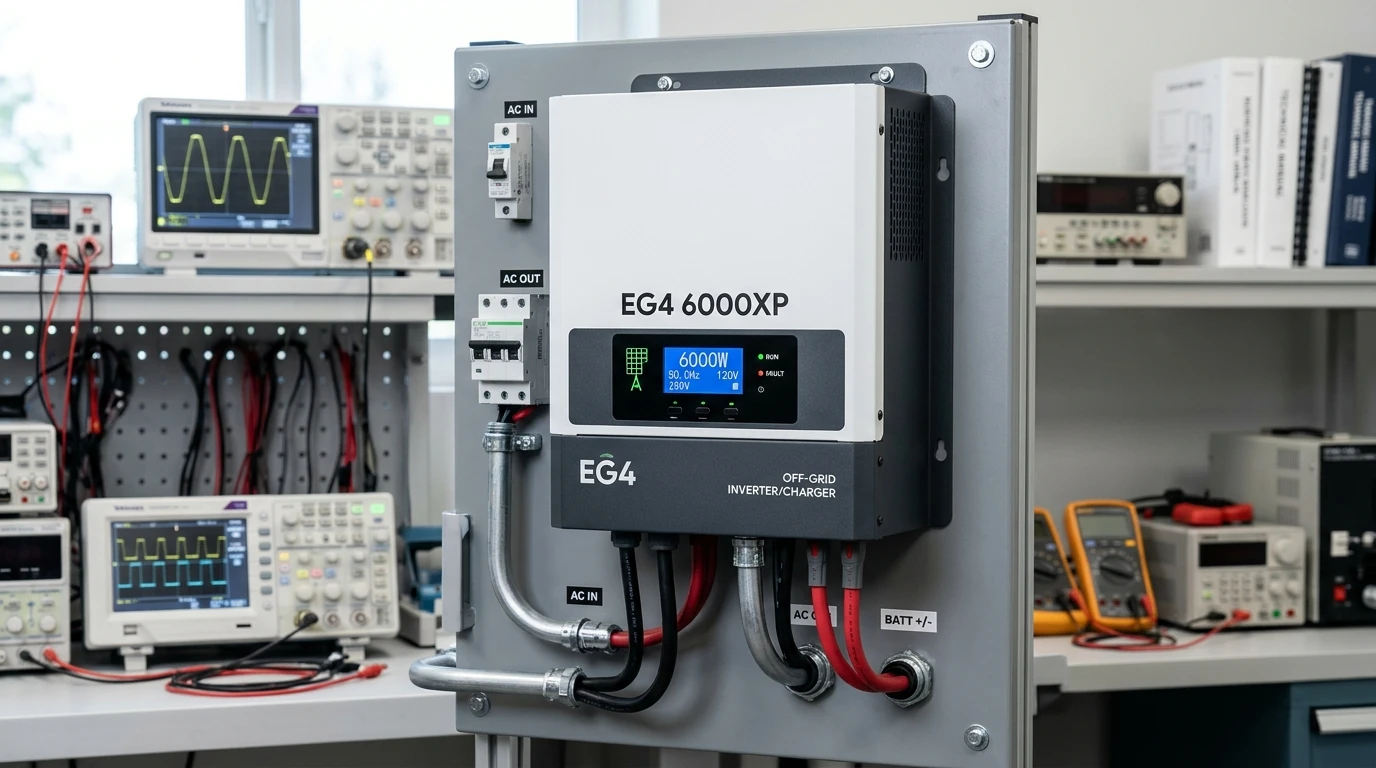
EG4 6000XP All-in-One Off-Grid Inverter (6kW / 120V/240V)
Delivers true 120V/240V split-phase power from a single unit without external autotransformers. Features dual MPPT charge controllers (up to 8,000W PV input) and ultra-clean pure sine wave output for whole-home breaker panels.
View EG4 6000XP Pricing →
2. High-Efficiency True Sine Power Station: EcoFlow DELTA Pro 3
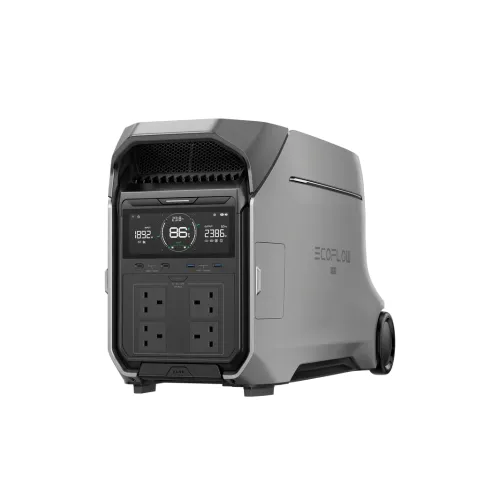
EcoFlow DELTA Pro 3 (4,096Wh / 4,000W Continuous)
Features native 120V and 240V dual voltage outputs in a single portable console. Employs advanced X-Fusion technology for whisper-quiet pure sine wave operation under 30 dB at low loads.
Explore DELTA Pro 3 Deals →
Interactive Inverter & Runtime Calculators
Analyze your AC power requirements with our interactive engineering tools:
- Inverter Tare Loss Calculator: Calculate the 24-hour vampire draw of your AC inverter under zero load.
- Solar Generator Runtime Calculator: Predict real-world appliance runtimes taking inverter conversion efficiency into account.
- Sump Pump LRA Surge Calculator: Test whether your AC inverter can handle inductive motor startup spikes.
Frequently Asked Questions (FAQ)
What does 60 Hertz (Hz) mean in household electricity?
Frequency, measured in Hertz (Hz), tells you how many complete sine wave cycles occur each second. In North America, AC electricity operates at 60 Hz, meaning current changes direction back and forth 120 times per second (60 full forward-and-backward cycles).
Can I run a microwave on a modified sine wave inverter?
While a microwave will turn on, its high-voltage transformer and cooling fan will buzz loudly, run noticeably hotter, and take roughly 20% to 30% longer to cook food due to harmonic distortion. Over time, modified sine wave power degrades the magnetron and digital control board.
What is Total Harmonic Distortion (THD)?
Total Harmonic Distortion measures how closely an AC waveform matches an ideal, smooth mathematical sine wave. Utility grid power typically has a THD between 3% and 5%. Quality Pure Sine Wave inverters maintain a THD under 3%, whereas cheap modified sine wave units often exceed 30% THD.
Why do some countries use 50Hz instead of 60Hz?
During the late 19th century, European electrical companies standardized on 50Hz because it aligned neatly with metric units (such as 50 cycles matching engine RPM divisions). In the United States, Westinghouse adopted 60Hz because it eliminated noticeable flickering in early arc lamps. Both frequencies work effectively, but equipment designed for 60Hz may overheat if run on 50Hz without adjustments.