When you install solar panels on your roof or connect a battery bank in your off-grid cabin, you are generating and storing Direct Current (DC) electricity.
However, almost every standard household appliance in your home—from your kitchen refrigerator and television to your laptop charger and air conditioner—runs on 120V or 240V Alternating Current (AC).
This fundamental electrical mismatch makes the solar inverter the indispensable mechanical heart and electronic brain of your entire energy setup. Without an inverter, the electricity captured by your solar panels cannot power a single wall outlet in your home.
In this beginner-friendly technical guide, GridSpecLab explains how inverters work, compares the core inverter architectures, breaks down pure sine wave versus modified sine wave output, and highlights the essential metrics you must verify before purchasing equipment.
A solar inverter takes low or high-voltage DC electricity from solar panels (or 12V/24V/48V batteries) and converts it into pure, oscillating 60Hz 120V/240V AC power that perfectly mimics the public utility grid. Never buy a cheap “Modified Sine Wave” inverter—always choose Pure Sine Wave to safeguard compressors, digital timers, and sensitive microprocessors. For modern DIY setups, Hybrid Inverters (like the EG4 18kPV or Sol-Ark 15K) and Dedicated Off-Grid Inverters (like the EG4 6000XP) have largely replaced complex separate charge controllers and transfer switches.
Compare Top Lab-Tested Inverters →
How a Solar Inverter Works: The Physics of Inversion
Direct Current (DC) electricity flows in a constant, single direction—like water streaming through a pipe. Alternating Current (AC), by contrast, rapidly switches its flow direction forward and backward 60 times every second in North America (60Hz frequency) and 50 times every second in Europe and Asia (50Hz).
To transform steady DC power into oscillating AC power, an inverter utilizes solid-state semiconductor switches called MOSFETs (Metal-Oxide-Semiconductor Field-Effect Transistors) or IGBTs (Insulated-Gate Bipolar Transistors):
High-Speed Switching (H-Bridge)
Internal transistors switch on and off tens of thousands of times per second using Pulse Width Modulation (PWM), alternating the polarity of the DC input.
Transformer / DC-DC Boost
The alternating pulses pass through a magnetic step-up transformer or high-frequency DC bus to elevate voltage from 48V up to 120V / 240V RMS.
LC Filter Network
Inductors (L) and capacitors (C) filter out high-frequency switching noise, polishing the raw pulsed square waves into a silky-smooth pure sine wave.
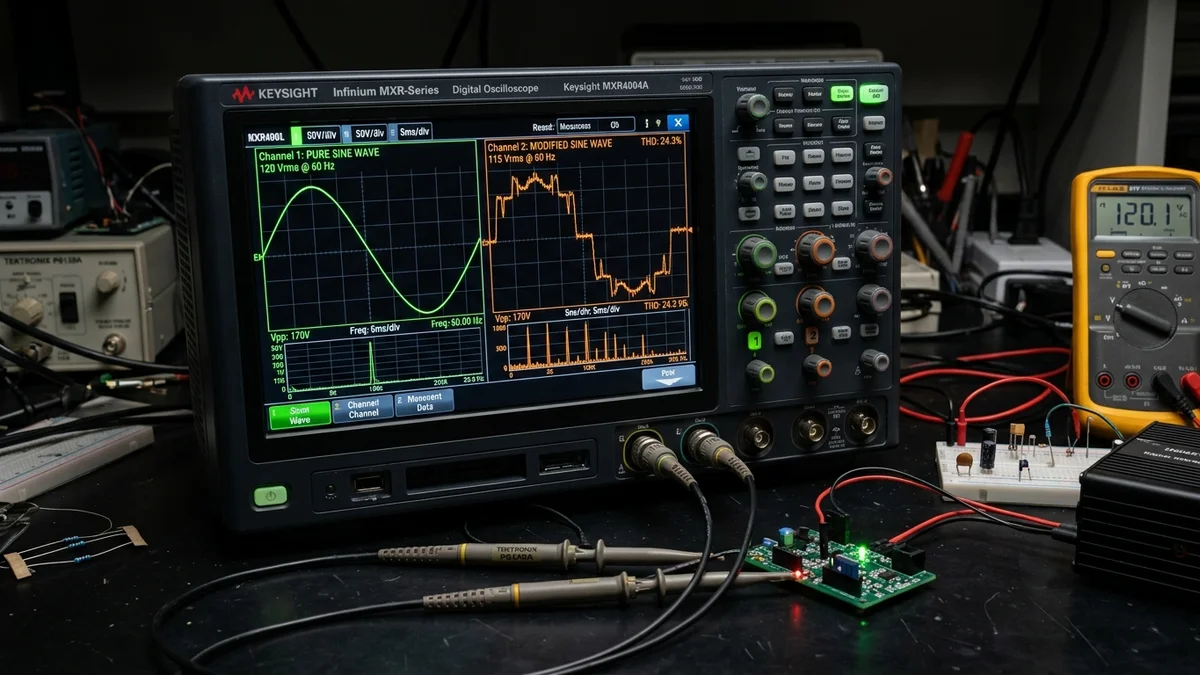
Pure Sine Wave vs. Modified Sine Wave: Why the Waveform Matters
Not all alternating current is created equal. When shopping for inverters, you will encounter two primary output classifications:
| Performance Attribute | Pure Sine Wave Inverter | Modified Sine Wave (Square Wave) |
|---|---|---|
| Waveform Geometry | Smooth, continuous mathematical sine curve | Coarse, choppy staircase stepped square wave |
| Total Harmonic Distortion (THD) | Low ( THD) | Severe ( THD) |
| Motor Compatibility | Refrigerator compressors and well pumps run quiet and cool | Motors buzz loudly, vibrate, and run 20°C hotter |
| Electronics Safety | Safe for medical CPAPs, laptops, LED dimmers, laser printers | Can burn out control boards, produce audio hum, or fail entirely |
| Equipment Cost | Slightly higher | Cheap ($50–$150 for small car inverters) |
| GridSpecLab Verdict | Mandatory for all home and solar systems | Avoid completely for permanent installations |
Induction motors in appliances like refrigerators and sump pumps rely on the smooth magnetic flux of a pure sine wave. When fed a blocky modified wave, the abrupt voltage transitions create harmonic eddy currents. This wasted electrical energy turns directly into destructive heat inside the motor windings, cutting compressor lifespans in half.
The Three Core Types of Solar Inverters
Depending on your property’s electrical connection, inverters are designed to work with or without batteries and public utility lines:
Grid-Tie String Inverters
Synchronizes directly with the utility grid. Exports excess solar power back for utility credits. Crucial limitation: Shuts down automatically during a blackout for anti-islanding safety (no battery storage).
Dedicated Off-Grid Inverters
Operates in complete electrical isolation from utility lines. Combines solar MPPT charge controllers and battery power into split-phase 120V/240V power with zero permitting red tape.
See EG4 6000XP Off-Grid Review →
All-In-One Hybrid Inverters
The ultimate modern design. Connects to grid, batteries, and solar panels simultaneously. Features 200A whole-home transfer switches for seamless sub-10ms emergency backup power.
See EG4 18kPV Hybrid Review →
Five Critical Specifications Every Beginner Must Check
Before purchasing any solar inverter, evaluate these five technical parameters on the manufacturer spec sheet:
Continuous Output Power (Running Watts)
Continuous wattage defines the maximum combined load your inverter can power indefinitely without overheating. If you plan to run a 1,200W coffee maker, a 180W refrigerator, and 300W of lighting simultaneously, your continuous load is . We recommend applying the 80% sizing rule: size your inverter so continuous loads never exceed 80% of its rated capacity (a 3,000W inverter is ideal for a 2,000W house load). Read our full engineering tutorial on How to Size a Solar Inverter.
Peak Motor Surge Capacity (Locked Rotor Amps)
Appliances with compressor motors (refrigerators, deep freezers, HVAC compressors, well pumps) draw 5x to 7x their normal operating power for 150 to 300 milliseconds at startup. A standard 6,000W inverter should support a minimum of 12,000W (200%) surge for 5 seconds to prevent nuisance overload tripping.
Idle Standby Tare Loss
An inverter consumes electricity simply remaining switched on with nothing plugged in. While premium off-grid inverters (like the EG4 6000XP) draw as little as 34 Watts on standby, older or oversized 15kW commercial units can consume 90W to 120W continuously. Over a 24-hour winter cycle, that phantom load consumes over 2,400Wh of your battery bank! Calculate your system losses using our guide on Inverter Efficiency Curves & Low-Load Drop.
Maximum MPPT Solar Input Voltage ()
If your inverter includes an internal MPPT solar charge controller, check the maximum DC input voltage limit (typically 500V to 600V on modern residential units). In freezing winter weather, solar panel open-circuit voltage spikes significantly. If your array exceeds the inverter’s maximum input voltage by even 1 Volt, the input circuitry can suffer catastrophic failure.
Split-Phase 120V / 240V Output Architecture
In North American residential electrical systems, large heavy-duty appliances (central air conditioners, electric water heaters, well pumps, EV chargers) require 240V split-phase power delivered across two synchronized 120V hot legs (L1 and L2). If you need whole-home backup, confirm that your inverter outputs native 120V/240V split-phase power rather than single-phase 120V only.
Frequently Asked Questions (FAQ)
Can a solar inverter work without batteries?
Yes. Grid-tie string inverters and microinverters operate without batteries by feeding solar energy directly into your home or the utility grid. However, if utility grid power goes down, a grid-tied inverter without a battery bank will shut down immediately for safety and cannot provide emergency backup.
What size solar inverter do I need for a typical home?
For typical North American homes seeking partial backup (fridge, lights, Wi-Fi, microwave, well pump), a 6,000W to 8,000W split-phase inverter is sufficient. For whole-home backup including central air conditioning and electric ovens without circuit subpanel shedding, homeowners generally install a 12,000W to 15,000W hybrid inverter (such as the EG4 18kPV or Sol-Ark 15K).
How long does a solar inverter last?
Quality string and hybrid inverters typically last between 10 and 15 years, while microinverters (such as Enphase) often carry 25-year warranties. Inverter lifespans depend heavily on ambient operating temperatures and ventilation; installing your inverter in a cool, dust-free garage or utility room extends internal capacitor longevity significantly.
What is the difference between a solar charge controller and an inverter?
A solar charge controller regulates the variable DC voltage coming from solar panels to safely charge a DC battery bank without overcharging. An inverter takes DC battery power and transforms it into 120V/240V AC electricity for your household appliances. Modern “all-in-one” inverters integrate both components into a single chassis.