It is one of the most disheartening moments in whole-home solar commissioning: you have invested thousands of dollars into a robust off-grid or hybrid power system. Your inverter is rated for a massive 6,000W or 8,000W continuous output with a 12,000W surge capability. Your 48V battery bank is fully charged and resting at 53.5V.
You set your central heat pump or air conditioner thermostat to 72°F. The outdoor condenser contactor clunks shut, the fan blades begin to spin, and inside the compressor housing, the motor attempts to turn.
Then—BEEP-BEEP-BEEP! The power room goes dark. The inverter screen flashes a harsh red fault: “Error 08: Inverter Overload Hardware Trip”.
When you check the manufacturer’s nameplate on the outdoor condenser, it says the unit draws only 14 Amps running at 240 Volts—roughly 3,360 Watts. How could a 3,360-watt load instantly overwhelm an 8,000-watt inverter with a 12,000-watt surge ceiling?
The culprit is Locked Rotor Amperage (LRA). In this technical engineering guide, GridSpecLab explains the electrodynamics of compressor startup inrush, why standard inverter surge ratings fail to capture inductive spikes, provides a definitive soft starter sizing chart across AC tonnages, and walks through the exact four-wire hookup required to start heavy central air units cleanly on battery power.
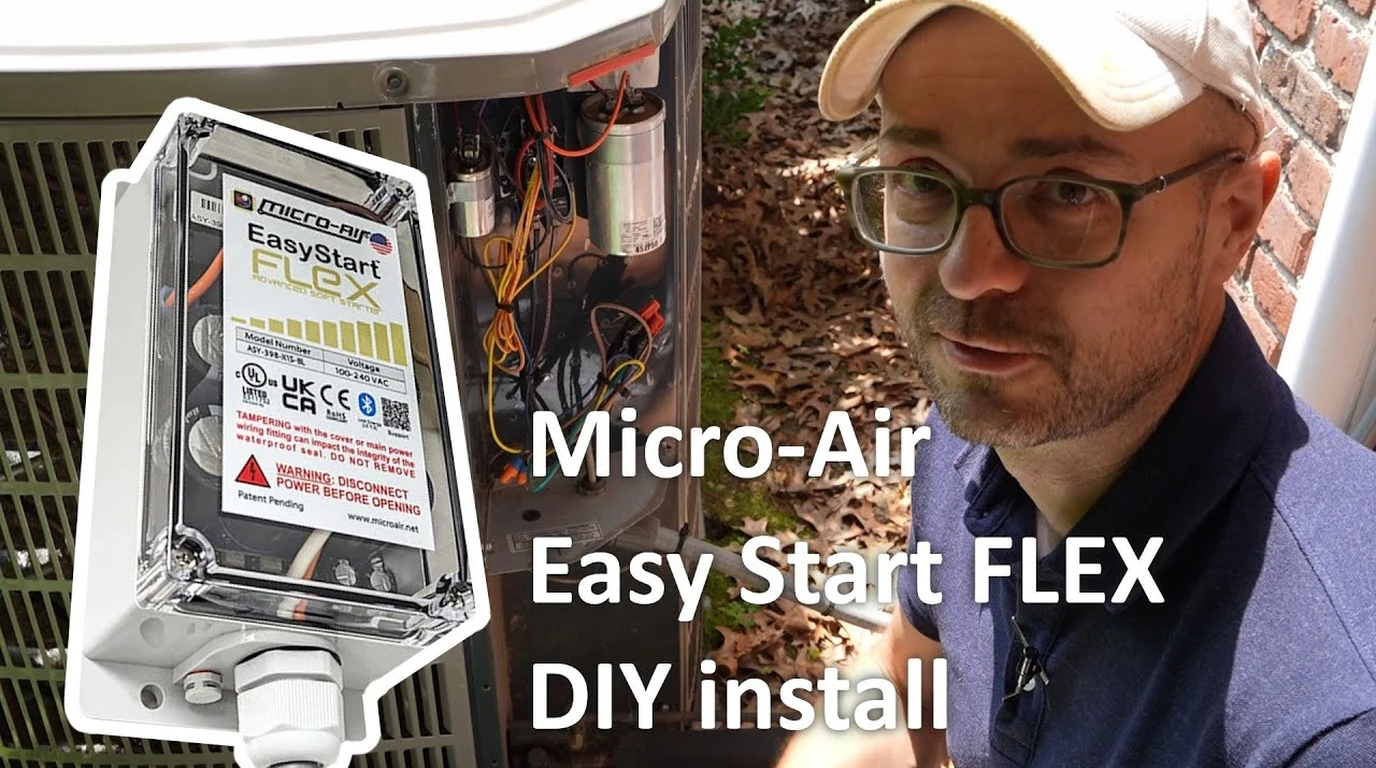
A standard 3-ton to 4-ton scroll compressor demands an instantaneous 75A to 110A LRA spike (18kW to 26kW at 240V) to break mechanical inertia and overcome head pressure. This 100-millisecond pulse exceeds the microsecond overcurrent protection thresholds of inverter MOSFETs/IGBTs. Installing a microprocessor-controlled electronic soft starter (such as the Micro-Air EasyStart 368 or ICM870) ramps voltage gradually across 300ms, slashing peak inrush by 65% to 75% (down to 25A–30A), allowing central AC units to start effortlessly on 6kW to 10kW inverters.
Explore Tested Solar Air Conditioning →
Electrodynamics of Compressor Startup: LRA vs RLA
To understand why air conditioners overwhelm off-grid inverters, you must examine the physical state of an electric motor at rest.
When an electric induction motor (such as the hermetic scroll compressor in a residential condenser) is stationary, there is zero Counter-Electromotive Force (Back-EMF) generated within the stator windings. The only physical parameter opposing the flow of electric current is the minuscule DC resistance of the copper wire windings (often under 0.8 ohms).
On the condenser data plate, you will find two critical electrical metrics:
- Running Load Amps (RLA): The continuous current drawn while the compressor operates at full design load and maximum head pressure (typically 12A to 18A on a 3-ton system).
- Locked Rotor Amps (LRA): The maximum current drawn at the exact microsecond the contactor closes and the rotor is physically locked at zero RPM ().
       TYPICAL 3-TON COMPRESSOR (240V SINGLE-PHASE)

   RUNNING STATE (RLA):            STARTUP TRANSIENT (LRA):
   Continuous Load                 First 100 Milliseconds

       14.2 Amps                       82.5 Amps
   ====================            =============================================
   Power = 3,408 Watts             Power = 19,800 Watts (19.8 kW)
   Inverter Handling: Easy         Inverter Handling: HARDWARE TRIP!
The 19.8-Kilowatt Mathematical Trap
When your thermostat calls for cooling, that 3-ton compressor demands:
Even if you own a high-quality 8,000W low-frequency inverter with a rated 16,000W peak surge rating for 5 seconds, the surge capacity is insufficient.
Inverter surge ratings are measured across a multi-second thermal envelope. But inside the inverter chassis, the microprocessors and Insulated Gate Bipolar Transistors (IGBTs) feature hardware-level instantaneous overcurrent protection (IOC) calibrated to trip within 5 to 10 milliseconds if current exceeds 150% to 180% of rated peak.
The 19.8 kW pulse trips the inverter’s silicon switches before the compressor rotor can even complete its first full mechanical rotation.
Why Hard Start Kits Do Not Solve Inverter Overload
When homeowners consult HVAC technicians about compressor starting problems, the standard recommendation is often to install a cheap “Hard Start Kit” (such as a Supco SPP6 or 5-2-1 kit retailing for 40).
Installing a hard start kit on an off-grid solar system is a critical mistake:
+---------------------------------------------------------------------------------+
|                    HARD START KIT vs ELECTRONIC SOFT STARTER                    |
+---------------------------------------------------------------------------------+

  HARD START KIT (Potential Relay + Electrolytic Start Capacitor):
  - Function: Adds a massive burst of capacitive current to maximize starting torque.
  - Inrush Effect: INCREASES PEAK CURRENT (Can push 80A LRA up to 95A+).
  - Target Audience: Overcoming sticky compressors on weak utility grids with thick wire.
  - Off-Grid Solar Result: GUARANTEED INVERTER OVERLOAD TRIP.

  ELECTRONIC SOFT STARTER (Microprocessor + SCR Semiconductor Ramping):
  - Function: Chops and phases the AC sine wave, stepping voltage smoothly over 300ms.
  - Inrush Effect: REDUCES PEAK CURRENT BY 65% TO 75% (Cuts 82A down to 26A).
  - Target Audience: Off-grid solar inverters, generators, and battery backup systems.
  - Off-Grid Solar Result: FLAWLESS COMPRESSOR START FROM BATTERY.
A hard start kit is designed to unstick failing compressor bearings on a robust utility grid that can supply 200 Amps without blinking. It achieves this by forcing more current through the start winding. On an off-grid inverter with fixed semiconductor limits, increasing peak current guarantees an immediate shutdown.
How Microprocessor-Controlled Soft Starters Function
A true electronic soft starter—such as the industry-standard Micro-Air EasyStart 368 or ICM Controls ICM870—is not a simple capacitor. It is a sophisticated, solid-state power electronic computer.
       SOFT STARTER CURRENT MODULATION (300ms RAMP)

   Raw Grid / Inverter Sine Wave (100% Voltage)
   ------------------------------------------------------------

   Soft-Starter Output Waveform to Compressor:

    [ SCR 1 ]         [ SCR 2 ]         [ SCR 3 ]         [ Full Sine ]
    Chops early       Widens Phase      Full Conduction   Bypass Relay
    Cycle (30% V)     Angle (65% V)     Cycle (90% V)     Engaged (100% V)
       _                 _--_              _--_              _--_
      / \               /    \            /      \          /      \
   --+---+-----------+--------+--------+----------+------+--------+---
      |                  |                 |                 |
      v                  v                 v                 v
    t = 0ms            t = 80ms          t = 180ms         t = 300ms
    Current: 22A       Current: 26A      Current: 18A      Current: 14A (RLA)
The Three-Stage Soft-Start Sequence
- Dynamic Phase-Angle Firing: Dual internal Silicon-Controlled Rectifiers (SCRs) chop the incoming 240V sine wave, delivering a truncated voltage waveform starting at roughly 35% of nominal voltage during the initial cycles.
- Current Ramping: Over the course of 300 to 400 milliseconds, the microprocessor smoothly advances the SCR firing angle, stepping motor voltage upward in lockstep with the accelerating rotor.
- Internal Bypass Relay: Once the rotor reaches synchronous speed (3,450 to 3,600 RPM) and current drops to normal running levels, an internal heavy-duty mechanical relay closes. This completely bypasses the SCRs, eliminating heat generation and harmonic distortion during normal continuous cooling.
Furthermore, advanced soft starters incorporate self-learning neural algorithms. During the first 5 starts, the internal computer measures exact rotor inertia, winding inductance, and refrigerant head pressure, automatically calibrating its firing profile for maximum inrush reduction.
Air Conditioner Soft Starter Sizing Matrix
To match your air conditioning condenser with the correct soft starter model and confirm whether your solar inverter can handle the load, consult the laboratory sizing matrix below:
| AC Tonnage / Cooling Capacity | Compressor Type | Typical Running Current (RLA) | Raw Locked Rotor Current (LRA) | Reduced Inrush Current (Soft Start) | Peak Surge Power Required | Minimum Recommended Inverter Capacity | Recommended Soft Starter Model |
|---|---|---|---|---|---|---|---|
| 1.5 Ton (18,000 BTU) | Rotary / Recip | 8.5A – 10.5A | 45A – 55A | 14A – 17A | 3.6 kW – 4.1 kW | 4.0 kW to 5.0 kW (e.g. EG4 6000XP) | Micro-Air EasyStart 368-X48 or ICM870-16A |
| 2.0 Ton (24,000 BTU) | Scroll / Rotary | 10.5A – 12.5A | 55A – 65A | 18A – 22A | 4.3 kW – 5.3 kW | 5.0 kW to 6.0 kW (e.g. Victron MultiPlus-II) | Micro-Air EasyStart 368-X48 or ICM870-16A |
| 2.5 Ton (30,000 BTU) | Scroll | 12.0A – 14.0A | 65A – 75A | 21A – 25A | 5.0 kW – 6.0 kW | 6.0 kW to 8.0 kW (e.g. Sol-Ark 8K / Deye 8K) | Micro-Air EasyStart 368-X48 or ICM870-32A |
| 3.0 Ton (36,000 BTU) | Scroll (Copeland) | 13.5A – 16.0A | 75A – 88A | 24A – 28A | 5.8 kW – 6.7 kW | 8.0 kW (e.g. Sol-Ark 12K / Schneider XW Pro) | Micro-Air EasyStart 368-X48 or ICM870-32A |
| 3.5 Ton (42,000 BTU) | Scroll (Copeland) | 16.0A – 18.5A | 88A – 105A | 28A – 33A | 6.7 kW – 7.9 kW | 8.0 kW to 10.0 kW (e.g. MidNite Rosie 7048) | Micro-Air EasyStart 368-X48 or ICM870-32A |
| 4.0 Ton (48,000 BTU) | Scroll (Copeland) | 18.0A – 21.0A | 105A – 125A | 33A – 38A | 7.9 kW – 9.1 kW | 10.0 kW to 12.0 kW (e.g. Sol-Ark 15K / EG4 18kPV) | Micro-Air EasyStart 368-X48 or ICM870-32A |
| 5.0 Ton (60,000 BTU) | Scroll (Heavy-Duty) | 22.0A – 26.0A | 130A – 155A | 40A – 46A | 9.6 kW – 11.0 kW | 12.0 kW to 15.0 kW (e.g. Sol-Ark 15K / Deye 12K) | Micro-Air EasyStart 368-X48 or ICM870-32A |
Step-by-Step Installation and Wiring Schematic
Installing a modern 4-wire soft starter into an outdoor condenser takes roughly 30 to 45 minutes using standard hand tools.
+---------------------------------------------------------------------------------+
|                       FOUR-WIRE SOFT STARTER HOOKUP TOPOLOGY                    |
+---------------------------------------------------------------------------------+

       [ CONTACTOR ]                       [ DUAL RUN CAPACITOR ]
       +-----------+                       +--------------------+
  L1 ->| T1     L1 |                       | [C]   [HERM] [FAN] |
       |           |                       +--+-------+-----+---+
  L2 ->| T2     L2 |                          |       |     |
       +--+--------+                          |       |     +--> Fan Motor
          |                                   |       |
          | (White Wire)                      |       | (Existing Start Wire Removed)
          v                                   |       v
       [ SOFT STARTER ]                       |   [ SOFT STARTER ]
       |  WHITE LEAD  |                       |   |  BROWN LEAD  |
       |  BLACK LEAD  |-----+                 |   +--------------+
       |  ORANGE/BLUE |<----+-----------------+
       +--------------+     | (Connects to Run Capacitor C)
                            v
                     [ Contactor T1 ] (Black Lead)
Safety and Pre-Installation Protocol
- Isolate Power: Pull the outdoor high-voltage disconnect block adjacent to the condenser. Verify with a non-contact voltage tester and multimeter that 0.0V exists across contactor terminals L1, L2, T1, and T2.
- Discharge the Run Capacitor: Touch an insulated 20k-ohm 5W resistor (or an insulated screwdriver shank across terminals) from
HERMtoCandFANtoCon the dual round run capacitor to safely discharge residual high-voltage energy. - Mount the Soft Starter: Fasten the weatherproof soft starter enclosure securely to the condenser control compartment bulkhead using self-tapping sheet metal screws, ensuring wire knockouts face downward.
The Four-Wire Connection Sequence
Follow this color-coded hookup protocol (standard for Micro-Air EasyStart and ICM870):
- Black Wire: Connect to the outdoor contactor Terminal T1 (switched Line 1 side that feeds the compressor).
- White Wire: Connect to the outdoor contactor Terminal T2 (switched Line 2 side). If your unit has a factory compressor run wire connected to the run capacitor
Cterminal, splice the soft-starter white wire directly into that path according to the manufacturer’s manual. - Brown Wire: Locate the compressor start wire attached to the HERM terminal of the dual run capacitor. Disconnect this wire from the capacitor, and connect it directly to the soft starter’s Brown Wire using a secure insulated wire nut or flag connector.
- Orange (or Blue) Wire: Connect directly to the empty HERM terminal of the run capacitor where the compressor start wire was previously installed.
Field Verification and Inrush Clamp Meter Testing
Once the soft starter is wired, never assume it is working based on sound alone. You must electrically verify inrush reduction using a true-RMS clamp meter with an Inrush Measurement Mode (e.g., Fluke 376 FC, Klein CL800, or Fieldpiece SC680).
+---------------------------------------------------------------------------------+
|                       INRUSH VERIFICATION MEASUREMENT                           |
+---------------------------------------------------------------------------------+

  Step 1: Clamp meter jaw around the black wire feeding Contactor Terminal T1.
  Step 2: Press the "INRUSH" button on the clamp meter (displays "Inrush Armed").
  Step 3: Power up the condenser and drop the thermostat to trigger cooling.
  Step 4: Record peak inrush reading on Start #1, Start #3, and Start #5.

  LEARNING PROGRESSION (3-TON COPELAND SCROLL):
  - Baseline (No Soft Starter): 82.4 Amps Peak (Inverter Overload)
  - Start #1 (Initial Learning): 41.2 Amps Peak (50% Reduction)
  - Start #3 (Optimizing Ramp):  31.5 Amps Peak (62% Reduction)
  - Start #5 (Fully Calibrated): 25.8 Amps Peak (69% Reduction - Inverter Rock Steady!)
Inverter Telemetry Checks During Compressor Start
While the clamp meter captures transient amperage at the condenser, monitor your hybrid inverter’s control screen (or mobile app):
- AC Voltage Sag: AC output voltage should not drop below 228V AC during startup.
- DC Battery Bus Ripple: Verify that 48V battery bus voltage does not sag by more than 1.8V DC during the start spike.
- Zero Fault Alarms: The inverter should exhibit zero light flicker and zero momentary overload warning flashes.
Frequently Asked Questions
Can a soft starter damage my air conditioner compressor?
No. Soft starters actually extend compressor lifespan significantly. By eliminating the violent mechanical shock of locked rotor starting, soft starters reduce rotational torque stress on compressor scroll plates and motor windings. Furthermore, major compressor manufacturers (including Copeland and Danfoss) approve approved solid-state soft starters for residential installations.
Do modern variable-speed inverter AC units need a soft starter?
No. Variable-speed inverter air conditioners and mini-split heat pumps (such as units from Mitsubishi, Daikin, or EG4) already contain internal variable-frequency drives (VFDs). These units naturally start at 0Hz and slowly ramp compressor speed upward, drawing less than 2 Amps at initial start. Soft starters are required only for single-stage and two-stage standard induction compressors.
Why does my soft starter take 5 starts to achieve maximum inrush reduction?
Micro-Air EasyStart and ICM units use an adaptive microprocessor that learns the specific inductance and mechanical load characteristics of your compressor. On Start 1, it applies a conservative starting profile to ensure the motor turns over. Across Starts 2 through 5, it progressively delays and trims the SCR firing angle until it finds the lowest possible current required to start the rotor without stalling.
Can I run my central AC from a portable generator if I install a soft starter?
Yes. Installing a soft starter is the single most common modification made by homeowners wanting to run a central 3-ton to 4-ton AC from a portable 7,500W to 9,500W generator (like a Predator 9500 or Champion dual-fuel). Without a soft starter, the 80A LRA surge stalls portable generator engines instantly.