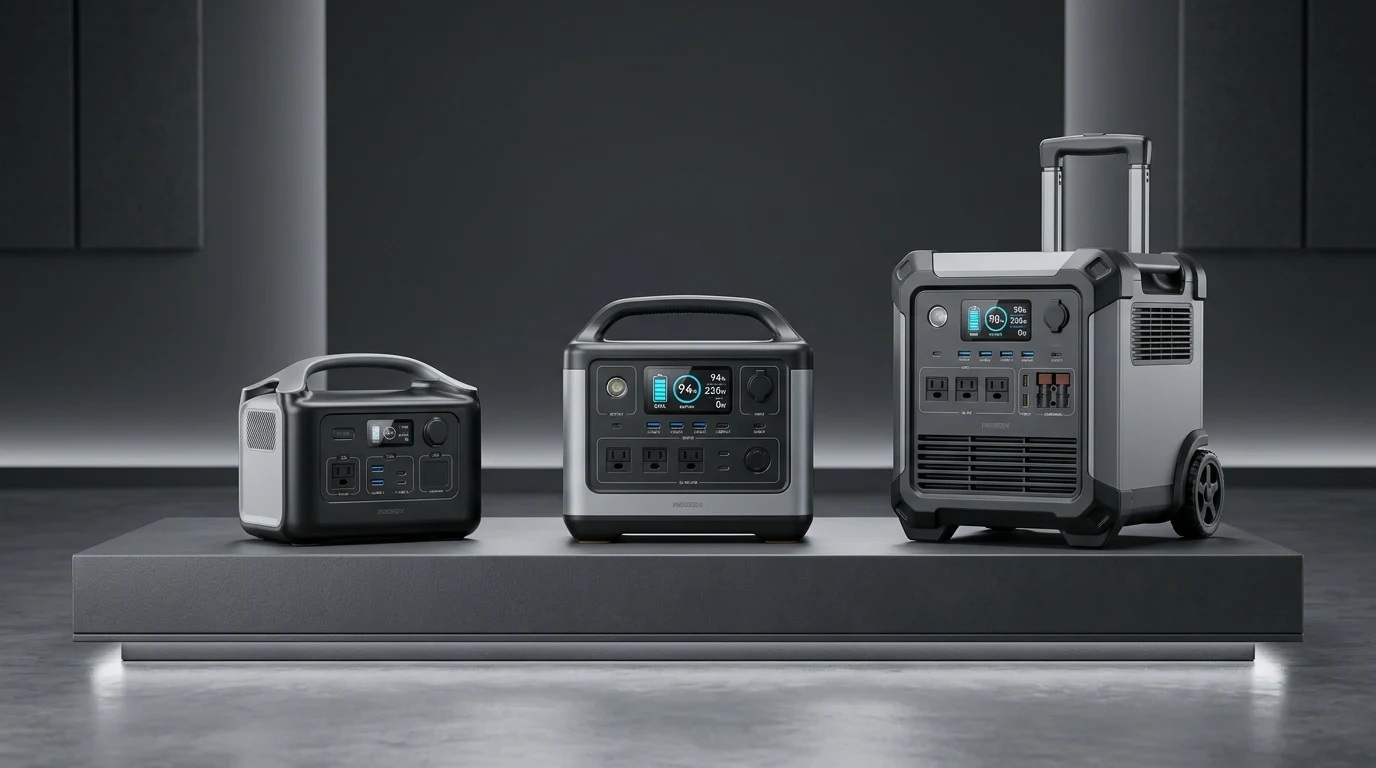
Selecting the correct portable power station requires moving past marketing hype and evaluating the raw electrical physics of your load profile. At GridSpecLab, we evaluate units based on continuous inverter output, battery chemistry longevity, and real-world conversion efficiency under thermal stress.
This guide delivers an interactive sizing methodology, mathematical frameworks, and a structured recommendation engine to match your exact electrical requirements.
Key Engineering Takeaways Calculate your continuous and surge power needs with our Power Station Capacity Sizing Calculator and estimate appliance runtimes with our Solar Power Consumption Calculator.
- Load Concurrency Factor: Total running wattage is rarely the sum of all nameplate ratings. You must account for simultaneous starting surges of inductive loads like refrigerators and compressors.
- Inverter Efficiency Losses: Direct Current (DC) to Alternating Current (AC) conversion introduces thermal losses, typically reducing raw watt-hours by 12% to 18% depending on the inverter topology.
- Cycle Life vs. Chemistry: LiFePO4 () cells provide deeper usable cycling and structural safety compared to older Lithium Nickel Manganese Cobalt (NMC) formulations, reducing long-term cost per kilowatt-hour.
Interactive Power Station Sizing Calculator
Use this engineering-grade tool to calculate your exact runtime and required battery capacity based on your custom load profile.
Use our integrated engineering calculator below to calculate your exact runtime and required battery capacity based on your custom load profile.
First-Principles Electrical Physics & Formulas
To engineer a reliable off-grid or emergency backup system, you must calculate true runtime using fundamental electrical equations. Nominal battery capacity () in Watt-hours () does not equal deliverable AC energy.
The governing formula for true runtime () is expressed as:
Where:
- = Gross battery capacity in Watt-hours ()
- = Depth of Discharge limit (e.g., for or for advanced BMS configurations)
- = Inverter conversion efficiency (typically to )
- = Total active continuous load in Watts ()
Example Calculation
If you run a refrigerator on a LiFePO4 power station with an efficient inverter and an safe depth of discharge:
Practical Test Bench Benchmarks
Our test bench evaluates portable power stations under resistive and inductive loads at ambient temperatures. The table below outlines real-world operational runtimes for common household and field appliances.
| Appliance Category | Running Watts (W) | Surge Watts (W) | 1,000Wh Station Runtime | 2,048Wh Station Runtime |
|---|---|---|---|---|
| CPAP Machine (with humidifier) | 55W | 90W | Approx. 13.5 hours | Approx. 27.5 hours |
| Full-Size Residential Fridge | 150W (avg) | 1,200W | Approx. 4.8 hours | Approx. 9.8 hours |
| Starlink Gen 2 / Mini Terminal | 75W | 130W | Approx. 9.9 hours | Approx. 20.2 hours |
| Portable Air Conditioner (8,000 BTU) | 900W | 2,500W | Incompatible / Overload | Approx. 1.5 hours |
| LED Work Light / Laptop Charging | 80W | 100W | Approx. 9.3 hours | Approx. 19.0 hours |
Real-World Sizing / Installation Scenarios
Scenario 1: The Remote Telemetry & Communications Node
- Profile: Powering a Starlink terminal () and weather monitoring sensors () continuously for 48 hours without grid power.
- Total Load: continuous ( consumed daily).
- Engineering Recommendation: A modular power station equipped with dual 400W solar panel arrays to maintain energy equilibrium during variable weather conditions.
Scenario 2: Essential Home Emergency Backup (Medical & Refrigeration)
- Profile: Running a medical CPAP machine () and a kitchen refrigerator ( average duty cycle) during an extended grid outage.
- Total Load: combined active load.
- Engineering Recommendation: A mid-tier LiFePO4 generator. This configuration provides over 9 hours of uninterrupted power while leaving headroom for intermittent lighting and phone charging.
Power Station Recommendations by Capacity Bracket
Under 500Wh: Ultra-Portable & Medical Backup
Best for weekend camping trips, drone battery recharging, and single-device CPAP use during short outages.
- Key Specifications: 300W to 500W continuous pure sine wave inverter, under 15 lbs, LiFePO4 internal chemistry.
- Top Pick: EcoFlow River 2 Max (Offers rapid AC recharging and stable output for light electronics).
1000Wh to 2000Wh: Mid-Tier Emergency & Overlanding
The sweet spot for home emergency preparedness, powering refrigerators, small microwaves, and communication tools.
- Key Specifications: 1,500W to 2,000W continuous output, expandable battery port options, fast solar input controllers (MPPT).
- Top Pick: Bluetti AC200MAX (Features a robust modular architecture and reliable surge handling).
3000Wh+: Whole-Home Integration & Heavy Loads
Engineered for heavy inductive loads, air conditioning units, power tools, and multi-day off-grid living.
- Key Specifications: 3,000W+ continuous output, 240V split-phase capability, high-voltage solar panel charging inputs.
- Top Pick: Anker Solix F3800 (Provides massive capacity, expandable storage, and heavy-duty grid-tie integration).
Frequently Asked Questions (FAQ)
Can I run sensitive medical equipment like an oxygen concentrator or CPAP on a portable power station?
Yes, provided the power station features a pure sine wave inverter. Modified sine wave inverters generate electrical noise that can damage sensitive motor controls and internal power supplies in medical equipment. Always verify that the continuous wattage rating of the inverter exceeds the maximum surge draw of the device.
How do sub-freezing temperatures impact lithium power station performance?
Lithium-ion and LiFePO4 battery management systems (BMS) automatically restrict or halt charging when internal cell temperatures drop below () to prevent permanent lithium plating and dendrite formation. However, discharging is generally safe down to , though internal resistance increases, reducing total usable capacity.
What is the difference between peak surge wattage and continuous wattage?
Continuous wattage is the maximum load the inverter can supply indefinitely without thermal overload. Peak surge wattage is a short-duration burst capacity (usually lasting a fraction of a second) designed to overcome the initial startup inertia of electric motors found in compressors, pumps, and power tools.