A solar array without properly sized battery storage is like an automobile with a thimble-sized fuel tank: no matter how powerful the engine is, you run out of energy the moment the supply stops.
Undersizing your battery storage bank leads to frequent blackout shutoffs, dangerous low-voltage disconnect faults, and premature cell degradation caused by excessive discharge rates. Oversizing your battery bank by 300%, on the other hand, wastes thousands of dollars in idle capital on lithium cells that sit under-utilized while suffering irreversible calendar aging.
Accurate battery bank sizing is not an estimate—it is a rigorous first-principles engineering calculation based on your daily consumption profile (), desired Days of Autonomy (), inverter conversion efficiency (), and the continuous discharge amperage limits () of your Battery Management System (BMS).
In this comprehensive guide, we walk you through the five-step engineering framework to calculate the exact battery capacity required for your power system—whether you are designing an off-grid cabin, an RV mobile electrical system, or a whole-home emergency backup bank.
Watt-Hour Audit
Sum running Watts × operating hours plus 24-hr inverter tare loss.
Days of Autonomy
Multiply by 1 to 3 days of zero-solar cloud or winter storm coverage.
Derate for DoD
Divide by 0.85 (LiFePO4) or 0.50 (Lead-Acid) to protect cycle lifespan.
Voltage Bus
Adopt 48V for systems >3kWh to cut circuit amperage and heat by 75%.
BMS Peak Amps
Verify parallel modules meet maximum inverter kW discharge draw.
Energy (kWh) vs. Power (kW): The Critical Sizing Distinction
Before calculating formulas, you must understand the distinction between Energy Capacity and Power Delivery:
Energy (Kilowatt-Hours / kWh) = Size of the Water Tank    ──► Dictates HOW LONG appliances run.
Power (Kilowatts / kW)         = Diameter of the Pipe      ──► Dictates HOW MANY appliances run AT ONCE.
Many solar builders calculate that their home needs 10kWh of daily energy, purchase two 5kWh lithium batteries, and are shocked when their system trips offline the moment their well pump starts up.
Why does this happen?
- Each 5.12kWh 48V battery has an internal Battery Management System (BMS) with a continuous discharge current rating—typically 100 Amps.
- At a nominal 51.2 Volts, a 100A BMS can supply a maximum continuous power of:
- If your home features an 8,000W or 12,000W inverter (like an EG4 6000XP or Sol-Ark 15K), running a central A/C and electric water heater simultaneously pulls over 7,500 Watts.
- A single battery module cannot supply 7.5kW. Its BMS overcurrent protection trips immediately, leaving you in the dark even though the battery was 90% full!
[!IMPORTANT] When sizing a solar battery bank, you must size for both total energy capacity (kWh) and continuous discharge power (kW). Your battery bank’s combined BMS output amperage must equal or exceed your inverter’s maximum continuous AC wattage.
The Five-Step Solar Battery Sizing Framework
Use this step-by-step engineering calculation to find your exact battery bank dimensions:
Conducting a 24-Hour Energy Audit
Calculate the total electrical energy consumed by your appliances during a full 24-hour cycle in Watt-hours (). Multiply each appliance’s running wattage by the number of hours it runs per day:
Do not forget to add your inverter’s internal standby consumption (tare loss). A typical 3kW to 6kW all-in-one inverter consumes between 25W and 55W simply sitting idle with its power switch turned on:
For a 50W idle draw: simply to keep the inverter alive!
Determining Days of Autonomy
Days of Autonomy () represents how many consecutive days your battery bank can sustain critical loads with zero solar recharging (e.g., during prolonged blizzards, dense overcast, or wildfire smoke):
- Mobile RV / Van Life: Typically 1 to 1.5 Days (supplemented by alternator charging or portable generator).
- Residential Grid-Tied Emergency Backup: Typically 1 to 2 Days (supplemented by dual-fuel generators).
- Year-Round Off-Grid Cabins & Homesteads: Typically 2.5 to 3.5 Days to avoid excessive engine wear on backup generators during cloudy winter stretches.
Applying Usable Depth-of-Discharge (DoD) Derating
No battery should ever be cycled to 0% State of Charge. Discharging lithium cells flat accelerates mechanical electrode degradation, while discharging lead-acid batteries beyond 50% causes irreversible plate sulfation:
- Lithium Iron Phosphate (LiFePO4): Safely operated at 80% to 90% DoD (). Limiting daily discharge to 85% yields over 4,000 to 6,000 cycles (12 to 18 years).
- Sealed Lead-Acid / AGM: Limited to 50% DoD (). Discharging past 50% destroys AGM batteries in under 350 cycles.
Furthermore, converting 48V DC power into 120V/240V AC power incurs heat loss inside the inverter’s magnetic transformer and switching MOSFETs. High-quality pure sine wave hybrid inverters operate at approximately 90% average conversion efficiency ().
Worked Calculation: Sizing an Off-Grid Cabin
Let us size an off-grid cabin with the following load profile:
- Refrigerator, Starlink, lighting, water pump: 3,800 Wh/day
- Inverter idle tare loss (45W × 24h): 1,080 Wh/day
- Total Daily AC Consumption:
- Desired Autonomy: 2 Days ()
- Target Chemistry: LiFePO4 (, )
Calculate nominal battery bank size:
To supply two full days of off-grid living, this cabin requires a nominal battery bank of at least 12.8 kWh.
Selecting the Optimal DC Voltage Architecture
Once capacity in Watt-hours is established, configure your physical DC system voltage. Electrical power physics () dictates the current flowing through your battery cables:
| System DC Voltage | Current at 3,000W Load | Required Conductor Gauge | Maximum Recommended Battery Size |
|---|---|---|---|
| 12 Volts | 277 Amps | 4/0 AWG (Heavy Welding Cable) | Under 2,500 Wh (RVs, small boats) |
| 24 Volts | 138 Amps | 1/0 AWG or 2/0 AWG | 2,500 Wh – 5,000 Wh (Overlanding rigs) |
| 48 Volts | 69 Amps | 4 AWG or 2 AWG (Standard flexible wire) | 5,000 Wh – 100,000+ Wh (Cabins, whole homes) |
For our 12.75 kWh cabin requirement, a 48V DC bus is non-negotiable. At 48V nominal (51.2V LiFePO4):
This requirement is cleanly satisfied by three 48V 100Ah server rack batteries wired in parallel (), or a single 14.3kWh wall-mounted battery (like the EG4 PowerPro).
Verifying BMS Discharge C-Rate and Peak Amperage
Three 48V 100Ah server rack batteries in parallel feature three independent 100A BMS units, giving you a total combined continuous discharge capability of 300 Amps:
This provides ample headroom to power a 6,000W or 10,000W hybrid inverter at full continuous load with zero thermal strain on individual battery cells!
Temperature Derating: Accounting for Sub-Zero Winter Capacity Loss
If your battery bank is installed in an unheated garage, outdoor shed, or exterior trailer tongue box, ambient temperature directly dictates cell chemistry:
- At 77°F (25°C): LiFePO4 delivers 100% of rated nameplate capacity.
- At 32°F (0°C): Usable capacity contracts by 12% to 15% due to increased electrolyte viscosity and internal resistance ().
- At 14°F (-10°C): Usable capacity drops by 25% to 30%.
- The Cold Charging Rule: LiFePO4 batteries must never be charged below 32°F (0°C). Charging sub-zero cells forces metallic lithium dendrite plating on the graphite anode, permanently ruining capacity and creating fire hazards.
[!TIP] If your system will operate in freezing winter conditions, choose batteries with built-in internal thermal heating elements (such as the EG4 LL-S or heated WattCycle packs) and add a 15% capacity buffer to your sizing calculations.
Top Recommended Solar Battery Systems for 2026
Based on verified cycle life benchmarks, closed-loop inverter communications, and integrated BMS safety protections, here are the top solar battery systems for 2026:

EG4 LifePower4 V2 48V
5,120Wh (5.12kWh) • 100A Smart BMS • Closed-Loop CAN
- Tier-1 prismatic LiFePO4 cells rated for 7,000+ cycles
- Onboard LCD screen shows individual cell millivolt health
- Scales up to 16 modules (81.9kWh) in a single metal rack
Read EG4 Storage Review →

EG4 PowerPro 14.3kWh
14,336Wh (14.3kWh) • 200A Continuous • NEMA 3R Outdoor
- Massive 200A continuous discharge delivers 10.2kW power
- NEMA 3R weatherproof outdoor-rated enclosure
- Integrated emergency stop and aerosol fire suppression
Check PowerPro Details →
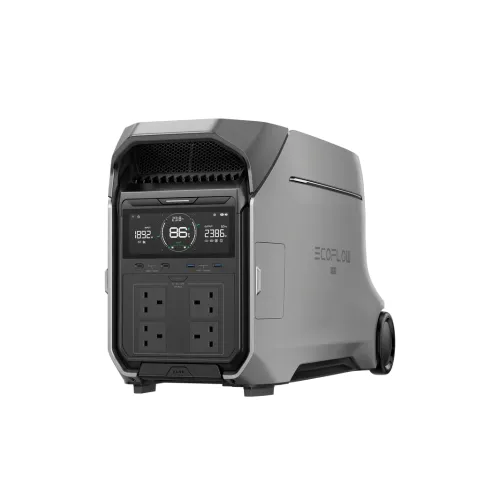
EcoFlow DELTA Pro 3
4,096Wh – 48kWh Modular • 4,000W AC • 120V/240V
- Zero-permit plug-and-play installation with rollable chassis
- Expandable up to 12kWh per console with smart extra batteries
- Sub-10ms automatic transfer switch for home backup
Check Best Price on Amazon →
1. EG4 LifePower4 V2 48V Server Rack (Best Modular Off-Grid Storage)
For off-grid cabins, workshops, and DIY homeowners building custom energy storage, the EG4 LifePower4 V2 is the industry standard. Each 19-inch rack-mount module packs 5,120 Watt-hours (51.2V 100Ah) into a rugged steel chassis. Featuring automotive-grade prismatic LiFePO4 cells rated for over 7,000 cycles, it includes closed-loop CAN/RS485 communications that seamlessly report state-of-charge to EG4, Sol-Ark, and Schneider inverters.
2. EG4 PowerPro 14.3kWh WallMount (Best High-Capacity Residential Bank)
If you want to eliminate server rack wiring and power heavy whole-home appliances, the EG4 PowerPro 14.3kWh WallMount delivers industrial power. With a massive 200-Amp continuous smart BMS, a single unit can deliver 10,240 Watts of continuous discharge power—effortlessly starting 3-ton central air conditioners, deep well pumps, and electric stoves without requiring multiple battery packs. Its NEMA 3R outdoor rating allows safe installation on an exterior wall.
3. EcoFlow DELTA Pro 3 Expandable Battery System (Best Zero-Wiring Modular System)
For homeowners who want substantial emergency backup without hiring an electrician to wire server racks, the EcoFlow DELTA Pro 3 provides modular simplicity. Starting at 4,096Wh of integrated LiFePO4 storage, you can plug in two 4kWh extra batteries to scale capacity to 12.28kWh in minutes. Its built-in 4,000W split-phase inverter outputs native 120V and 240V electricity directly to generator inlets or transfer switches.
Six Costly Battery Sizing Mistakes to Avoid
- Sizing for Storage (kWh) While Ignoring Discharge Power (kW): A battery bank must provide enough continuous amperage to handle your inverter’s maximum output. Always ensure your total battery BMS capacity () exceeds your inverter’s full-rated AC wattage.
- Forgetting Inverter Standby Tare Loss: An inverter consumes 25W to 55W continuously just being turned on. Over 24 hours, that is 600Wh to 1,300Wh of parasitic phantom drain that must be included in your energy audit.
- Designing a Massive 12V Battery Bank: Never build a 12V battery system larger than 2,500Wh. Pulling 2,500 Watts at 12V requires 250 Amps of DC current, creating severe voltage drop and requiring expensive 4/0 welding cables. Always transition to 48V for systems over 3kWh.
- Discharging Lead-Acid Below 50%: If you use AGM or lead-acid batteries, you only have access to 50% of their nameplate capacity. Discharging an AGM battery to 20% causes rapid cell sulfation, destroying the battery in under a year.
- Charging Lithium in Sub-Freezing Temperatures: Cold temperatures prevent lithium ions from diffusing into graphite anodes, resulting in metallic lithium plating and permanent capacity destruction. Always install batteries in conditioned spaces or specify packs with internal heating pads.
- Mixing Old and New Battery Packs: Adding a brand-new battery module to an older, 3-year-old battery bank causes current imbalances. The older pack has higher internal resistance, forcing the new pack to carry disproportionate charging and discharging loads.
Frequently Asked Questions (FAQ)
How many kilowatt-hours (kWh) of battery do I need for an off-grid home?
An average American household using conservative electrical habits (LED lighting, high-efficiency refrigerator, mini-split heat pump, and well pump) consumes approximately 10 to 15 kWh of electricity per day. To bridge a standard 2-day cloudy period with an 85% Depth-of-Discharge buffer, you need a 25 kWh to 35 kWh LiFePO4 battery bank (typically 5 to 7 server rack batteries or two 14.3kWh wall-mounted batteries).
What is the formula for converting Amp-hours (Ah) to Watt-hours (Wh)?
Energy in Watt-hours is calculated by multiplying battery capacity in Amp-hours by nominal voltage: For example, a 12V 100Ah battery contains , while a 48V 100Ah battery contains (four times as much energy!).
Why is 48V better than 12V for solar battery storage?
At equivalent wattage, increasing voltage from 12V to 48V reduces electrical current by 75% (). Because resistive wire heating and power loss are proportional to the square of current (), a 48V system reduces line losses by a factor of 16, runs significantly cooler, and uses lightweight, inexpensive 4 AWG wire instead of thick 4/0 AWG welding cables.
Can I expand my battery bank with more modules in the future?
Yes, especially if using 48V server rack batteries connected in parallel. Modern server rack batteries allow up to 16 modules to be connected in parallel on a single DC busbar with closed-loop communication. To ensure balanced cell aging, it is best to add expansion packs within the first 12 to 18 months of initial deployment.
