Lithium Iron Phosphate (LiFePO4 / LFP) has rightfully displaced legacy lead-acid and cobalt-based ternary NMC chemistries in solar energy storage. With chemical stability that resists thermal runaway up to 518°F (270°C) and an inherent lifespan rated at 3,000 to 5,000 full discharge cycles, a quality LiFePO4 battery should outlast a decade of daily off-grid cycling.
However, “durable” does not mean “indestructible.” In our battery testing facility, we frequently see lithium packs degrade to 70% state-of-health in under three years due to preventable configuration errors: over-aggressive float voltages, continuous 100% SoC float saturation, and unmonitored sub-freezing charging.
By applying three straightforward electrical calibration adjustments, you can easily extend your battery pack’s usable life from 10 years to over 18 years.
Set your solar charge controller’s absorption voltage to 14.0V for 12V packs (3.50V/cell) or 56.0V for 48V packs with a 30-minute absorption timer, and set float voltage to 13.4V (53.6V for 48V). This avoids the high-voltage electrolyte decomposition zone while harvesting 98% of total rated Amp-hours.
The Voltage Knee Curve: Why 3.65V/Cell Degrades Cathodes
Standard LiFePO4 cells have a nominal voltage of 3.2V. During charging, their voltage profile features an exceptionally flat plateau between 3.25V and 3.35V where roughly 80% of energy is absorbed. Once the cell reaches 95% capacity, the voltage shoots upward almost vertically into what engineers call the “Upper Voltage Knee”:
- Manufacturer Spec Sheet Limit: 3.65V per cell (14.6V for 12V / 58.4V for 48V).
- The Physical Reality: A cell at 3.45V is already at 96% state-of-charge. Pushing voltage from 3.45V to 3.65V only adds roughly 2% to 3% additional energy, but subjects the internal cathode lattice and solid electrolyte interphase (SEI) layer to severe electrochemical oxidation stress.
| Absorption Target (Per Cell) | 12V / 48V Bank Voltage | Usable Capacity Harvested | Estimated Cycle Life |
|---|---|---|---|
| 3.65 V / cell (Aggressive) | 14.6 V / 58.4 V | 100.0% | 2,500 – 3,500 Cycles |
| 3.55 V / cell (Standard) | 14.2 V / 56.8 V | 99.0% | 4,000 – 5,000 Cycles |
| 3.45 V – 3.50 V / cell (Optimal) | 13.8 V – 14.0 V / 55.2 V – 56.0 V | 97.5% – 98.5% | 7,000+ Cycles (18+ Years) |
By dropping your daily absorption target from 3.65V to 3.50V, you sacrifice a negligible 1.5% of battery runtime while more than doubling the cycle lifespan of your investment.
Managing Charge and Discharge C-Rates
A battery’s C-Rate expresses the speed of charge or discharge relative to its maximum capacity:
For example, drawing 50 Amps from a 100Ah battery equals a discharge rate of . Drawing 100 Amps equals .
While quality LiFePO4 cells can deliver continuous output (and up to burst), sustained high C-rates cause internal resistive heating:
- Optimal Operating Range: Keep continuous charge and discharge rates between and . For a 48V 100Ah server rack battery (EG4 LifePower4 v2), this means charging at 20A to 50A.
- The Multi-Pack Advantage: If your home inverter draws 6,000W continuously ( at 48V), running a single 100Ah battery forces it to endure a grueling rate. Paralleling two or three batteries splits that current across multiple packs, dropping the individual load down to a gentle per battery.
Sub-Freezing Charging: The Irreversible Plating Trap
The single fastest way to destroy a Lithium Iron Phosphate battery is attempting to recharge it when cell internal temperature is below 32°F (0°C).
While LiFePO4 batteries can safely discharge down to -4°F (-20°C) with minor capacity loss, charging at freezing temperatures alters the internal electrochemistry:
- At sub-freezing temperatures, the diffusion rate of lithium ions through the carbon/graphite anode slows down dramatically.
- When charging current is applied, lithium ions cannot intercalate into the graphite crystal structure fast enough.
- Instead of intercalating cleanly, the ions accumulate on the surface of the anode as solid metallic lithium plating.
- Over repeated cold charging cycles, microscopic needle-like metallic spikes called dendrites grow across the liquid electrolyte separator until they physically puncture the cathode, causing a permanent internal dead short.
Protection Protocol:
- Ensure your Battery Management System (BMS) includes Low-Temperature Charge Cutoff Protection set to 32°F (0°C).
- If your system operates in cold sheds or unheated vans, invest in heated battery modules with internal thermal wrap pads (such as EG4 LL-S Heated or Bluetti AC200L) that warm the cells to 41°F (5°C) before accepting solar current.
Off-Season Storage Protocol (The 50% SoC Rule)
Many solar power station and battery owners store their equipment incorrectly between camping seasons or power outages:
| Storage Mistake | Degradation Mechanism | Correct Protocol |
|---|---|---|
| Stored at 100% Full Charge | High internal cell stress accelerates calendar aging by 3x. | Discharge to 50% SoC (3.28V – 3.30V per cell). |
| Stored at 0% Flat Dead | Parasitic BMS drain drops cells below 2.0V, permanently bricking pack. | Top up to 50% every 4 to 6 months. |
| Stored in Hot Attic (>100°F) | Elevated temperature exponentially increases electrolyte dry-out. | Store in a dry, cool room between 50°F and 70°F (10°C–21°C). |
Preventing BMS Parasitic Tare Drain During Storage
Every modern lithium battery contains an active electronic Battery Management System (BMS) microprocessor that continuously monitors individual cell voltages, temperature sensors, and Bluetooth/CAN communications. This board consumes between 10mA and 50mA of parasitic power 24 hours a day.
Over a 6-month winter storage window, this tiny trickle drain can exhaust 15% to 30% of a battery pack’s remaining reserves. If you put a battery into storage at 15% state-of-charge, the BMS parasitic draw will eventually drag individual cell voltages down below the critical 2.0V safety floor. When cell voltage collapses below 2.0V, the copper substrate dissolves into the electrolyte, and the BMS permanently locks out the pack into an unrecoverable “bricked” state.
Action Steps for Long-Term Storage:
- Discharge or charge the pack to 50% State of Charge.
- Physically switch off the battery’s integrated breaker or BMS soft-power toggle.
- Disconnect the main positive battery cable to eliminate external parasitic inverter drains.
- Set a recurring smartphone calendar reminder every 90 days to verify resting voltage.
Recommended Cold-Weather & Long-Life LiFePO4 Equipment
Investing in batteries with built-in thermal management prevents cold-charging damage automatically:

EG4 LL-S 48V 100Ah Server Rack Battery
Engineered for harsh ambient conditions with an integrated internal heating pad that automatically warms cells before accepting charge below 32°F. Rated for 7,000+ cycles at 80% DoD with closed-loop inverter communications.
- • Capacity: 5,120Wh (51.2V nominal)
- • Low-Temp Protection: Built-in 32°F heating pad
- • Cycle Life: 7,000+ cycles to 80% capacity
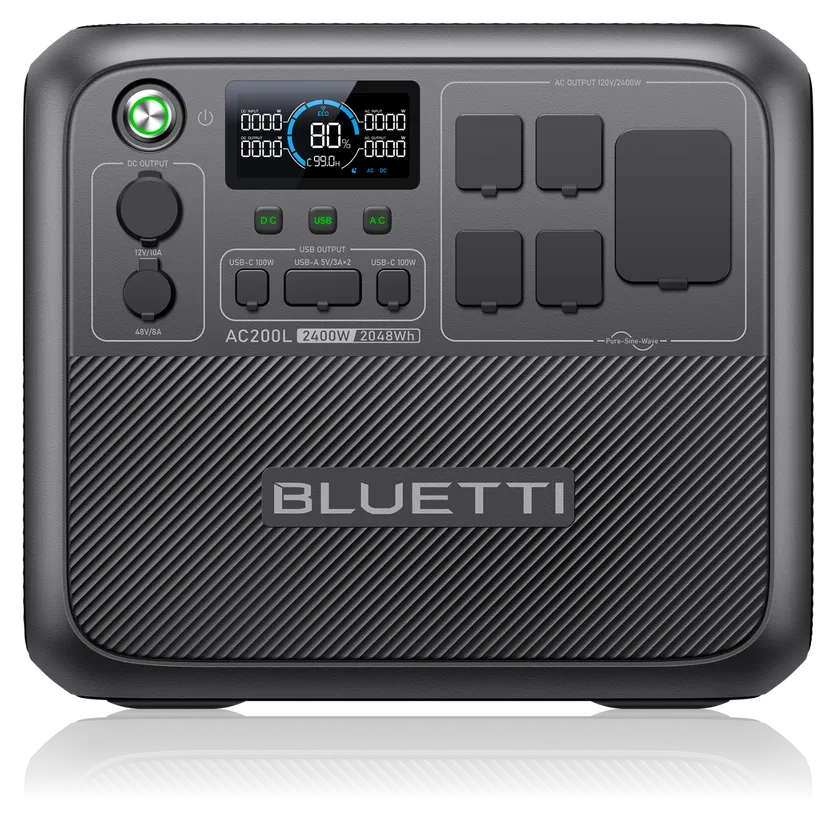
Bluetti AC200L (2,048Wh LiFePO4)
Equipped with EV-grade LiFePO4 cells delivering 3,000+ cycles to 80% retention. Intelligent BMS temperature sensor arrays prevent sub-zero charging, and customizable app charging limits allow you to cap charging at 80% SoC for daily cycling.
- • Continuous Inverter: 2,400W pure sine wave
- • Solar MPPT: 1,200W fast input
- • Battery Chemistry: LiFePO4 with active temp cutoffs
Summary: LiFePO4 Longevity Checklist
- Lower Absorption Voltage: Set charging profiles to 14.0V (12V) or 56.0V (48V).
- Limit Float Voltage: Float at 13.4V (53.6V) to prevent continuous high-pressure stress.
- Operate at Moderate C-Rates: Size battery bank so continuous discharge remains under 0.5C.
- Verify Low-Temp Protection: Never permit charging below 32°F (0°C).
- Store at 50% State-of-Charge: Keep resting cells between 50°F and 70°F away from direct heat.
Frequently Asked Questions
Can I leave my LiFePO4 battery plugged into a solar charger all winter?
Yes, provided your charge controller has an active temperature sensor with a low-temperature charge cutoff set to 32°F (0°C), or your battery has internal heating elements. If the battery is in an unheated location and lacks low-temp protection, you must disconnect the solar charger to prevent irreversible metallic lithium plating during freezing temperatures.
Is it better to store a LiFePO4 battery at 100% or 50%?
Always store LiFePO4 batteries at approximately 50% state of charge (3.28V to 3.30V per cell) for periods exceeding one month. Storing lithium cells at 100% full charge subjects the internal cathode lattice to continuous mechanical stress and accelerates calendar aging by up to three times compared to storage at 50% SoC.
At what voltage is a 12V LiFePO4 battery fully charged?
A 12V LiFePO4 battery reaches full charge between 14.2V and 14.6V (3.55V to 3.65V per cell) during the absorption phase. Once charging terminates and surface charge settles, resting full voltage sits between 13.4V and 13.6V (3.35V to 3.40V per cell). Lowering your daily absorption target to 14.0V–14.2V achieves 99% capacity while greatly reducing cell degradation.
Why does charging below freezing destroy lithium batteries?
At temperatures below 32°F (0°C), the mobility of lithium ions through the electrolyte slows dramatically. When a charging current is applied, ions cannot cleanly intercalate into the graphite anode. Instead, they deposit onto the anode surface as solid metallic lithium. Over time, these form sharp metallic dendrites that puncture the separator, causing a catastrophic internal short circuit.
