When designing a solar power installation, your very first engineering decision dictates every component you will purchase: Which fundamental system architecture fits your property, budget, and energy goals?
Too many homeowners mistakenly believe that installing rooftop solar panels automatically gives them emergency power when the neighborhood blackout strikes. In reality, standard grid-tied systems immediately power off when the grid fails, leaving you in total darkness unless you have engineered battery isolation into your electrical infrastructure.
Today’s photovoltaic landscape is divided into four distinct system architectures:
- Grid-Tied (On-Grid / String & Micro-inverters)
- Hybrid Grid-Tied with Battery Backup (Energy Storage Systems / ESS)
- Dedicated Off-Grid Islanded Systems (Homesteads & Cabins)
- DC-Coupled vs. AC-Coupled Microgrid Architectures
Below, we audit each system’s electrical topology, equipment costs, permitting requirements, and blackout resilience so you can engineer the ideal solution for your home.
If your priority is lowest upfront cost and maximizing financial utility bill savings under favorable net metering (NEM), a standard Grid-Tied system is ideal. If you want financial savings plus automatic storm outage protection, a Hybrid System with LiFePO4 batteries is the modern residential benchmark. If you are building miles away from utility power lines, an Off-Grid System with a dedicated generator input is your sole self-sufficient path.
Technical Comparison of the 4 Solar Architectures Not sure which system architecture matches your budget and emergency needs? Take our interactive Off-Grid Solar Backup Power Quiz for personalized sizing advice.
| Architecture | Grid Interconnection | Blackout Functionality | Battery Bank | Typical Round-Trip Efficiency | Relative Equipment Cost |
|---|---|---|---|---|---|
| 1. Standard Grid-Tied | Yes (Net Metering) | Zero Power (Shuts Down) | None | 96% – 98% | $ (Lowest Cost) |
| 2. Hybrid with Battery | Yes (Net Metering + TOU) | Automatic UPS Backup | Yes (10kWh – 30kWh) | 88% – 92% | $$$ (Medium-High) |
| 3. True Off-Grid | No (100% Autonomous) | Continuous Power | Large (15kWh – 60kWh) | 85% – 90% | $$$$ (High Storage Cost) |
| 4. DC-Coupled Microgrid | Optional (Grid or Off-Grid) | Continuous Power | Yes (48V Server Rack / LFP) | 92% – 95% | $$$ (High Efficiency) |
Grid-Tied Systems: Maximum Financial ROI, Zero Emergency Power Learn how grid export billing has evolved from traditional compensation to avoided-cost tariffs in our complete Net Metering & NEM Billing Guide. For current conversion fundamentals, see AC vs DC Power in Solar Systems Explained.
A Grid-Tied Solar System (also known as on-grid or grid-direct) is the most widespread residential solar installation in North America and Europe. High-voltage DC electricity from rooftop panels passes through either a central string inverter or individual micro-inverters mounted under each panel, converting solar power into utility-matched 240V AC.
The Anti-Islanding Reality (UL 1741)
When the municipal utility grid goes down due to fallen tree limbs or equipment failure, utility lineworkers must physically service high-voltage neighborhood distribution wires. If thousands of residential rooftop solar arrays continued pumping AC power back into the local grid, lineworkers would face fatal electrocution risks.
To prevent this, the National Electrical Code (NEC Article 690.12) and UL 1741 standards require all grid-tied inverters to disconnect within 100 milliseconds of losing grid voltage. Unless you have a specialized transfer switch and physical battery storage, a standard grid-tied system will never provide emergency blackout power.
- Best For: Suburban homeowners with reliable electric grids seeking minimum payback periods under 1:1 net metering.
- Trade-Off: Zero resilience during severe storms, hurricanes, or rolling brownouts.
Hybrid Solar Systems: The Modern Residential Benchmark
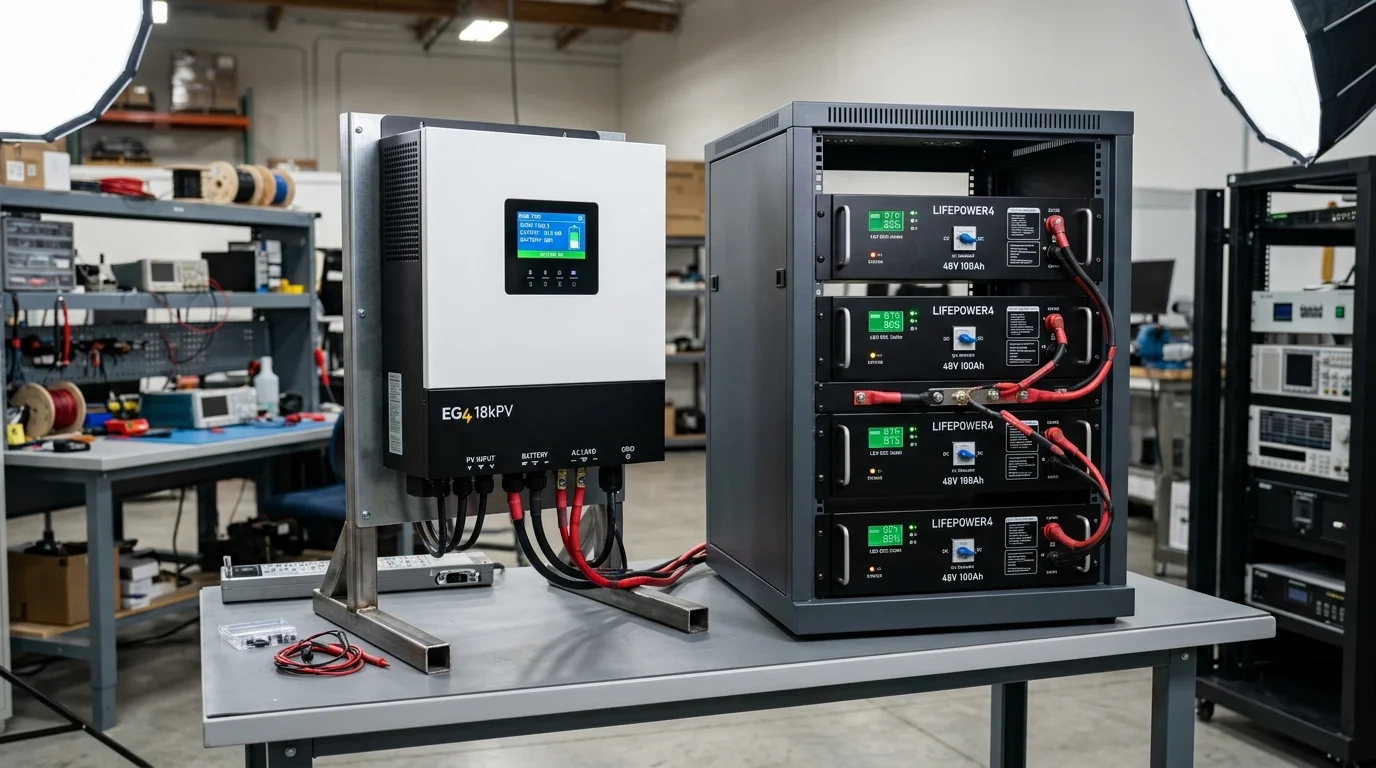
A Hybrid Solar System (or Grid-Tied with Energy Storage) combines grid interconnection with a dedicated Lithium Iron Phosphate (LiFePO4) battery bank and an intelligent automatic transfer switch (ATS) or smart electrical panel.
During normal grid operation, the hybrid inverter (such as the Sol-Ark 15K or EG4 18kPV evaluated in our Best Batteries & Inverters Guide) performs two functions:
- Self-Consumption & Peak Shaving: Storing cheap excess daytime solar in your battery bank and discharging it during peak utility evening hours ( Time-of-Use rates) to slash electric bills.
- Net Energy Metering: Exporting surplus generation back to the utility once batteries reach 100% State of Charge (SOC).
The Blackout Transition: Fast UPS Switching
When utility grid voltage drops, the hybrid inverter’s integrated high-speed contactor physically opens within 10 to 20 milliseconds, completely disconnecting your house from the grid (islanding). It instantly routes solar power and stored battery energy to your home’s critical loads subpanel without dropping desktop computers or Wi-Fi routers.
To understand the electrical safety and transfer switch wiring required, see our comparison on Transfer Switch vs. Interlock Kit for Home Backup.
Dedicated Off-Grid Systems: 100% Autonomy & Self-Reliance
For remote homesteads, off-grid cabins, and rural properties where utility grid extension quotes exceed 80,000, a Dedicated Off-Grid Solar System is the premier choice.
Off-grid systems have zero physical electrical connection to utility poles. Because there is no electrical grid to lean on during 4-day winter blizzard spells, off-grid systems must be engineered around three critical design tenets:
- Autonomy Factor (Days of Storage): The battery bank must store enough usable energy to sustain essential baseline household loads for 2 to 3 consecutive sunless days without discharging below safe thresholds.
- DC-to-AC Array Oversizing: Sizing the solar array with a high Inverter Loading Ratio (ILR 1.30 to 1.45) so panels produce sufficient energy even under overcast diffuse winter skies. See our guide on How to Size a Solar Inverter.
- Automated Generator Integration (Auto-Start / AGS): A dual-fuel propane/gas inverter generator wired directly into the inverter’s AC auxiliary input to charge batteries automatically when battery voltage falls below critical thresholds.
For battery bank sizing, review our deep-dive on The 80% DoD Rule in LiFePO4 Cells and Best Server Rack Batteries Reviewed.
DC-Coupled vs. AC-Coupled Architectures
When integrating solar panels with energy storage, the electrical current path dictates system efficiency and equipment costs.
Solar panels generate DC power, which flows directly into an MPPT charge controller to charge a 48V DC battery bank without conversion. Power is converted from DC to AC only once, when household appliances demand electricity.
Path: PV (DC) → MPPT → Battery (DC) → Inverter → Loads (AC)
Best For: Off-grid systems, new hybrid builds, whole-home battery stations.
Solar panels feed micro-inverters that immediately convert power to 240V AC. To store that energy in a battery, a secondary battery inverter must rectify AC back into DC, and later invert DC back to AC when running appliances.
Path: PV (DC) → Microinverter (AC) → Rectifier (DC) → Battery → Inverter (AC)
Best For: Retrofitting battery storage onto existing rooftop grid-tied arrays.
For portable and modular home power stations like the Anker SOLIX F3800 and EcoFlow DELTA Pro Ultra evaluated in our Best Big Power Stations for Home Backup, DC-coupling is used internally, yielding superior round-trip solar charging efficiency.
Decision Matrix: Which System Should You Choose?
- Choose Grid-Tied If: You live in a suburban neighborhood with strict HOA rules, zero blackout occurrences, and 1:1 net metering, aiming for the fastest 5-to-7-year equipment payback.
- Choose Hybrid If: You experience storm power outages, face punishing peak Time-of-Use utility rate structures, and want seamless whole-house backup without a noisy gas generator.
- Choose Off-Grid If: You live on rural land, a tiny house on wheels, or an off-grid homestead beyond the reach of municipal utility electrical grids.
Frequently Asked Questions (FAQ)
Can I add batteries to an existing grid-tied solar system later?
Yes. You can add battery storage to an existing grid-tied installation using AC coupling. A storage system (such as Tesla Powerwall or an AC-coupled battery inverter) connects directly into your existing electrical subpanel, capturing surplus AC solar generation to charge batteries during the day.
Do off-grid solar systems work during consecutive cloudy days?
Yes, provided your battery storage and array are sized with adequate reserve capacity. A well-designed off-grid system includes 2 to 3 days of autonomy (battery reserves) and is paired with a backup dual-fuel inverter generator that charges the battery bank automatically during extended winter storms.
What is the typical lifespan of a hybrid solar battery bank?
Modern Lithium Iron Phosphate (LiFePO4) solar batteries last between 3,500 and 6,000 full charge-discharge cycles before declining to 80% capacity. In typical residential daily cycling applications, this equates to 12 to 18 years of dependable operational life, far outlasting legacy lead-acid or AGM batteries.
Is a hybrid solar system more expensive than a grid-tied system?
Yes. A hybrid system includes the cost of LiFePO4 battery modules (typically $3,000 to $10,000 depending on kWh capacity) and an automatic transfer switch or smart panel. However, hybrid systems protect against utility rate hikes and provide invaluable emergency power security during extended grid blackouts.