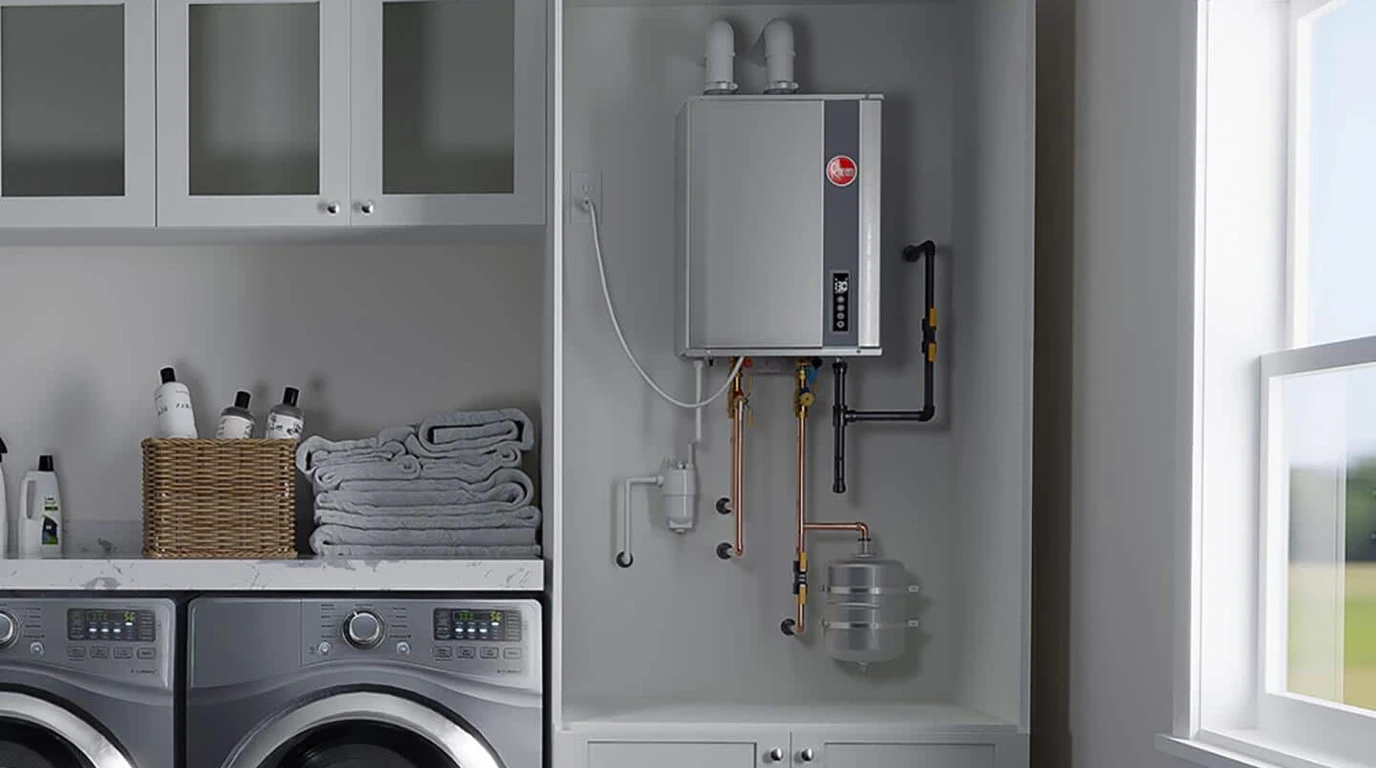
Among DIY builders, homesteaders, and off-grid cabin owners, the desire to install an electric on-demand tankless water heater is easy to understand. Modern tankless units like the EcoSmart 27, Stiebel Eltron Tempra 24 Plus, or Rheem RTEX-27 are compact, wall-mounted, visually sleek, and promise endless hot water without wasting standby energy keeping a massive 50-gallon tank warm.
When transitioning from a suburban grid-tied house to an off-grid solar homestead, many builders naturally assume that swapping out their bulky old tank for a modern electric tankless heater is an energy-saving upgrade.
In reality, installing a whole-home electric tankless water heater on an off-grid solar system is one of the most financially catastrophic and electrically destructive engineering mistakes a builder can make.
In this technical breakdown, the GridSpecLab engineering team calculates the physics of on-demand fluid heating, demonstrates why an electric tankless unit forces you to massively oversize your inverters and battery bank, and details three vastly superior alternatives for off-grid hot water.
An electric tankless water heater does not save energy off-grid—it converts manageable, continuous thermal heating into an extreme 27,000 Watt instantaneous power spike. Powering this massive surge requires paralleling three commercial hybrid inverters (e.g., three Sol-Ark 15Ks) and at least 30kWh of 48V LiFePO4 batteries just to survive a morning shower. Replacing the tankless unit with a hybrid heat pump water heater (consuming only 450W) or a propane on-demand unit saves over $16,000 in capital expenditures on inverters, copper wire, and battery storage.
Compare Hybrid Heat Pumps on Solar →
The Brutal Thermodynamics of Whole-Home Electric Tankless Heating
To understand why electric tankless water heaters break off-grid electrical systems, one must look at the immutable laws of fluid thermodynamics.
Water has an extraordinarily high specific heat capacity ( or ). Because a tankless water heater has no storage reservoir, it must flash-heat cold groundwater up to comfortable shower temperatures in the exact fraction of a second that the water flows across its bare heating elements.
+-----------------------------------------------------------------------------------------+
|                  INSTANTANEOUS FLUID HEATING THERMODYNAMIC EQUATION                     |
+-----------------------------------------------------------------------------------------+
|                                                                                         |
|       Required Power (kW) = GPM x Temperature Rise (°F) x 0.147                         |
|                                                                                         |
|       Where:                                                                            |
|       - GPM = Water Flow Rate in Gallons Per Minute                                     |
|       - Temperature Rise = Target Temperature (120°F) - Incoming Ground Water Temp      |
|       - 0.147 = Unit Conversion Constant (8.33 lb/gal x 60 min/hr / 3,412 BTU/kWh)     |
|                                                                                         |
+-----------------------------------------------------------------------------------------+
Calculating Instantaneous Power Demand from Flow Rate and Temperature Delta
Consider a standard domestic shower head delivering a modest flow rate of 2.5 Gallons Per Minute (GPM):
- In temperate or northern climates (or mountain homesteads), incoming winter well water or municipal supply water enters the building at 45°F (7.2°C).
- Standard domestic hot water must reach 120°F (48.9°C) at the fixture to compensate for plumbing pipe losses and allow comfortable shower blending.
- The required temperature rise () is:
Plugging these parameters into the fluid power equation:
If a second fixture is opened—such as a kitchen faucet running at 1.5 GPM while someone is showering—the total flow rate climbs to 4.0 GPM, requiring an astonishing 44.1 Kilowatts of instantaneous electric power.
+-----------------------------------------------------------------------------------------+
|                  REQUIRED INSTANTANEOUS HEATING POWER (KILOWATTS) BY GROUNDWATER TEMP   |
+-----------------------------------------------------------------------------------------+
| Flow Rate (GPM) | Deep Well (40°F) | Cold North (45°F) | Moderate (55°F) | Warm South (65°F) |
| :---:           | :---:            | :---:             | :---:           | :---:             |
| 1.5 GPM (Sink)  | 17.6 kW          | 16.5 kW           | 14.3 kW         | 12.1 kW           |
| 2.5 GPM (Shower)| 29.4 kW          | 27.6 kW           | 23.9 kW         | 20.2 kW           |
| 3.5 GPM (Dual)  | 41.2 kW          | 38.6 kW           | 33.4 kW         | 28.3 kW           |
| 4.5 GPM (Whole) | 52.9 kW          | 49.6 kW           | 43.0 kW         | 36.4 kW           |
+-----------------------------------------------------------------------------------------+
Electrical Service Panel Impact: Triple Double-Pole Circuit Breakers
In an on-grid suburban home, an electric utility provider connects your home to a 200-Ampere service transformer mounted on a street pole, providing virtually unlimited grid capacity to absorb massive current pulses.
To deliver 27,000 Watts at 240 Volts split-phase, the EcoSmart 27 draws:
To comply with the National Electrical Code (NEC Article 422), continuous water heating loads must be protected at 125% of full-load amperage:
Because standard residential double-pole circuit breakers rarely exceed 60 Amps, electric tankless units contain three separate internal heating chambers. An EcoSmart 27 requires:
- Three separate 40-Amp double-pole circuit breakers occupying six full breaker slots in the distribution panel.
- Three independent runs of heavy 8/2 AWG NM-B Romex copper cable routed through framing studs to the unit.
- A main electrical panel rated for at least 200 Amps exclusively dedicated to water heating.
Inverter and Battery Bank Sizing Catastrophe for a Ten-Minute Shower
While a utility grid can deliver 112.5 Amps without flinching, generating that power autonomously through off-grid inverters and low-voltage lithium batteries is an engineering nightmare.
+-----------------------------------------------------------------------------------------+
|                  OFF-GRID HARDWARE REQUIRED TO RUN A SINGLE ELECTRIC TANKLESS HEATER    |
+-----------------------------------------------------------------------------------------+
|                                                                                         |
|   [48V 600Ah LiFePO4 Battery Bank] (Six 100Ah Server Racks = 30.7 kWh)                  |
|                  |                                                                      |
|                  +=====> 562.5 Amps DC Continuous Draw (Heavy 4/0 AWG Busbars)          |
|                  |                                                                      |
|                  v                                                                      |
|   [Paralleled Split-Phase Inverters]                                                    |
|   - Option A: THREE Sol-Ark 15K Hybrid Inverters ($21,000 Inverter Hardware)            |
|   - Option B: FIVE EG4 6000XP Off-Grid Inverters ($7,500 Inverter Hardware)             |
|                  |                                                                      |
|                  +=====> 27,000 Watts (112.5 Amps @ 240V AC)                            |
|                  |                                                                      |
|                  v                                                                      |
|   [EcoSmart 27 Electric Tankless Unit] ====> Delivers ONE 2.5 GPM Shower at 120°F       |
|                                                                                         |
+-----------------------------------------------------------------------------------------+
Stacking Multiple High-Capacity Inverters in Parallel Split-Phase Configuration
Most off-grid homesteads operate a single high-efficiency inverter-charger rated between 5,000 and 12,000 Watts (such as a Victron MultiPlus-II 5kVA, EG4 6000XP, or Sol-Ark 12K). This is more than enough continuous capacity to run a refrigerator, chest freezer, well pump, microwave, Starlink terminal, washing machine, and mini-split air conditioner simultaneously.
However, the moment a hot water faucet opens on an electric tankless heater, the instantaneous load jumps from 800W to 27,800 Watts:
- Sol-Ark 15K Inverters: A single Sol-Ark 15K outputs a maximum of 12,000W continuous off-grid. To support a 27kW tankless heater, you must purchase and parallel three Sol-Ark 15Ks (3 \times \7,000 = $21,000$) just to support the water heater.
- EG4 6000XP Inverters: An EG4 6000XP outputs 6,000W continuous. You must parallel five EG4 6000XP inverters (5 \times \1,400 = $7,000$) plus mounting hardware, external AC combiner subpanels, and parallel communication cables.
- Standby Tare Loss Penalty: Paralleling three to five large inverters dramatically increases your 24/7 idle tare loss. Five EG4 6000XPs consume approximately 250 Watts 24 hours a day just sitting powered on, burning 6.0 kilowatt-hours of battery energy every single day even when zero hot water is being used.
Battery Current Draw, C-Rate Stress, and Voltage Sag Lockouts
The catastrophic bottlenecks are not limited to the AC inverter. The direct current (DC) battery bank must supply that 27,000 Watts through a 48-Volt nominal bus:
Drawing 600 Amperes continuous direct current presents severe operational hazards:
- BMS Over-Current Tripping: Standard 48V 100Ah server rack LiFePO4 batteries (such as EG4 LifePower4, SOK, or Eco-Worthy) feature a 100A internal battery management system (BMS) with a continuous discharge limit of 100A (1C). If you connect fewer than six batteries in parallel, drawing 600A instantly triggers the BMS over-current protection into short-circuit latch-up mode, dropping the entire house into a blackout.
- Instantaneous Voltage Sag: Under a 600A discharge pulse, internal cell impedance () and cable resistance cause terminal voltage to plummet from 53.2V down to under 47.0V in milliseconds. This severe voltage sag frequently trips inverter low-DC cut-off alarms, shutting down power mid-shower.
- Massive Copper Infrastructure: Safely carrying 600 Amps DC requires dual runs of 4/0 AWG welding cable or heavy commercial solid copper busbars (), along with expensive 600A Class T fusing.
The Thermal Battery Principle: Why Insulated Tanks Beat Lithium Batteries
The fundamental engineering flaw of the electric tankless heater is that it forces your electrical system to match the exact instantaneous power demand of the end-use appliance.
A standard storage water heater takes the exact opposite approach: it decouples energy collection from energy consumption by using water as a thermal battery.
+-----------------------------------------------------------------------------------------+
|                  THERMAL WATER BATTERY VS CHEMICAL LITHIUM BATTERY COMPARISON           |
+-----------------------------------------------------------------------------------------+
| Attribute                     | 50-Gallon Water Tank (135°F) | 100Ah 48V LiFePO4 Battery|
| :---                          | :---                         | :---                     |
| Stored Usable Energy          | 12.3 Kilowatt-Hours Thermal  | 4.8 Kilowatt-Hours Elec  |
| Capital Hardware Cost         | $450 - $650                  | $1,100 - $1,400          |
| Cost Per kWh of Storage       | $40.00 / kWh                 | $250.00 / kWh            |
| Operational Cycle Life        | 15 - 20 Years (With Anode)   | 10 - 15 Years (4000 cyc) |
| Degradation from 100% Cycling | Zero Degradation             | Slight Capacity Loss     |
| Continuous Charging Rate      | 1,000W - 1,500W (Gentle)     | 2,500W Max               |
+-----------------------------------------------------------------------------------------+
Converting Solar Surplus into Stored Thermal Energy with Slow-Soak Elements
Heating 50 gallons of water from 50°F to 135°F requires approximately 10.4 kilowatt-hours of thermal energy:
Instead of attempting to deliver that 10.4 kWh in a violent 27kW burst over 23 minutes, an insulated storage tank allows you to trickle-charge that energy slowly over 6 to 8 hours using a low-power 1,000-Watt or 1,500-Watt immersion element:
- A 1,200-Watt element draws only 5.0 Amps AC at 240V (or 25A DC from a 48V battery bank).
- Any modest 3,000W off-grid inverter can power this load effortlessly in the background while still running kitchen appliances and laundry.
- Even better, this 1,200W load perfectly matches the midday generation curve of a standard 3kW to 6kW rooftop solar array. Surplus solar photons are stored as piping-hot water for evening showers with zero battery degradation.
Standby Heat Loss Reality and Modern Insulation Jackets
Advocates of tankless heaters often argue that standard tanks waste massive amounts of power through standby jacket losses.
While this was true for uninsulated water heaters manufactured in the 1980s, modern tanks compliant with Department of Energy (DOE) standards feature 2 to 3 inches of high-density injected polyurethane foam insulation.
A modern 50-gallon electric storage tank loses less than 0.8 to 1.2 kilowatt-hours per day in standby thermal dissipation. In an off-grid home, this tiny standby loss costs roughly $0.00 because it is replenished entirely by free midday solar surplus. Spending $16,000+ on extra inverters and batteries to eliminate a $0.00 standby loss is financial madness.
Practical and Cost-Effective Off-Grid Alternatives
If an electric tankless water heater is an off-grid failure, what should an off-grid builder install? There are three proven, highly efficient engineering solutions:
+-----------------------------------------------------------------------------------------+
|                  THREE SUPERIOR OFF-GRID WATER HEATING ARCHITECTURES                    |
+-----------------------------------------------------------------------------------------+
|                                                                                         |
| 1. HYBRID HEAT PUMP WATER HEATER (Rheem ProTerra / AO Smith Voltex)                     |
|    - Pure electric heat pump mode draws only 420W to 550W continuous                    |
|    - COP 3.8 to 4.2: Extracts heat from ambient garage or basement air                  |
|    - Runs on any standard 3,000W off-grid inverter with zero battery strain             |
|                                                                                         |
| 2. ON-DEMAND PROPANE TANKLESS HEATER (Rinnai / Camplux / Eccotemp)                      |
|    - Endless on-demand hot water without electrical inverter loading                    |
|    - Operates on two standard D-cell batteries for electronic ignition (0W AC draw)     |
|    - Consumes 15 to 25 gallons of propane annually for a two-person household           |
|                                                                                         |
| 3. SOLAR PV DUMP LOAD TO STANDARD RESIDENTIAL STORAGE TANK                              |
|    - Standard $450 electric tank retrofitted with low-wattage 1,500W element            |
|    - Diverter (e.g. Myenergi Eddi) routes excess solar directly to element              |
|    - Serves as a 12kWh thermal storage battery at $45 per kWh installed                 |
|                                                                                         |
+-----------------------------------------------------------------------------------------+
Hybrid Heat Pump Water Heaters: Vapor Compression Efficiency
For all-electric homesteads, the Hybrid Heat Pump Water Heater (such as the Rheem ProTerra or AO Smith Voltex) is the undisputed pinnacle of efficiency:
- Thermodynamic Magic (COP 3.8 to 4.2): Rather than generating heat through brute-force electrical resistance, a heat pump moves heat from the surrounding air into the water using a small vapor-compression refrigeration cycle. For every 1 kilowatt-hour of electricity consumed, it outputs up to 4.2 kilowatt-hours of thermal heat into the water.
- Tiny Inverter Footprint: In dedicated heat pump mode, the unit draws only 420 to 550 Watts of continuous power (roughly 2.2 Amps at 240V). A single entry-level 3,000W off-grid inverter can run the heat pump, well pump, and refrigerator simultaneously with plenty of headroom to spare.
- Built-in Dehumidification: As a secondary benefit, the heat pump naturally cools and dehumidifies damp basements or utility rooms.
On-Demand Propane Tankless Units: Zero Electrical Inverter Load
If you demand the endless hot water and compact wall-mounted footprint of a tankless heater, choose liquid propane (LP) instead of electricity:
- Zero AC Electrical Demand: High-efficiency off-grid propane tankless units (such as the Rinnai Sensei or off-grid Camplux models) utilize electronic pulse igniters powered by two standard D-cell alkaline batteries or a tiny 12V DC adapter drawing less than 15 Watts.
- Massive Energy Density: One gallon of propane contains 91,547 BTUs of chemical energy. A standard 180,000 BTU propane tankless heater effortlessly delivers 4.5 GPM of continuous hot water in sub-zero winter temperatures without requiring a single watt from your solar battery bank.
- Low Operating Cost: A family of two typically consumes only 1.5 to 2.5 gallons of propane per month for water heating, translating to an annual fuel cost under $80.
Pre-Heat Solar Buffer Tanks and Wood Stove Thermo-Siphon Loops
For off-grid cabins in northern latitudes, a dual-tank pre-heat architecture provides the ultimate resilience:
- Passive Pre-Heat Tank: An unpowered 40-gallon storage tank sits in the utility room, allowing cold 42°F well water to warm up to ambient room temperature (65°F) for free before entering the primary water heater. This pre-tempering cuts the required heating energy by nearly 30%.
- Wood Stove Thermo-Siphon Coil: In winter, a stainless steel heat exchanger coil installed in your wood stove circulates hot water into the tank via natural gravity thermo-siphon convection without requiring an electric circulation pump.
Electrical Architecture and Comprehensive Financial Comparison Table
To demonstrate the staggering economic disparity, the table below compares the complete installed hardware costs and electrical footprints of an electric tankless setup versus real-world off-grid alternatives for a typical homestead:
| System Parameter | 27kW Electric Tankless (EcoSmart 27) | Hybrid Heat Pump (Rheem ProTerra 50-Gal) | On-Demand Propane Tankless (Rinnai LP) | Standard Tank + Solar PV Diverter |
|---|---|---|---|---|
| Instantaneous Power Demand | 27,000 Watts (Peak) | 450 Watts (Heat Pump) | 0 Watts (Battery Ignited) | 1,200 Watts (Modulated) |
| AC Running Current (240V) | 112.5 Amperes | 1.88 Amperes | 0.0 Amperes | 5.0 Amperes |
| 48V DC Battery Current | 600 Amperes | 10 Amperes | 0 Amperes | 26 Amperes |
| Minimum Required Inverter | 3x Sol-Ark 15K (36kW) | 1x Victron MultiPlus-II (3kVA) | 1x Basic Inverter (2kW) | 1x EG4 6000XP (6kW) |
| Minimum 48V Battery Bank | 600Ah (30.7 kWh) | 100Ah (5.12 kWh) | 100Ah (5.12 kWh) | 200Ah (10.24 kWh) |
| Breaker Panel Requirement | Three 40A 2-Pole Breakers | Single 15A 2-Pole Breaker | None (Mechanical plumbing) | Single 15A 2-Pole Breaker |
| Dedicated Inverter Cost | $21,000 (3x Inverters) | $1,400 (Single Inverter) | $0 (Runs on Base System) | $1,400 (Single Inverter) |
| Dedicated Battery Bank Cost | $7,500 (6x Racks) | $1,250 (1x Rack) | $0 (Runs on Base System) | $2,500 (2x Racks) |
| Water Heating Appliance Cost | $550 | $1,800 | $950 | $450 (Tank) + $650 (Eddi) |
| Heavy Copper Cabling & Fuses | $850 | $95 | $60 | $120 |
| Total Hardware Cost | $29,900 | $4,545 | $1,010 (+ Propane Tank) | $5,120 |
| Capital Cost Difference | Baseline | Saves $25,355 | Saves $28,890 | Saves $24,780 |
Final Engineering Verdict and Homestead Selection Checklist
The engineering verdict is clear and definitive: Never install a whole-home electric tankless water heater on an off-grid solar power system.
Attempting to flash-heat water on-demand with electricity forces you to overbuild your solar inverter capacity by 400% to 600%, subjects your lithium battery bank to violent current spikes, increases idle tare loss 24 hours a day, and burns through tens of thousands of dollars in redundant electrical hardware.
Use this simple decision matrix to choose the ideal water heating technology for your off-grid property:
- Choose a Hybrid Heat Pump Water Heater if your homestead is 100% all-electric, you have an enclosed basement or garage with ambient air above 40°F, and you want the highest possible thermodynamic efficiency (COP 3.8+) using small 450W power draws.
- Choose an On-Demand Propane Tankless Heater if you want unlimited hot water, minimal physical space requirements, and zero electrical inverter footprint.
- Choose a Standard Insulated Storage Tank with a Solar Diverter if you want the lowest equipment cost, simple bulletproof mechanical reliability, and the ability to use hot water as a 12kWh thermal battery to store midday solar surplus.
Off-Grid Water Heating Architecture Guide
Compare real-world lab tear downs, power audits, and inverter compatibility benchmarks.
Explore Solar Water Heating Hub →