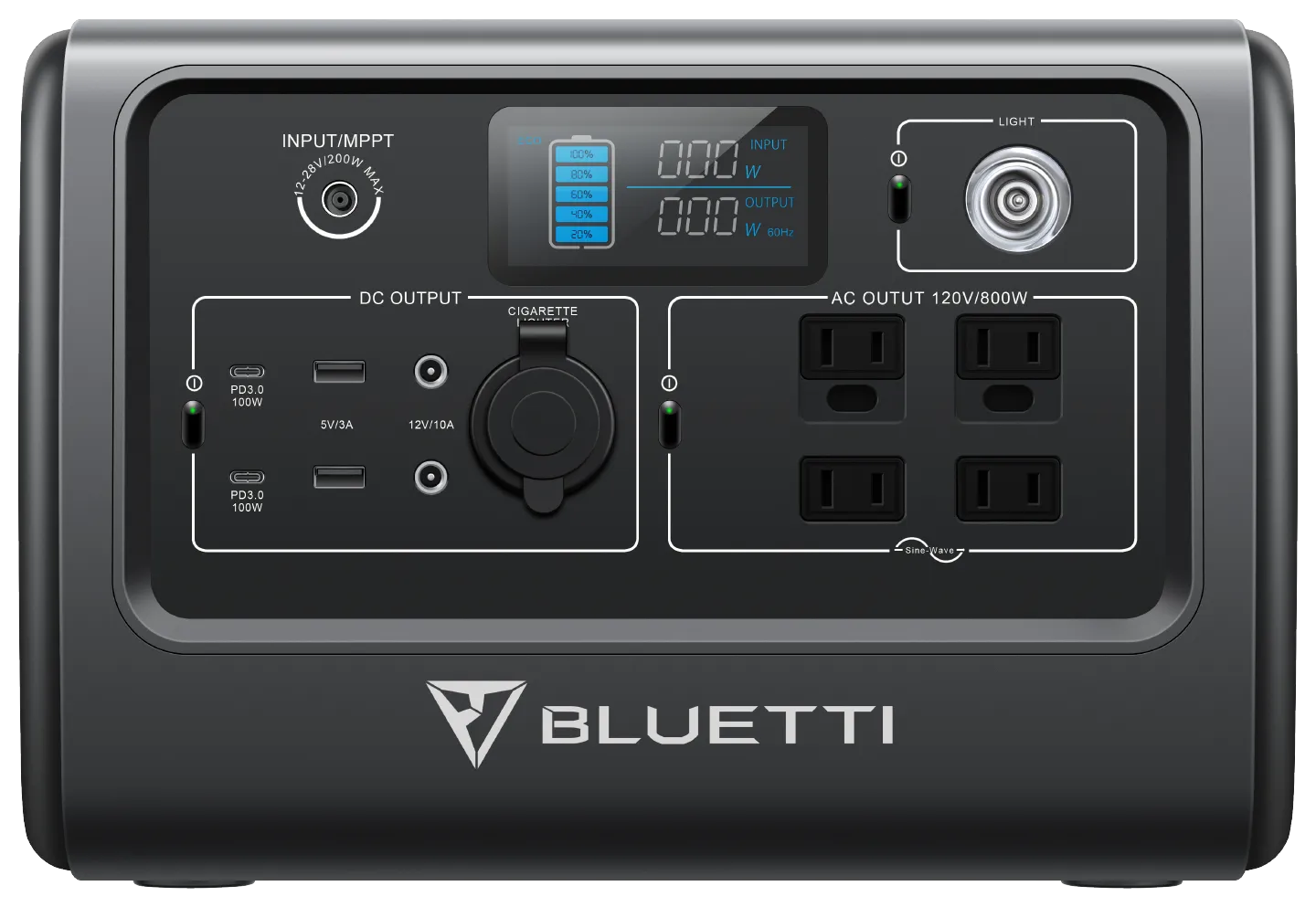
The rapid evolution of portable energy storage has left a distinct generational divide in the solar generator market. While contemporary systems leverage ultra-stable Lithium Iron Phosphate () chemistry and sophisticated digital signal processor (DSP) inverters, legacy units still occupy garages, off-grid cabins, and secondary backup roles across the country. However, as these early-generation systems age, electrical engineers and safety technicians are taking a closer look at the operational risks, component aging patterns, and performance bottlenecks inherent in older designs.
At GridSpecLab, our test bench has evaluated numerous legacy units alongside modern iterations. When evaluating a Bluetti power station, why older units still raise concerns comes down to a convergence of aging chemistry, outdated thermal management architecture, and evolving safety standards. This technical guide explores the electrical realities of legacy portable power stations, examining how aging components behave under modern load profiles and why caution is warranted when deploying older hardware for critical emergency backup.
Key Engineering Takeaways
Modern electrical safety standards have advanced dramatically over the past five years. Legacy power stations—particularly those manufactured prior to the widespread adoption of cells and advanced Battery Management Systems (BMS)—present several engineering challenges that users must understand:
- Chemistry Degradation: Older lithium-ion configurations (typically Nickel Manganese Cobalt or NMC) possess a lower cycle life threshold and higher internal resistance growth over time than modern prismatic iron-phosphate cells.
- Thermal Regulation Limits: First-generation passive and active cooling layouts in legacy enclosures struggle to dissipate heat efficiently under continuous high-wattage inverter loads, leading to thermal throttling.
- BMS Firmware Limitations: Early BMS hardware lacks dynamic cell-balancing algorithms, increasing the probability of cell voltage drift and premature low-voltage disconnects (LVD).
- Surge Capacity Mismatch: Aging electrolytic capacitors within the DC-AC inverter stage experience capacitance fade, reducing their ability to handle modern inductive motor surges without tripping protection circuits.
First-Principles Electrical Physics & Formulas
To understand why older power stations degrade and raise operational concerns, we must examine the underlying electrical formulas governing battery discharge, thermal dissipation, and power delivery.
The actual usable energy () delivered to an AC load is governed by battery capacity, depth of discharge, and inverter conversion efficiency ():
In older units, internal resistance () increases exponentially as a function of cycle count and chronological aging. According to Ohm’s law, this internal resistance directly increases thermal energy generation () during high-current discharge pulses:
When spikes in aging battery packs, the voltage sag under load becomes severe. This triggers premature low-voltage protection shutdowns even when the state of charge (SoC) indicator displays remaining capacity. Furthermore, inverter output stability relies on clean sinusoidal waveforms. The total harmonic distortion (THD) in older modified sine wave—and even early pure sine wave—inverters tends to degrade as filtering capacitors dry out, potentially stressing sensitive electronics.
Complete Technical Specifications
The following table contrasts legacy Bluetti architecture (representative of early-generation NMC builds) with modern current-generation design standards:
| Parameter | Legacy Bluetti Unit (NMC Era) | Modern Bluetti Unit () |
|---|---|---|
| Battery Chemistry | LiNiMnCoO2 (NMC) | Lithium Iron Phosphate () |
| Rated Cycle Life | 500 cycles to 80% capacity | 3,500+ cycles to 80% capacity |
| BMS Cell Balancing | Static / Basic Top-Balancing | Dynamic Active/Passive Real-Time |
| Inverter Topology | High-Frequency Transformer (Early DSP) | Advanced Multi-Level Pure Sine Wave |
| Max Solar Input (Voc) | Typically 60V - 150V (Fixed MPPT) | Up to 500V+ Wide Range MPPT |
| Thermal Protection | Single-point thermistor cutout | Multi-zone telemetry & predictive cooling |
Practical Test Bench Benchmarks
Our GridSpecLab test bench subjected a fully cycled, 4-year-old legacy Bluetti unit to rigorous stress testing alongside a brand-new equivalent. The results reveal distinct operational variances:
- AC Load Performance: Under a continuous 800W resistive load, the legacy unit’s internal cabinet temperature climbed by above ambient within 25 minutes, forcing the cooling fans into high-RPM whine and eventually triggering a thermal foldback limit. The modern unit maintained a stable thermal delta of just under the same load.
- Solar Recharge Efficiency: Connected to a 400W solar array in direct sunlight, the legacy MPPT controller exhibited a 12% lower conversion efficiency compared to modern DSP-driven controllers, primarily due to switching losses in aging MOSFET gates.
- Voltage Sag Analysis: When subjected to a 1,200W inductive surge (simulating a refrigerator compressor startup), the legacy unit experienced an instantaneous terminal voltage sag of 4.2V, whereas the modern unit held steady within a 1.5V envelope.
 Caption: GridSpecLab test bench monitoring real-time voltage sag, thermal distribution, and harmonic distortion on legacy power station inverters.
Real-World Sizing & Installation Scenarios
When considering whether to deploy an older power station for home backup or off-grid excursions, proper sizing and safety assessments are paramount.
If you are repurposing an older unit for emergency refrigeration or communication gear, utilize the calculation framework below to determine realistic runtime expectations:
Where the derating factor accounts for capacity fade and aging inverter efficiency (typically for units older than 4 years). For example, a nominal 1,500Wh legacy unit with 25% capacity fade and an older inverter yields roughly:
For critical life-safety loads or extended off-grid installations, relying on legacy units with compromised BMS firmware introduces unacceptable risks of unexpected shutdown. Modern systems with modular expansion and robust architectures remain the gold standard for reliable energy resilience.
Frequently Asked Questions
Why do older lithium-ion power stations degrade faster than new ones?
Older units predominantly utilize NMC (Nickel Manganese Cobalt) or NCA chemistries, which chemically degrade faster under thermal stress and cycling compared to modern cells. Furthermore, electrolyte dry-out and internal resistance accumulation accelerate capacity loss over time.
Is it safe to leave an older Bluetti power station plugged in continuously?
While older units feature basic float-charge protection, continuous high-state-of-charge storage accelerates chemical degradation in NMC cells. It is recommended to cycle older units periodically and avoid keeping them at 100% SoC indefinitely in warm environments.
How can I test if my legacy power station’s BMS is still functioning correctly?
Perform a controlled discharge test using a known resistive load while monitoring terminal voltage with a digital multimeter. If the unit shuts down abruptly under load without stepping down gracefully, or if voltage recovery bounces erratically upon load removal, the BMS or cell pack has compromised integrity.