Installing a residential solar energy system or whole-home battery backup is one of the most rewarding investments a homeowner can make. When engineered correctly, solar provides predictable, clean power at an effective levelized cost under 7¢ per kilowatt-hour, delivering total energy independence and complete blackout resilience.
However, the residential solar industry is riddled with predatory financing contracts, misleading sales pitches, and critical engineering oversights.
Every week at GridSpecLab, our technical team reviews design schematics and utility bills from frustrated homeowners who spent $20,000 to $40,000 on clean energy—only to discover their inverters trip on startup, their export credits are virtually worthless, or their property title is encumbered by a third-party financier.
To protect your home equity and maximize your clean energy return on investment (ROI), here are the four most catastrophic solar mistakes you cannot afford to make in 2026—and the precise engineering formulas to prevent them.
The four costliest solar mistakes are signing third-party escalator PPAs instead of owning your system, installing solar without battery storage under NEM 3.0 tariffs, neglecting cold-weather MPPT voltage limits, and failing to account for motor startup Locked Rotor Amps (LRA). Avoiding these four traps saves between $15,000 and $35,000 in unnecessary fees, blown components, and lost energy credits.
Explore Pre-Engineered Solar Packages →
Signing Escalating Solar PPAs and Third-Party Leases
The single most financially devastating mistake made by residential consumers is signing a Solar Power Purchase Agreement (PPA) or third-party solar lease promoted under the guise of “Zero-Down Solar.”
Under a PPA, a third-party financing corporation installs solar panels on your roof for zero upfront cash, and you agree to purchase the generated electricity for 20 to 25 years.
Almost all residential PPAs include an annual price escalator (typically 2.9% to 3.9%). While year-one rates look enticing (e.g. 16¢/kWh), the compounding math turns toxic over time:
Why PPAs Destroy Home Sales
When you enter a PPA, the solar corporation files a UCC-1 fixture financing statement (lien) against your property title. If you sell your home before the 25-year contract expires:
- The prospective buyer must submit credit applications to assume your remaining contract.
- If the buyer refuses to take over a contract with an escalating payment, you must pay an out-of-pocket cash buyout (typically between $15,000 and $30,000) from your sale proceeds at closing escrow.
- Crucially, the developer claims the lucrative 30% Federal Clean Energy Tax Credit (Section 25D), completely depriving you of thousands of dollars in federal incentives.
Solution: Always insist on direct ownership. Purchase your system via cash or a low-interest clean energy loan from a local credit union. You retain 100% of the 30% tax credit, add direct appraisal equity to your home, and keep a clean, unencumbered property title. Learn more in our complete exposé: What Is a Solar PPA? Pros & Cons Explained.
Going Solar-Only Under Avoided-Cost Net Billing (NEM 3.0)
For over fifteen years, the formula for residential solar was simple: put as many panels on your roof as possible, export excess daytime power to the grid for full 1-to-1 retail credit, and draw that power back at night for free.
Under modern utility tariffs—led by California’s Net Billing Tariff (NEM 3.0) and expanding across Arizona, North Carolina, and Hawaii—that era is officially dead.
- Midday Solar Export Credit: 5¢ to 8¢ / kWh (Avoided cost)
- Evening Peak Utility Draw (4pm–9pm): 45¢ to 58¢ / kWh
- Net Value Capture: You sell power at wholesale and repurchase your own electricity at an 800% markup.
- Financial Payback Period: 12 to 14 Years
Homeowners lose up to 75% of solar financial return.
- Midday Solar Routing: Diverted 100% into 48V home battery bank.
- Evening Discharge: Battery powers home during 48¢ peak hours.
- Grid Export: Minimal to zero exported to utility.
- Financial Payback Period: 6.5 to 7.8 Years + Blackout Defense
Captures 100% of solar value + full grid blackout security.
Solution: Never install solar panels in modern net-billing territories without an appropriately sized Energy Storage System (ESS). A 10kWh to 15kWh 48V LiFePO4 battery pack (such as EG4 LifePower4 or Tesla Powerwall) allows complete self-consumption arbitrage, protecting your solar investment from utility tariff suppression.
Ignoring Open-Circuit Voltage () Cold Weather Spikes
In the DIY solar community and among inexperienced installers, the most common hardware catastrophe is blowing the input charge controller on a freezing winter morning.
Every solar panel datasheet lists an Open-Circuit Voltage () evaluated at Standard Test Conditions (STC: 25°C / 77°F). However, photovoltaic silicon has a negative temperature coefficient: as ambient temperature drops, solar panel voltage increases.
To prevent destructive overvoltage, you must calculate the maximum voltage your array will produce at the lowest recorded historical temperature in your area:
V_max = Number of Series Panels × V_oc × [ 1 + ( Temperature Coefficient × ( T_min - 25°C ) ) ]
Real-World Disaster Scenario: A homeowner wires three 400W panels in series (each with a 40V nominal) into a charge controller rated for 130V maximum input. At 77°F, everything functions normally. But on a clear January morning when temperatures drop to 5°F (-15°C), panel voltage rises by roughly 12% to 134.4 Volts. The moment sunlight strikes the array, the input overvoltage protection trips—or internal MOSFET transistors burn out permanently.
Solution: Always maintain a minimum 15% to 20% safety margin between your maximum calculated cold-weather voltage and the charge controller’s maximum voltage ceiling ().
Undersizing Inverter Motor Inrush Surge Capacity
When sizing an off-grid or emergency backup inverter, many homeowners look only at the running wattage label of their household appliances:
- Full-Size Refrigerator: 150 Watts
- Deep Well Water Pump (1/2 HP): 850 Watts
- Sump Pump (1/3 HP): 600 Watts
A homeowner adds up these numbers (), purchases an inexpensive 2,000W continuous inverter, and assumes their home is fully prepared for an emergency outage.
Then the power grid fails, the well pump tries to cycle on, and the inverter immediately shuts down on overcurrent overload.
Locked Rotor Amperage (LRA)
When an inductive electric motor (refrigerator compressor, well pump, air conditioning blower) starts from a complete standstill, it has zero counter-electromotive force (CEMF). For the first 50 to 150 milliseconds, the motor draws between 300% and 600% of its normal running current.
A 850W well pump surges to over 4,500W to start.
Low-Frequency & High-Surge Inverters
Cheap high-frequency inverters can only sustain peak surge for 10 to 20 milliseconds before shutting down. To start inductive motors reliably, select heavy-duty low-frequency inverters or modern hybrid inverters (like EG4 18kPV or Sol-Ark 15K) equipped with 200% surge capacity for a full 5 to 10 seconds.
Effortlessly absorbs heavy inductive motor inrush.
Top Recommended High-Reliability Solar Hardware
To avoid these design traps, invest in pre-engineered equipment packages that feature built-in cold-temperature margins, pure sine wave power quality, and heavy motor surge capabilities:
1. Complete Pre-Wired Solar Kit: ShopSolar Grid-Tied / Off-Grid

ShopSolar Complete Home Solar Packages (5kW – 15kW)
Eliminates predatory PPA contracts and design mistakes. Includes Tier-1 bifacial panels, matched hybrid inverters with generous MPPT voltage windows, and full permit-ready single-line wiring diagrams.
Explore ShopSolar Packages →
2. High-Surge Whole-Home Inverter: EG4 18kPV
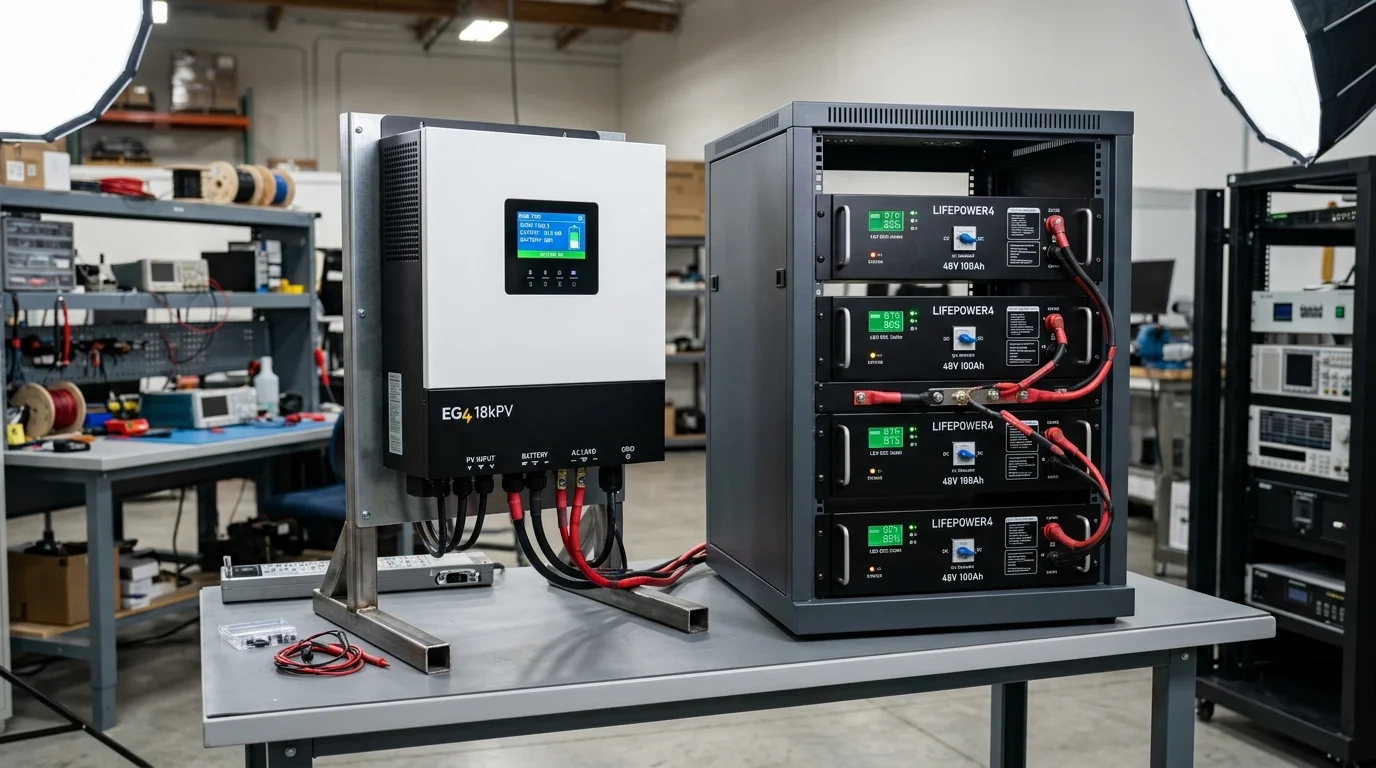
EG4 18kPV All-In-One Hybrid Inverter
Features a massive 12,000W continuous split-phase output that surges to 24,000W for 10 seconds, effortlessly starting 3-ton to 5-ton central air conditioning compressors and deep well pumps without soft-starter boxes.
Check EG4 18kPV Pricing →
Interactive Sizing and Runtime Calculators
Avoid under-sizing your equipment by testing your appliance wattages with our calibrated laboratory tools:
Simulate Real Appliance Runtimes with Inrush Surge
Input your emergency motor appliances (refrigerator, well pump, sump pump) to verify that your chosen inverter and battery capacity can withstand peak startup current.
Open Solar Generator Runtime Calculator →
Frequently Asked Questions (FAQ)
What is the difference between buying solar panels and a solar PPA?
When you buy solar panels (cash or loan), you own the physical asset, claim the uncapped 30% Federal Clean Energy Tax Credit, add direct resale equity to your home, and enjoy free electricity once the system pays for itself. Under a Solar PPA (Power Purchase Agreement), a third-party developer owns the panels on your roof, claims the tax credit, and charges you for the power generated with an annual price escalator (typically 2.9%), leaving you with a 25-year contractual lien on your property title.
Why do solar panels produce more voltage in cold weather?
Photovoltaic silicon cells operate on semiconductor bandgap physics. As ambient temperatures drop, thermal vibration in the silicon crystal lattice decreases, reducing electron recombination and allowing charge carriers to move more efficiently. This increases the open-circuit voltage () of the solar panel by roughly 0.25% to 0.35% per degree Celsius below standard test temperature (25°C / 77°F).
How can I tell if my well pump will trip my solar inverter?
Look at the metal specification plate on your well pump motor or pressure switch for the Locked Rotor Amps (LRA) rating. Multiply the LRA rating by the voltage (typically 240V for deep well pumps) to find the true startup surge wattage: . For example, an LRA rating of 25A requires of surge headroom for 100 milliseconds to start without tripping your inverter.
Can I add a battery to an existing solar system later?
Yes. You can add energy storage to an existing solar array using either AC-coupling (such as a Tesla Powerwall or Enphase IQ Battery connected on the 120V/240V AC side of your electrical panel) or by replacing your older string inverter with an advanced DC-coupled hybrid inverter (such as the EG4 18kPV or Sol-Ark 15K) that manages both your rooftop solar strings and 48V LiFePO4 batteries in one enclosure.
