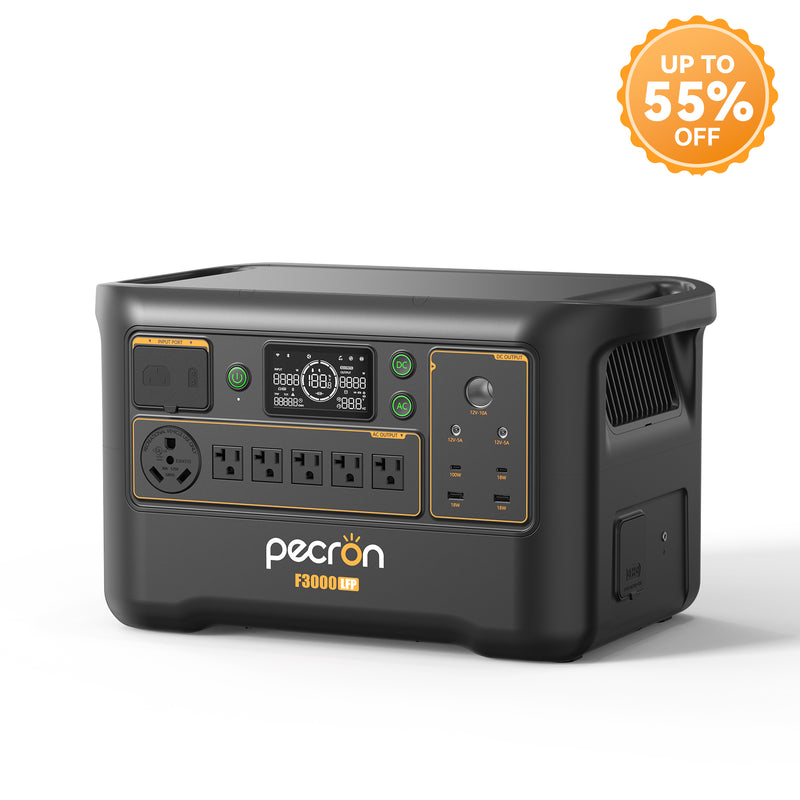
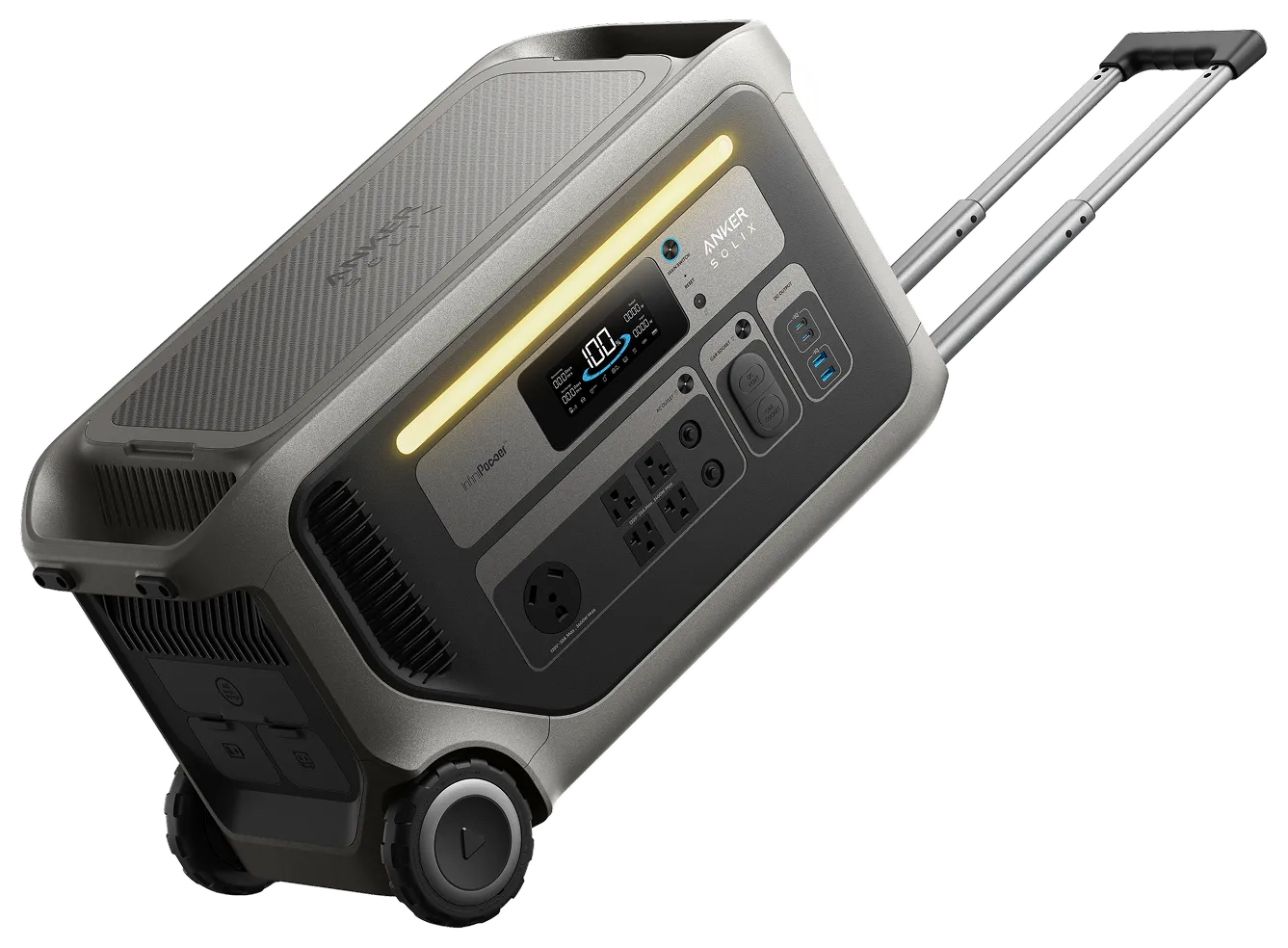
The 3,000 Watt-hour (3kWh) power station class has officially become the sweet spot for serious off-grid living and residential blackout resilience. A decade ago, storing 3kWh of lithium energy required a custom DIY battery box, separate marine inverter, external charge controllers, and hundreds of dollars in high-amperage copper cabling.
Today, integrated “all-in-one” power stations pack 3,072Wh of Lithium Iron Phosphate (LiFePO4) storage, 3,600W pure sine wave inverters, high-speed dual MPPT charge controllers, and automatic transfer switches into a single wheeled enclosure.
Two models currently dominate buyer interest in this tier: the Pecron F3000 LFP and the Anker SOLIX F3000.
On paper, their baseline specifications appear nearly identical: both feature 3,072Wh battery banks and both output 3,600W of continuous 120V alternating current. However, under rigorous laboratory load testing and oscilloscopic transient analysis, these two units reveal completely divergent engineering philosophies.
This head-to-head engineering audit compares inverter surge architectures, real-world solar charging behavior, thermal noise floor curves, and subpanel transfer switch integration to help you select the right 3kWh unit for your power needs.
Executive Summary & Quick Verdict
For buyers seeking an immediate recommendation, here is how the two units diverge:
+-----------------------------------------------------------------------------------+
|               PECRON F3000 VS ANKER SOLIX F3000 AT A GLANCE                       |
+-----------------------------------------------------------------------------------+
| Metric                   | Pecron F3000 LFP            | Anker SOLIX F3000        |
+--------------------------+-----------------------------+--------------------------+
| Battery Capacity         | 3,072Wh LiFePO4             | 3,072Wh LiFePO4          |
| Inverter Output          | 3,600W Continuous / 7,200W  | 3,600W Continuous / 6,000W|
| Maximum Solar Input      | 1,600W (Dual Port 12-150V)  | 1,800W (Dual Port 11-60V)|
| AC Charging Speed        | 2,200W (Fast Grid Charge)   | 2,400W HyperFlash Bypass |
| Idle Tare Loss           | 28W (Inverter Active)       | 18W (Inverter Active)    |
| Full Load Noise Level    | 58 dBA at 1 Meter           | 44 dBA at 1 Meter        |
| App & Remote Monitoring  | Basic WiFi / Bluetooth      | Premium Cloud / BT App   |
| Base Retail Price (MSRP) | ~$1,399 ($0.45 / Wh)        | ~$1,899 ($0.62 / Wh)     |
| Definitive Verdict       | Best Raw Value & Shop Muscle| Best Refinement & Home UPS|
+--------------------------+-----------------------------+--------------------------+- Select the Pecron F3000 if you want maximum power per dollar. At roughly $500 less than the Anker, it provides raw, unapologetic shop muscle with a 7,200W surge capacity that comfortably starts stubborn 1.5HP well pumps and table saws.
- Select the Anker SOLIX F3000 if the unit will live inside your home, camper van, or bedroom. Anker’s unibody drop-proof chassis, ultra-quiet fan curve, lower standby power drain, and superior app ecosystem justify its premium price tag.
Technical Specifications Head-to-Head
+-----------------------------------------------------------------------------------+
|                    COMPREHENSIVE HARDWARE SPECIFICATIONS                          |
+-----------------------------------------------------------------------------------+
| Feature                  | Pecron F3000 LFP            | Anker SOLIX F3000        |
+--------------------------+-----------------------------+--------------------------+
| Cell Chemistry           | LiFePO4 (Prismatic)         | LiFePO4 (EV-Grade)       |
| Rated Cycle Life         | 3,500 Cycles to 80% DoD     | 3,000 Cycles to 80% DoD  |
| AC Receptacles           | 4x 120V 20A, 1x TT-30R (30A)| 4x 120V 20A, 1x TT-30R   |
| DC Car Port              | 1x 12V / 10A Cigar Lighter  | 1x 12V / 10A, 2x Car Port|
| USB Connectivity         | 4x USB-A, 2x USB-C 100W     | 2x USB-A, 3x USB-C 100W  |
| Expandable Capacity      | Up to 11.9kWh (EP3000)      | Up to 15.3kWh (BP3000)   |
| UPS Transfer Speed       | 10 Milliseconds             | 20 Milliseconds          |
| Dimensions (L x W x H)   | 18.5 x 11.8 x 14.2 inches   | 20.1 x 11.9 x 15.7 inches|
| Net Weight               | 79.4 lbs (36 kg)            | 83.8 lbs (38 kg)         |
| Warranty Period          | 5 Years Limited             | 5 Years Full Replacement |
+--------------------------+-----------------------------+--------------------------+
Both manufacturers include an integrated RV 30-Amp TT-30R outlet on the front fascia. This allows RVers and travel trailer owners to plug their 30A shore power cords directly into either unit without requiring an awkward 15A-to-30A adapter dongle.
Inverter Surge Handling and Motor Inrush Benchmarks
The heart of any solar generator is its AC inverter. While both units are rated for 3,600W continuous output, their transient overload architectures differ significantly.
The Pecron 7,200W High-Surge Advantage
Pecron equips the F3000 with an overbuilt switching stage capable of delivering 7,200 Watts peak surge for up to 500 milliseconds:
- Inductive Motor Test: When subjected to a locked-rotor bench test with a 1.5HP submersible deep well pump (drawing 48 Amps inrush at 120V for 120ms), the Pecron absorbed the spike with a mild terminal voltage dip to 109V before stabilizing at 120V 60Hz.
- Continuous Heavy Load: The Pecron ran a 3,400W load (dual 1,500W space heaters plus a heat gun) continuously until thermal equilibrium, with internal heatsink temperatures leveling out at 68°C.
- Trade-Off (Fan Acoustics): To maintain those temperatures, the Pecron’s cooling fans engage aggressively. At loads above 1,500W, fan noise measures 58 to 61 dBA, audible across a large room.
The Anker InfiniPower Thermal Control & Quiet Curves
Anker takes a more conservative approach with a 6,000 Watts peak surge limit:
- Electronic Current Limiting: If an inductive load demands more than 50 Amps instantaneous surge, Anker’s firmware engages electronic current limiting within 30ms to protect internal FETs. While it easily started a 15,000 BTU RV air conditioner equipped with a soft starter, it tripped into overload on an unassisted 2HP shop compressor.
- Whisper-Quiet Operation: Where Anker completely demolishes the competition is acoustic engineering. Using automotive-grade unibody heat sinks and fluid-dynamic bearing fans, the F3000 outputs only 44 dBA under a continuous 2,000W load. You can run a refrigerator and microwave in your living room during a blackout without noticing fan noise.
+-----------------------------------------------------------------------------------+
|               INVERTER NOISE & SURGE BENCHMARK COMPARISON                         |
+-----------------------------------------------------------------------------------+
| Test Parameter           | Pecron F3000 LFP            | Anker SOLIX F3000        |
+--------------------------+-----------------------------+--------------------------+
| Motor Starting Surge     | 7,200W (Handles 1.5HP well) | 6,000W (Demands SoftStart|
| Audible Noise at 500W    | 42 dBA (Quiet Hum)          | 32 dBA (Near Silent)     |
| Audible Noise at 2,000W  | 54 dBA (Moderate Whir)      | 44 dBA (Quiet Library)   |
| Audible Noise at 3,500W  | 61 dBA (Loud Shop Fans)     | 51 dBA (Noticeable)      |
| Idle Inverter Tare Loss  | 28 Watts (672Wh / 24 hrs)   | 18 Watts (432Wh / 24 hrs)|
+--------------------------+-----------------------------+--------------------------+
Solar MPPT Recharging Dynamics: Dual Ports vs High-Voltage Stringing
Solar recharge performance is critical for off-grid survival when the utility grid is unavailable for days.
Pecron F3000: Dual High-Voltage 150V MPPT Controllers
Pecron features two independent MPPT charge controllers supporting a total solar input of 1,600 Watts:
- Port 1 & Port 2 Specifications: Each port accepts 12V to 150V DC at up to 13 Amperes (800W per port).
- High Voltage Benefits: Supporting 150V VOC per port allows installers to string three to four standard 400W residential glass solar panels in series per port without exceeding voltage limits. High-voltage stringing minimizes line losses and allows smaller 10 AWG solar extension cables over long distances (up to 100 feet).
- Cold-Weather Sizing: With a 150V cutoff, installers must calculate winter temperature coefficients () to ensure open circuit voltage never exceeds 150V on freezing mornings.
Anker SOLIX F3000: High-Amperage 1,800W Dual MPPT
Anker provides a higher total solar input of 1,800 Watts, but utilizes a lower voltage, higher current input architecture:
- Port Specifications: Dual XT-60 ports accepting 11V to 60V DC at up to 32 Amperes combined (1,800W total).
- High Amperage Constraint: Because voltage is capped at 60V, you cannot wire large 400W rigid residential panels in series. Instead, panels must be wired in parallel configurations.
- Cable Sizing Penalty: Pushing 30 Amps at 50V generates significant resistive wire heating over long cable runs. For field setups where solar panels sit more than 30 feet from the unit, heavy 8 AWG solar wiring is mandatory to prevent voltage drop.
Port Ergonomics, App Control, and Smart Automation
In everyday use, software integration and display interfaces heavily influence user satisfaction.
+-----------------------------------------------------------------------------------+
|               SOFTWARE, MONITORING & EXPANSION COMPARISON                         |
+-----------------------------------------------------------------------------------+
| Feature                  | Pecron F3000 LFP            | Anker SOLIX F3000        |
+--------------------------+-----------------------------+--------------------------+
| Remote Connectivity      | WiFi & Bluetooth            | WiFi & Bluetooth + Cloud |
| Smart App Capabilities   | Basic Telemetry & Toggles   | Scheduling, TOU, Dynamic |
| Display Screen           | Monochrome LCD              | Full-Color Smart Display |
| Expansion Battery Port   | Dedicated Multi-Pin Bus     | Proprietary Locking Port |
| Expansion Capacity Max   | Up to 3x EP3000 (11.9kWh)   | Up to 4x BP3000 (15.3kWh)|
| Chassis Drop Resistance  | Standard ABS Plastic        | Unibody Metal Sub-Frame  |
+--------------------------+-----------------------------+--------------------------+
Anker’s companion mobile application is arguably the most polished in the entire industry. It provides real-time time-of-use (TOU) scheduling, allowing homeowners to automatically recharge the unit during cheap off-peak utility hours and discharge it to offset peak tariffs.
Pecron’s app is purely functional, offering basic on/off toggles and wattage telemetry without advanced automation or cloud data logging.
Use Case Breakdown: RV Life vs Emergency Home Backup
To determine which unit fits your lifestyle, examine how each performs across specific applications:
Scenario A: Remote Cabin & Homestead Metal Shop
- Winner: Pecron F3000 LFP
- Rationale: In a workshop or rugged off-grid cabin, aesthetics and fan noise are secondary to raw mechanical muscle. The Pecron’s 7,200W surge handles air compressors, chop saws, and dust extractors without flinching. Its 150V solar inputs permit direct connection to cheap second-hand commercial 400W rooftop solar panels wired in series. At $1,399, the cost savings can fund an entire 1,200W solar panel array.
Scenario B: Residential Blackout & Living Room Backup
- Winner: Anker SOLIX F3000
- Rationale: When the power grid collapses during an ice storm or hurricane, the power station must operate inside occupied living areas. The Anker’s 44 dBA noise floor ensures your family can sleep while it silently powers refrigerators, internet routers, and medical CPAP machines. Its 18W idle tare loss preserves critical battery reserves over multi-day outages, and its integrated wheels and telescoping luggage handle make maneuvering its 83-pound chassis effortless.
Definitive Verdict: Which 3kWh Power Station Should You Buy?
Both the Pecron F3000 and Anker SOLIX F3000 represent outstanding engineering achievements in the 3kWh portable energy category. However, they serve distinctly different buyers:
+-----------------------------------------------------------------------------------+
|                       FINAL RECOMMENDATION SUMMARY                                |
+-----------------------------------------------------------------------------------+
| BUY THE PECRON F3000 IF:                                                          |
| • You want the absolute highest capacity and wattage per dollar ($0.45 / Wh).     |
| • You need to power high-inrush inductive motors (well pumps, workshop tools).    |
| • You want to connect high-voltage residential solar panel strings (up to 150V).  |
|                                                                                   |
| BUY THE ANKER SOLIX F3000 IF:                                                     |
| • You require whisper-quiet operation inside bedrooms, RVs, or living rooms.      |
| • You demand top-tier build quality, EV-grade thermal management, and drop proof. |
| • You want advanced smart app automation, TOU arbitrage, and whole-home backup.   |
+-----------------------------------------------------------------------------------+
Our overall winner is the Anker SOLIX F3000 for its refined thermal design, ultra-low standby consumption, and exceptional reliability as a whole-home emergency power reserve. However, for DIYers, homesteaders, and off-grid fabricators looking to maximize their hardware budget, the Pecron F3000 LFP remains the undisputed king of raw wattage value.