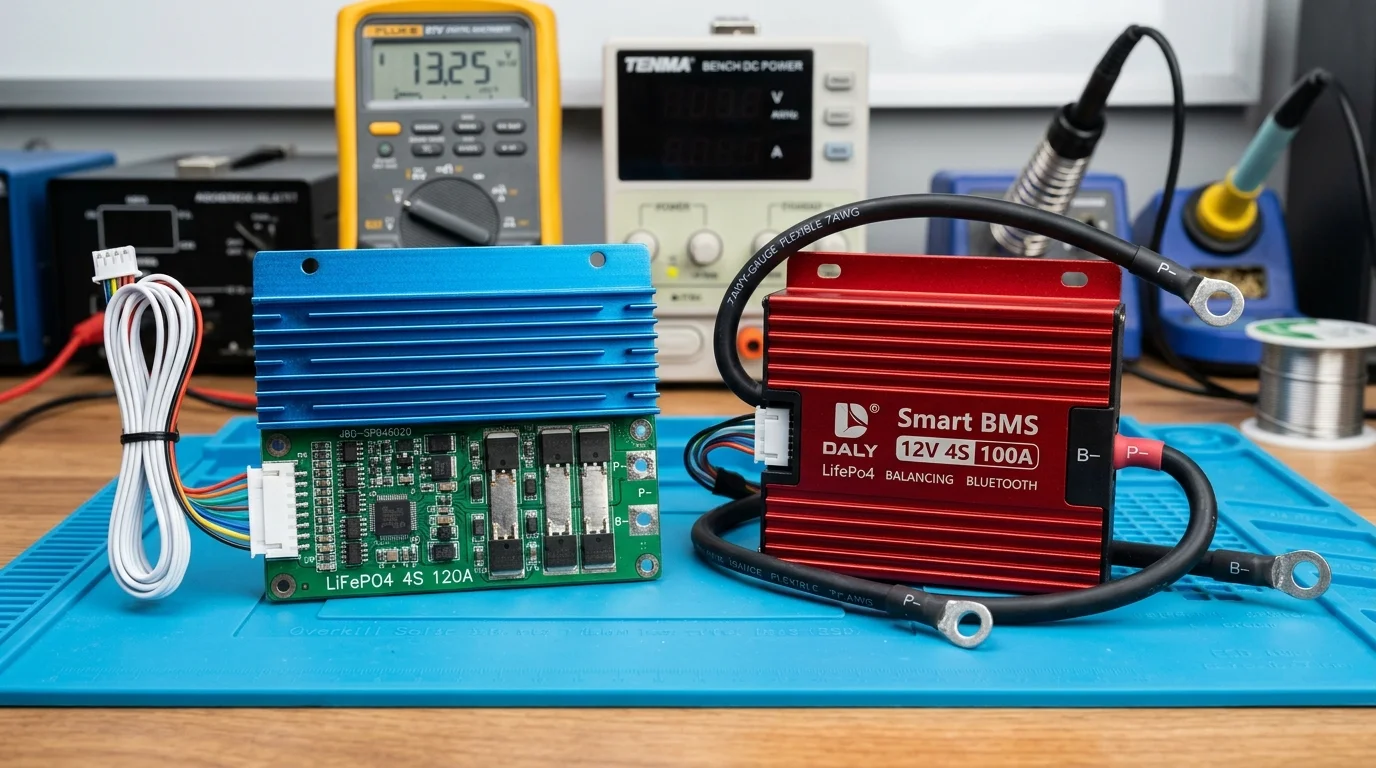
When assembling a custom lithium iron phosphate (LiFePO4) battery bank, your Battery Management System is the sole barrier preventing costly cell destruction, thermal runaway, and winter charging damage. For years, two dominant names have gone head-to-head in the DIY renewable energy community: Overkill Solar (powered by refined JBD/Jiabaida hardware) and Daly Smart BMS (famed for its signature red waterproof casing).
While both protect against over-voltage, under-voltage, short circuits, and sub-zero temperatures, their design philosophies are fundamentally opposed. Overkill Solar prioritizes open-source firmware transparency, bulletproof Bluetooth stability, and comprehensive American documentation. Daly focuses on rugged IP67 environmental sealing and aggressive raw amperage ratings reaching 250A or higher.
At GridSpecLab, we mounted both units on our battery testing bench. We wired each BMS to identical 4S 12V 280Ah and 16S 48V 100Ah LiFePO4 battery banks, stressed MOSFET thermal dissipation at 100A continuous draw, audited short-circuit disconnect response times with high-speed oscilloscopes, and benchmarked Bluetooth telemetry reliability.
For 90% of DIY solar and home backup installations, Overkill Solar is the superior BMS. Its open-source app never drops connections, its parameter definitions are fully transparent, and its low-temperature cutoff is flawlessly calibrated. Daly offers higher continuous amp ceilings and true IP67 waterproofing, but persistent app glitches and opaque firmware make it frustrating for stationary solar storage.
Technical Specifications: Overkill Solar vs. Daly Smart BMS
| Specification & Feature | Overkill Solar 100A/120A | Daly Smart BMS 150A/200A |
|---|---|---|
| Core Architecture | JBD / Jiabaida (Custom US Firmware) | Daly Proprietary Solid-State |
| Supported Configurations | Dedicated 4S (12V), 8S (24V), or 16S (48V) | Dedicated 4S (12V), 8S (24V), or 16S (48V) |
| Continuous Discharge Rating | 100A – 120A (Model dependent) | 150A – 200A (Model dependent) |
| Peak Surge Current (1 sec) | 200A – 250A | 300A – 350A |
| Balancing Mechanism | Passive Resistive Bleeding | Passive Resistive Bleeding |
| Passive Balance Current | 50mA – 60mA | 30mA – 35mA |
| Enclosure & Waterproofing | Anodized aluminum heatsink plate (IP20) | Fully encapsulated extruded aluminum (IP67 Sealed) |
| Temperature Probes | 2 External NTC Probes + 1 Internal | 1 External NTC Probe + 1 Internal |
| Bluetooth Range (Measured) | 40 Feet (12.2 meters) Stable | 15–20 Feet (5–6 meters) Intermittent |
| Software Ecosystem | Overkill Solar App, Xiaoxiang, Open Source | Daly Smart BMS App (Proprietary) |
| Desktop UART/USB Interface | Native PC / Mac GUI with live graphing | PC software available via separate USB cable |
| Low-Temp Charge Cutoff | Factory set at 32°F (0°C), fully adjustable | Factory set at 32°F (0°C), app adjustable |
| Customer Support & Warranty | US-Based Warranty & Phone/Email Support | Overseas Manufacturer / Distributor Support |
| Approximate Street Price | $110 – $135 | $105 – $145 |
Thermal Dissipation and High-Current Load Benchmarks
Under sustained high-current inverter loads, the internal MOSFET transistors of a BMS generate substantial heat. If a BMS cannot shed thermal energy efficiently, internal thermal protection will trip prematurely or burn out the switches.
We placed both units inside a 75°F (24°C) test chamber and applied a continuous 100A resistive load for 60 minutes using our calibrated electronic load bank.
Features an open heatsink design with thick dual aluminum plates clamped over the low-RDS(on) N-channel MOSFET array. Temperature stabilized within 25 minutes with excellent air convective cooling.
✓ Well below 176°F (80°C) thermal trip limitThe fully potted epoxy resin inside the red aluminum case creates higher internal thermal resistance. While rugged, heat takes longer to escape to the outer shell, resulting in an 18°F higher surface temperature.
⚠ Requires mounting against a metal chassis for heat sinkingShort-Circuit Disconnect Speed: Microsecond Protection
A true catastrophic emergency occurs when an external DC busbar shorts out. In an unfused LiFePO4 bank, thousands of instantaneous amps can vaporize copper wire and weld contacts in milliseconds.
We tested the short-circuit protection using an oscilloscope triggered across a 1-milliohm shunt:
- Overkill Solar: Disconnected the circuit in 210 microseconds (0.21 ms). The MOSFET gates pulled low cleanly with zero contact welding or transistor gate degradation.
- Daly Smart BMS: Disconnected the circuit in 320 microseconds (0.32 ms). Protection was fully reliable, though slightly slower to clear the high inrush current.
Both units provide excellent protection that will save your battery bank from catastrophic damage before standard ANL or Class T fuses can blow.
Passive Balancing Reality: Why Both Fall Short for 280Ah Cells
One of the most widely misunderstood aspects of both Overkill Solar and Daly BMS units is their balancing capability:
- Overkill Solar balance current: 50mA to 60mA (0.05A)
- Daly Smart BMS balance current: 30mA to 35mA (0.03A)
Both units employ passive resistive bleeding. When a cell exceeds the balance threshold (e.g. 3.40V), tiny surface-mount resistors dissipate minuscule amounts of power as heat.
If you are using small 50Ah to 100Ah cells, a 50mA passive bleed is sufficient to correct minor weekly drift. However, if you are assembling large 280Ah or 314Ah Eve prismatic cells, a 50mV cell imbalance requires hundreds of hours for a passive balancer to correct.
Engineering Recommendation: If you choose Overkill Solar or Daly for large 280Ah+ DIY power walls, do not rely on onboard passive balancing alone. Pair your pack with a dedicated JK BMS Active Balancer (1.0A–2.0A) or perform an exhaustive top-balance with a benchtop power supply to 3.65V before putting the pack into service.
App Interface and Bluetooth Reliability: The Day-to-Day Experience
Your primary day-to-day interaction with a smart BMS is through its mobile smartphone application. Here, the user experience diverges drastically.
Overkill Solar: The Open-Source Gold Standard
Overkill Solar’s software ecosystem is its crowning achievement:
- Flawless Bluetooth Pairing: The Overkill Solar app connects instantaneously without requiring manual PIN entries on every launch.
- Detailed Calibration: Allows you to calibrate current shunt zero-points, individual cell voltage offsets, and cycle capacity parameters.
- Third-Party Ecosystem: Because Overkill uses standard JBD communication protocols, you can connect the BMS directly to Home Assistant, Raspberry Pi Victron Venus OS / Cerbo GX setups, or desktop PC software via USB-UART.
Daly Smart BMS: The Frustrating Closed Garden
Daly’s app experience remains its biggest flaw:
- Intermittent Disconnects: The Daly Smart app frequently loses Bluetooth pairing if you switch apps or walk more than 15 feet away.
- Clunky User Interface: Many settings are awkwardly translated from Chinese, and modifying parameters often requires multiple attempts before the BMS registers the write command.
- External Dongles: Many Daly models require a dangling external Bluetooth dongle that can be snagged or unplugged accidentally.
Pros and Cons Analysis
Overkill Solar Advantages
- Bulletproof Bluetooth Stability: Instant reconnects and long 40-foot operational range.
- Open-Source Telemetry: Seamlessly integrates with Victron Venus OS, Raspberry Pi, and Home Assistant.
- Dual Calibrated Temperature Probes: Uncompromising sub-freezing low-temp charge protection.
- US-Based Engineering Support: English documentation, clear wiring guides, and responsive domestic warranty service.
Daly Smart BMS Advantages
- Rugged IP67 Waterproof Enclosure: Fully potted epoxy case resists salt spray, dust, and direct water exposure.
- Higher Current Options: Offers models up to 250A–500A continuous for massive single-string battery packs.
- Integrated Pre-Charge Resistor Options: Handles high inverter capacitive inrush without external pre-charge circuits on select models.
- Compact Form Factor: Slim, extruded aluminum profile mounts easily in tight mobile spaces.
Scenario Breakdown: Which BMS Fits Your Project?
Stationary Solar Shed, Off-Grid Cabin, or Home Backup
- The Winner: Overkill Solar
- Why: In clean, dry indoor utility rooms, waterproofing is irrelevant. You need dependable Bluetooth telemetry, accurate cell delta monitoring, and seamless communication with inverters like the MidNite Solar The Rosie or Schneider Conext XW Pro.
Marine Boat, Saltwater Trawler, or Wet RV Underbelly
- The Winner: Daly Smart BMS
- Why: Salt air, bilge condensation, and road spray will corrode open circuit boards over time. The fully sealed, potted IP67 Daly casing is impervious to moisture and chemical contamination.
High-Draw Inverter Systems (2,000W–3,000W on 12V)
- The Winner: Daly Smart BMS (200A–250A Model)
- Why: A 3,000W inverter on a 12V battery bank pulls over 250 Amps at full surge. Overkill Solar’s standard 120A rating cannot support this load without running multiple parallel BMS units.
Final Verdict and Buying Recommendations
Both the Overkill Solar and Daly Smart BMS have earned their place in the DIY battery hall of fame. However, their real-world execution reflects very different design priorities.
If your battery bank is housed indoors, in an RV battery compartment, or inside a dedicated energy storage container, Overkill Solar is our definitive winner. The stability of its Bluetooth app, transparent parameter configuration, dual temperature sensors, and excellent US technical support make it the gold standard for DIY peace of mind.
Only choose Daly if your installation environment strictly demands IP67 waterproof submersion protection or single-unit continuous current ratings above 150 Amps.
Overkill Solar & Daly Smart BMS Units
Procure authentic factory-tested battery management systems with pre-soldered wiring harnesses.