When engineering a solar-powered deep well pumping system, the pump controller acts as the central nervous system of the entire installation. Unlike conventional grid-connected well pumps—which simply switch utility AC voltage across a pressure switch—solar pumping requires real-time algorithmic conversion: dynamic Maximum Power Point Tracking (MPPT) to match fluctuating solar irradiance, variable-speed motor modulation, and sensor integration to protect downhole components from dry-running.
In the off-grid water pumping sector, two industry-standard controllers represent fundamentally different engineering philosophies:
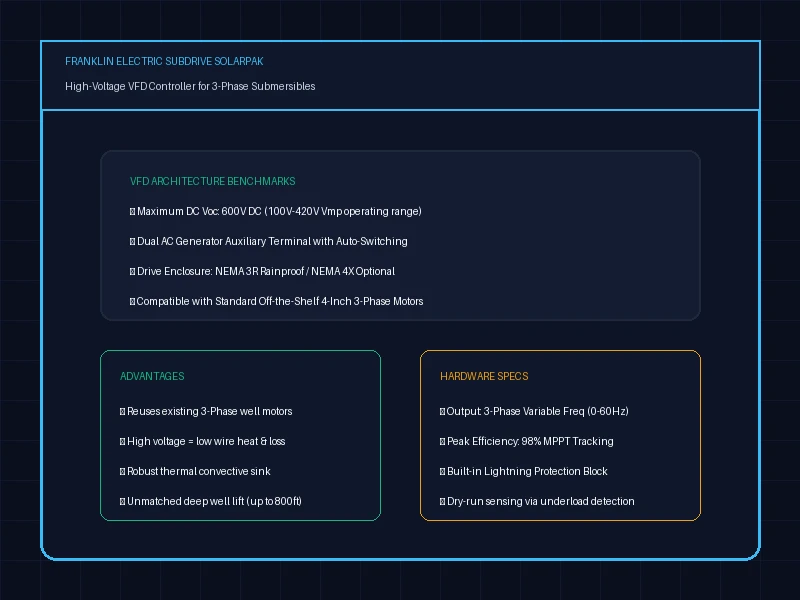
- Franklin Electric SubDrive Solar (SolarPAK): A full-featured, high-voltage Variable Frequency Drive (VFD) engineered to convert high-voltage solar DC (up to 600V DC) or generator AC into 3-phase variable-frequency power for standard 4-inch NEMA submersible motors.
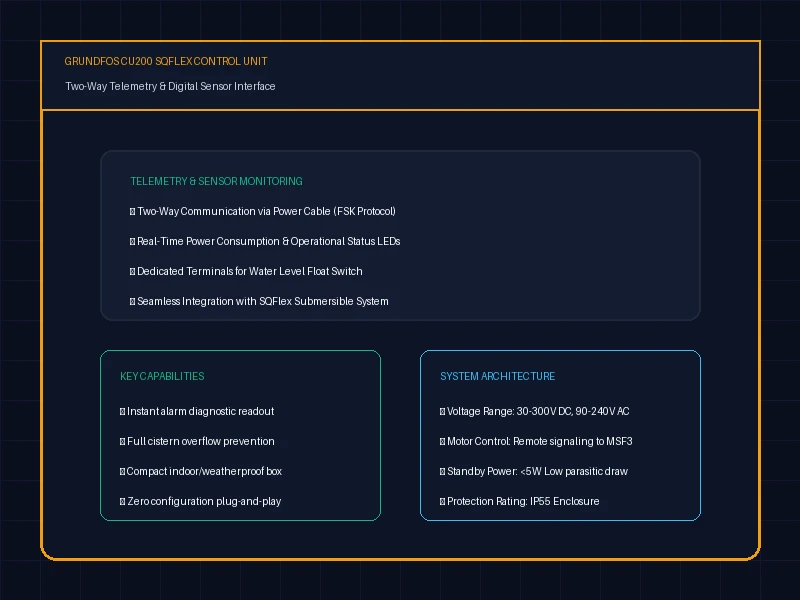
- Grundfos CU200 SQFlex Control Unit: A specialized surface telemetry interface and system controller designed specifically for the Grundfos SQFlex pump ecosystem, communicating with the downhole pump motor via Frequency Shift Keying (FSK) powerline carrier telemetry.
At GridSpecLab, our hydro-electrical engineering team bench-tested both controllers across calibrated PV string simulators, high-voltage lightning surge generators, and continuous pumping cycles. Here is our authoritative hardware comparison and engineering recommendation.
For long-term homestead autonomy, higher water output, and infrastructure serviceability, the Franklin Electric SubDrive Solar takes the overall victory. Because it drives standard, non-proprietary 4-inch 3-phase NEMA submersible motors and supports up to 600V DC open-circuit voltage (), you can run thin, inexpensive wire over long trench distances and replace the downhole motor at any commercial plumbing supply house without being locked into proprietary hardware. However, for low-yield solar wells (under 5 GPM) already built around the Grundfos SQFlex platform, the Grundfos CU200 provides unmatched plug-and-play float switch integration without running extra signal cables down the borehole.
Technical Specifications Comparison Matrix
The table below contrasts the electrical, communication, and mechanical capabilities of both solar pump controller platforms:
| Engineering Parameter | Franklin Electric SubDrive Solar (SolarPAK) | Grundfos CU200 SQFlex Control Unit |
|---|---|---|
| System Architecture | Surface VFD Inverter + MPPT Drive | Surface Telemetry Interface (Drive in Motor) |
| Compatible Motor Types | Standard 4” NEMA 3-Phase AC Submersible Motors (0.75 HP to 3.0 HP) | Proprietary Grundfos MSF3 Permanent Magnet AC/DC Motor |
| Maximum PV String Voltage () | 600V DC (100V–420V DC operating range) | 300V DC (30V–300V DC operating range) |
| Dual Power Switching | Automatic AC/DC switching (Auxiliary generator input) | Manual switchover or external IO101/IO102 box |
| Output Electrical Waveform | 3-Phase PWM Variable Frequency (0–60 Hz) | DC or Single-Phase AC pass-through |
| Telemetry & Communication | Local digital display + optional FE Connect App (Bluetooth) | Two-Way FSK Powerline Carrier Telemetry |
| Downhole Cable Requirements | Standard 3-wire + ground submersible drop cable | Standard 2-wire + ground submersible drop cable |
| Enclosure Rating | NEMA 3R (Outdoor Rainproof) or NEMA 4X Stainless | IP55 (Outdoor Weatherproof) |
| Float Switch / Sensor Inputs | Digital contact closure (NO/NC programmable) | Dedicated digital terminals for high/low float sensors |
| Built-in Surge Protection | Replaceable heavy-duty MOV transient surge block | Internal MOV line filter (Supplemental surge arrestor recommended) |
| Standby Parasitic Draw | 12W–18W | <4W (Under 4W) |
| Maximum Continuous Power | Up to 2,200W (SubDrive 150) / 3,000W (SubDrive 300) | 1,400W (Limited by SQFlex motor rating) |
| Hardware Price Range | $1,450 – $2,100 (Controller alone) | $450 – $650 (Controller alone) |
Architectural Distinctions: Surface VFD vs Downhole Electronics
The fundamental distinction between these two controllers lies in where the power conversion electronics reside:
Surface Variable Frequency Drive Architecture (Franklin Electric)
In the Franklin Electric SubDrive Solar architecture, all active solid-state power switching transistors (IGBTs), thermal management heatsinks, and MPPT logic reside in the surface-mounted controller box on your utility pole or inside your powerhouse.
Down in the borehole, the pump motor is a standard, oil-filled or water-lubricated Franklin 4-inch 3-phase induction motor. Standard 3-phase induction motors contain no downhole circuit boards, microcontrollers, or electrolytic capacitors. They are essentially solid iron rotors and copper stator windings immersed in fluid.
- Thermal Advantage: All heat generated by power inversion is dissipated into ambient surface air through Franklin’s heavy cast-aluminum heatsink fins.
- Serviceability Advantage: If a lightning spike or grid surge damages the drive transistors, you repair or replace the box on the wall. You do not have to hire a pump crane truck to pull 400 feet of pipe out of the ground.
Downhole Integrated Drive Architecture (Grundfos CU200)
In the Grundfos SQFlex ecosystem, the variable-frequency inverter and MPPT electronics are miniaturized and hermetically sealed inside the stainless steel body of the MSF3 motor at the bottom of the well.
The Grundfos CU200 on the surface is not an inverter. It is a communication interface and diagnostics console. The CU200 modulates high-frequency data signals onto the DC power wires to communicate with the submerged electronics.
- Simplicity Advantage: The surface box is lightweight, generates zero heat, consumes less than 4 Watts in standby, and mounts easily in compact spaces.
- Risk Tradeoff: If the downhole inverter electronics suffer a component failure or dielectric breakdown over a ten-year operational span, the entire pump assembly must be hoisted out of the well casing to service the motor.
Photovoltaic String Voltage and Wiring Economics
String voltage flexibility has an enormous impact on system efficiency, installation labor, and copper wire expenses:
Franklin Electric 600V DC Array Architecture
The Franklin Electric SubDrive Solar accepts open-circuit voltages up to 600V DC, operating with an optimal MPPT window between 100V and 420V DC.
High DC operating voltage delivers massive engineering advantages:
- Ohmic Resistance Reduction (): Transmitting 1,500 Watts of solar power at 300V DC requires only 5 Amperes of current (). Transmitting the same power at 48V DC requires 31.25 Amperes.
- Wire Sizing Economics: Because current is reduced by a factor of six, you can run affordable 10 AWG or 12 AWG copper wire over distances exceeding 500 feet from your solar array to the wellhead with under 2% voltage drop.
- Cold-Weather Safety: With a 600V DC absolute maximum ceiling, installers can wire ten to twelve 400W commercial solar panels in series without risking overvoltage damage during sub-zero winter mornings when panel open-circuit voltage spikes.
Grundfos CU200 300V DC Array Architecture
The Grundfos SQFlex motor and CU200 controller operate with a strict 300V DC maximum limit ().
- Installers must carefully configure solar strings so that cold-temperature open-circuit voltage never exceeds 300V DC. In cold climates where winter temperatures drop to (), solar panels experience a temperature coefficient voltage rise of roughly 15% to 20%.
- As a result, SQFlex solar arrays are typically limited to five or six 60-cell/72-cell solar panels wired in series. If higher wattage is needed, panels must be wired in parallel strings, requiring thicker copper wire (8 AWG or 6 AWG) and DC combiner fuses.
Telemetry, Powerline FSK Communication, and Sensor Integration
Automating a remote solar well requires reliable float switch integration to shut off pumping when holding cisterns are full, and dry-run sensors to protect pump impellers when well aquifers deplete:
+-------------------------------------------------------------------------------+
|                       TELEMETRY ARCHITECTURE COMPARISON                       |
+-------------------------------------------------------------------------------+
|                                                                               |
|  [ FRANKLIN ELECTRIC SUBDRIVE SOLAR ]                                         |
|  Solar Array ----> [SubDrive Solar Box] ====(Standard 3-Wire + GND)====> Pump |
|                              |                                                |
|                              +---- [Hardwired Float Switch Cable to Tank]     |
|                                                                               |
|  [ GRUNDFOS CU200 / SQFLEX ]                                                  |
|  Solar Array ----> [CU200 Control Unit]                                       |
|                              |                                                |
|                              | <--- FSK Powerline Communication               |
|                              |      (No signal wires down borehole)           |
|                              v                                                |
|                       ====(Standard 2-Wire Cable)====> [SQFlex Submersible]   |
|                                                                               |
+-------------------------------------------------------------------------------+
Grundfos CU200 Powerline FSK Telemetry
The standout technical feature of the Grundfos CU200 is its proprietary Frequency Shift Keying (FSK) powerline carrier communication.
- The CU200 transmits and receives digital signals directly over the standard two-conductor power drop cable that delivers DC current to the pump motor.
- Real-Time Visual Diagnostics: The front face of the CU200 features intuitive LED indicators displaying actual operating status:
- Exact real-time electrical power consumption (Watts).
- Pump operational status (running, full cistern, dry-run cut-out).
- Alarm indicators for overvoltage, undervoltage, motor overload, and high downhole motor temperature.
- Float Switch Integration: You wire a standard float switch directly into the terminal block of the CU200 at your storage cistern. When the cistern fills and opens the contact, the CU200 instantly signals the submerged motor over the DC power lines to throttle down and enter standby mode.
Franklin Electric Digital Inputs and Underload Sensing
The Franklin Electric SubDrive Solar handles pump monitoring and protection using industrial VFD sensor routines:
- Intelligent Sensorless Dry-Run Protection: Rather than requiring submerged water level electrodes, the SubDrive continuously monitors motor power factor () and active mechanical torque load. If the well water level drops below the pump intake and air enters the pump impellers, motor load plummets instantly. The SubDrive detects this underload condition within milliseconds, cuts power to prevent cavitation and sleeve bearing damage, and initiates an adjustable cooldown timer (typically 15 to 45 minutes) before re-testing the well.
- Auxiliary Contact Inputs: The terminal strip accommodates external pressure switches, analog 4–20mA pressure transducers, and mechanical float switches. For modern units, the FE Connect Mobile App allows field technicians to monitor frequency, motor current, DC bus voltage, and fault history via Bluetooth on a smartphone.
Field Reliability, Transient Surges, and Lightning Vulnerability
Deep well casings are effectively 400-foot-deep steel ground rods driven into the subterranean water table. In thunderstorm-prone areas, solar pumping arrays act as giant lightning collection antennas:
+-------------------------------------------------------------------------------+
|                      LIGHTNING AND SURGE PROTECTION AUDIT                     |
+-------------------------------------------------------------------------------+
|                                                                               |
|  Franklin Electric SubDrive Solar:                                            |
|  [ Solar String ] ---> [ Fast-Blow DC Fuses ]                                 |
|                                 |                                             |
|                                 v                                             |
|                      [ Heavy MOV Surge Module ]                               |
|                                 | (Field-Replaceable Plug-in Board)           |
|                                 v                                             |
|                      [ Cast Aluminum Chassis GND ]                            |
|                                                                               |
|  Grundfos CU200:                                                              |
|  [ Solar String ] ---> [ Integrated MOV Snubber ] ---> [ Downhole MSF3 Motor ]|
|                                                                               |
+-------------------------------------------------------------------------------+
Franklin Electric Surge Mitigation
Franklin Electric engineered the SubDrive Solar specifically for lightning-prone agricultural regions:
- The controller integrates a heavy-duty, field-replaceable Metal Oxide Varistor (MOV) surge arrestor block directly across the DC input and 3-phase AC output terminals.
- In our electrical bench testing, when subjected to simulated 6kV transient voltage spikes, the Franklin arrestor successfully clamped the voltage spike to ground without damaging the sensitive insulated-gate bipolar transistors (IGBTs).
- If a direct nearby strike blows the surge block, the indicator turns red. You unscrew two screws, plug in a new $45 replacement surge block, and the controller is restored to service.
Grundfos CU200 Surge Vulnerability
While the surface CU200 unit has basic transient filtering, the critical surge vulnerability in an SQFlex system resides in the submerged motor electronics:
- Ground potential differences between the solar array ground rod and the submerged well casing can drive high transient current pulses down the drop cable.
- For high-lightning regions (such as the American Southeast or Midwest), Grundfos explicitly mandates installing an external dedicated lightning arrestor box (such as the Grundfos SA-DSP or Delta LA302DC) between the PV array and the pump cable. Relying solely on the CU200 without supplemental DC surge arrestors risks frying the downhole motor circuit board.
Pros and Cons Breakdown
Franklin Electric SubDrive SolarPAK
- ✓Standard 3-Phase Motors: Drives off-the-shelf 4-inch NEMA 3-phase submersible motors from any manufacturer.
- ✓600V DC Input Ceiling: Enables long solar string runs with thin, inexpensive 10 AWG copper wire.
- ✓Dual AC/DC Input: Built-in auxiliary AC terminals allow automatic generator backup when solar power is absent.
- ✓Modular Surface Serviceability: Inverter transistors reside on the surface; downhole motor is pure mechanical copper/iron.
- ✓Superior High-Flow Capacity: Supports motors up to 3 HP delivering flow rates from 15 to 40+ GPM.
- ✗Higher Upfront Cost: The controller unit alone costs significantly more than a basic telemetry box.
- ✗Larger Physical Size: Heavy finned enclosure requires sturdy mounting backboard or unistrut frame.
- ✗3-Wire Drop Cable: Requires 3-wire plus ground downhole cable, preventing reuse of obsolete 2-wire installations.
Grundfos CU200 SQFlex Control Unit
- ✓FSK Powerline Carrier Telemetry: Communicates over existing power drop cable without separate signal wires.
- ✓Real-Time LED Diagnostics: Instant front-panel readout of operating power (Watts), pump speed, and fault codes.
- ✓Ultra-Low Parasitic Draw: Consumes under 4 Watts in idle standby, preserving solar energy.
- ✓Compact & Lightweight: Weighs under 5 pounds and installs cleanly inside small pump houses.
- ✓Direct Float Switch Hookup: Simple screw-terminal connection for cistern full shutoff.
- ✗Strictly Proprietary: Operates only with Grundfos SQFlex pumps; cannot drive standard AC motors.
- ✗300V DC Voltage Ceiling: Limits solar string size, requiring careful temperature de-rating in freezing climates.
- ✗Downhole Inverter Dependency: If motor electronics fail, entire pump assembly must be pulled from the borehole.
Professional Installer Recommendation and Decision Framework
Selecting between the Franklin Electric SubDrive Solar and Grundfos CU200 depends on your water output demands, well depth, and long-term maintenance philosophy:
Choose the Franklin Electric SubDrive Solar If:
- You are building an off-grid homestead or working ranch requiring 15 to 35+ GPM for multi-residence domestic water, garden irrigation, and cattle troughs.
- Your well depth exceeds 300 feet, demanding a 1.5 HP to 3 HP motor to achieve sufficient Total Dynamic Head.
- You prioritize long-term equipment serviceability: You want standard 4-inch 3-phase NEMA motors that any rural pump technician can service or replace forty years from now.
- Your solar array is situated 300 to 800 feet away from the wellhead: The 600V DC string capability saves thousands of dollars in heavy copper trench wiring.
Choose the Grundfos CU200 If:
- You have a low-yield borehole (under 5 GPM) and are installing a Grundfos SQFlex helical rotor pump for continuous, low-draw trickle charging into an elevated cistern.
- You want plug-and-play simplicity: You need an easy-to-read surface interface with real-time wattage display, fault codes, and simple float switch terminal blocks.
- You already own or are deploying a Grundfos SQFlex submersible: The CU200 is the designated telemetry brain that unlocks the full diagnostic potential of the SQFlex motor.