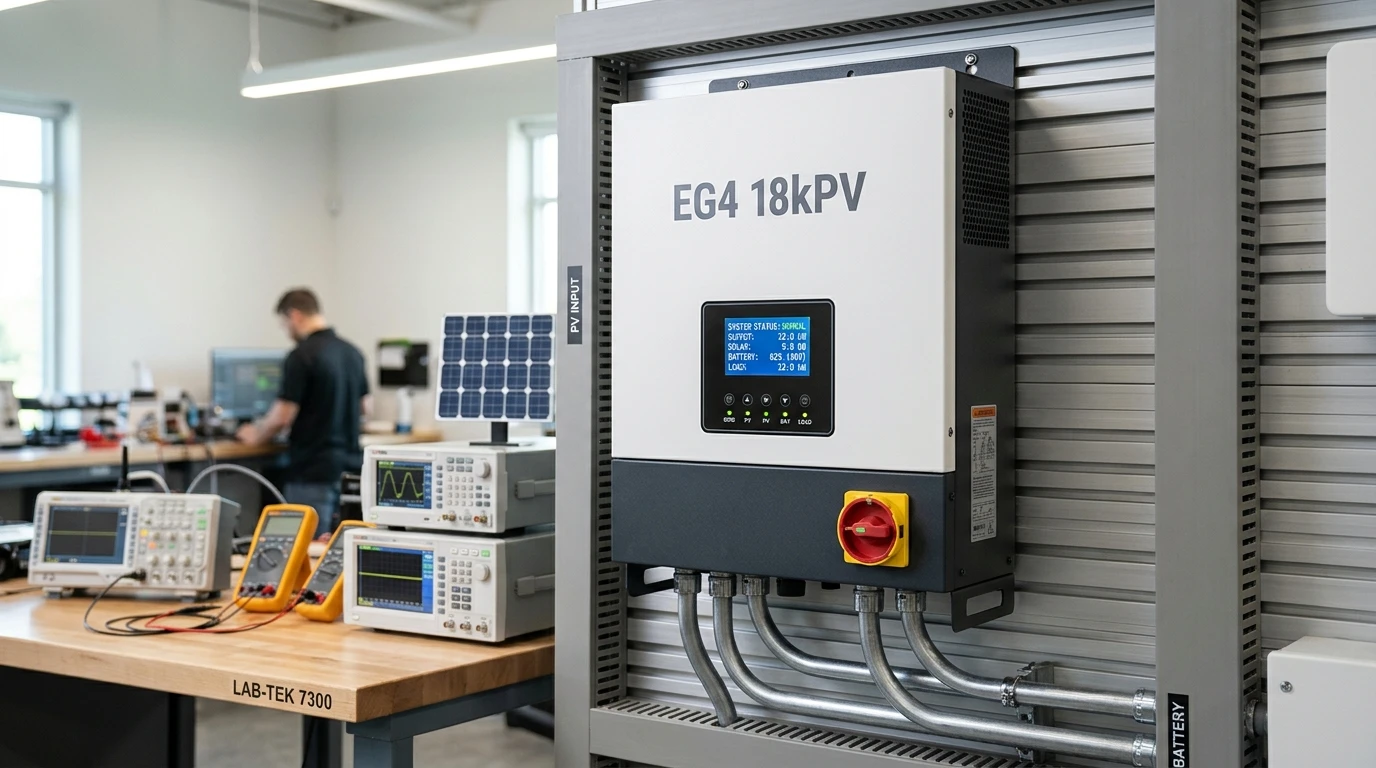
When designing a whole-home solar and battery storage system, few choices have as profound an impact on your daily energy independence as your hybrid inverter. EG4 Electronics revolutionized the residential energy market by introducing all-in-one split-phase hybrid inverters that combine high-voltage MPPT charge controllers, a heavy-duty pure sine wave inverter, an AC charger, and a built-in 200A grid bypass transfer switch into a single UL1741SB certified enclosure.
Among the EG4 lineup, two flagship models dominate DIY solar forums and professional contractor bids: the EG4 12kPV and the EG4 18kPV.
Both units share the same industrial white and dark slate aesthetics, operate on low-voltage 48V LiFePO4 battery banks, feature integrated 200A pass-through contactors, and interface seamlessly with EG4 LifePower4 v2 and WallMount 280Ah/314Ah batteries.
However, their internal power electronics, MPPT solar architectures, continuous off-grid battery ratings, and DC busbar current limits diverge significantly. In this detailed engineering audit, we compare the continuous output limits, thermal bench behavior, solar overpaneling headroom, and whole-home installation economics between the 12kPV and 18kPV.
Core Technical Specifications Comparison
Before analyzing real-world appliance loads, let us examine the fundamental engineering parameters that separate these two hybrid powerhouses:
| Engineering Parameter | EG4 12kPV Hybrid Inverter | EG4 18kPV Whole-Home Inverter | Engineering Significance |
|---|---|---|---|
| Continuous Output (Off-Grid / Battery) | 8,000 Watts (33.3A @ 240V) | 12,000 Watts (50.0A @ 240V) | 50% more continuous power during blackouts |
| Continuous Output (On-Grid / Solar + Grid) | 12,000 Watts (50.0A @ 240V) | 18,000 Watts (75.0A @ 240V) | Maximum grid sell-back and net-metering export |
| Motor Starting Surge (Peak) | 16,000 Watts (10 Seconds) | 16,000 Watts continuous / 24,000W momentary | Inrush capability for inductive compressor motors |
| Integrated Grid Bypass Transfer Switch | 200 Amperes | 200 Amperes | Eliminates external critical loads subpanel |
| Max Solar PV Input Power | 13,000 Watts (13kW DC) | 21,000 Watts (21kW DC) | Supports larger rooftop or ground-mount arrays |
| MPPT Trackers / String Inputs | 2 MPPTs (4 Strings: 2/2) | 3 MPPTs (4 Strings: 2/1/1) | Multi-azimuth roof orientations (East/South/West) |
| Max PV Input Voltage () | 500V DC | 600V DC | Longer series strings with winter cold voltage margins |
| MPPT Operating Voltage Range | 120V – 500V DC | 100V – 500V DC | Broader daylight tracking envelope |
| Max Battery Charge / Discharge Current | 185 Amperes DC | 250 Amperes DC | Maximum power extracted from 48V battery bank |
| Idle Tare Consumption | ~48 Watts | ~48 Watts | 24/7 background standby power draw |
| Grid Transfer Time (UPS) | <10 milliseconds | <10 milliseconds | Computers, routers, and clocks stay online |
| UL Safety Certifications | UL1741SB, CSA 22.2, IEEE 1547 | UL1741SB, CSA 22.2, IEEE 1547 | Interconnection approval across all 50 US states |
| Unit Weight | 97.0 lbs (44.0 kg) | 112.4 lbs (51.0 kg) | Mechanical mounting and wall stud reinforcement |
| Retail Price (Approx.) | $3,899 | $4,999 | $1,100 equipment price differential |
Off-Grid Continuous Power: Sizing 8kW vs 12kW for Real Appliances
The most critical distinction when choosing between these two inverters is continuous battery power delivery when the utility grid is dead.
The 8,000W Boundary on the EG4 12kPV
While the EG4 12kPV is named “12k,” that 12kW rating applies strictly when connected to an energized utility grid. When a blackout strikes and the unit is operating strictly off its 48V battery bank, its pure sine wave inverter is electronically rated for 8,000 Watts continuous split-phase output (33.3 Amperes at 240V).
An 8kW continuous ceiling is capable of handling standard suburban household loads:
- Refrigerator and chest freezer (~300W continuous)
- LED lighting and electronics throughout the house (~400W)
- Well pump or sump pump (~1,200W running)
- Mini-split heat pump or high-efficiency central inverter HVAC (~1,800W running)
- Microwave or induction cooktop burner (~1,500W)
Summing these loads results in approximately 5,200 Watts, leaving 2,800 Watts of operating headroom.
However, American households frequently feature high-draw 240V resistance loads. If an electric clothes dryer (4,500W), electric water heater (4,500W), or level 2 EV charger (7,200W) kicks on while your well pump or kitchen appliances are running, the total demand immediately surges past 8,000 Watts.
On the 12kPV, exceeding 8kW off-grid triggers inverter overload protection within seconds, causing a full system shutdown. To live comfortably with the 12kPV, homeowners must either:
- Wire high-draw appliances through smart load-shedding relays (such as the EG4 GridBOSS).
- Manually manage appliance usage during blackouts.
- Use high-efficiency heat pump water heaters and heat pump dryers rather than standard resistive elements.
The 12,000W Headroom on the EG4 18kPV
The EG4 18kPV delivers a true 12,000 Watts of continuous off-grid battery power (50.0 Amperes at 240V).
This additional 4,000 Watts of continuous capacity (a 50% power increase) completely changes the off-grid experience:
- You can run a 4-ton or 5-ton central heat pump (~3,500W)
- Run a deep well pump (~1,500W)
- Power kitchen refrigeration, internet router, and entertainment systems (~800W)
- Simultaneously bake with an electric oven (~2,500W) or run a clothes dryer (~4,000W)
Total combined demand sits at approximately 11,800 Watts. The 18kPV powers through this concurrent load without tripping, providing a true “zero compromise” whole-home backup experience where family members do not need to coordinate which appliances are turned on during an outage.
Solar PV Input Architecture: 2 MPPTs vs 3 MPPTs
Solar array configuration is another major engineering dividing line between the two models.
+-------------------------------------------------------------------------------------------------+
|                         SOLAR PV ARCHITECTURE & STRINGING COMPARISON                            |
+-------------------------------------------------------------------------------------------------+
| Specification                  | EG4 12kPV Inverter              | EG4 18kPV Inverter           |
+--------------------------------+---------------------------------+------------------------------+
| Max PV DC Input Power          | 13,000 Watts (13kW)             | 21,000 Watts (21kW)          |
| Number of MPPT Controllers     | 2 MPPTs                         | 3 MPPTs                      |
| String Inputs per MPPT         | 2 Strings / 2 Strings           | 2 Strings / 1 String / 1 Str |
| Max DC Input Voltage (Voc)     | 500V DC                         | 600V DC                      |
| Max MPPT Current (Imp)         | 14A / 14A                       | 25A / 15A / 15A              |
| Max Short-Circuit Current (Isc)| 18A / 18A                       | 30A / 20A / 20A              |
| Typical Series String Size     | 8 to 10 Panels (400W–500W)      | 10 to 12 Panels (400W–550W)  |
+-------------------------------------------------------------------------------------------------+
Why the 3rd MPPT on the 18kPV Matters
Most residential roofs do not face perfectly South. Often, solar arrays must be split across different roof planes:
- An East-facing array to capture morning production
- A South-facing array for peak midday generation
- A West-facing array to optimize late afternoon solar yield
With the EG4 12kPV’s dual MPPTs, you can only optimize two distinct roof orientations. If you parallel strings from two different roof pitches into a single MPPT, the voltage mismatch forces the MPPT to compromise, incurring significant string efficiency losses.
The EG4 18kPV features three completely independent MPPT trackers. MPPT 1 handles up to 25 Amps (two parallel strings of high-power commercial panels), while MPPT 2 and MPPT 3 each handle dedicated single strings up to 15 Amps. This allows you to wire East, South, and West arrays independently, squeezing maximum daily kilowatt-hours out of complex roof designs.
Maximum Voltage Headroom: 500V vs 600V
The 18kPV’s higher 600V maximum open-circuit voltage () rating offers a tangible installation benefit in northern climates.
Under standard test conditions (), a 500W solar panel might have an open-circuit voltage of . On a frigid winter morning at (), temperature coefficients drive that voltage up by 15% to 20%, pushing the panel past .
On a 500V inverter like the 12kPV, series strings must be restricted to 8 panels to avoid exceeding 500V in freezing weather (). On the 600V-rated 18kPV, you can comfortably run 10 to 11 panels in series (), reducing roof combiner boxes, conduit penetrations, and wire home runs.
48V Battery Current Draw: 185A vs 250A Benchmarks
Both inverters operate on 48V nominal battery banks (typically 51.2V LiFePO4). However, extracting 8kW or 12kW of electrical power at 48V requires massive direct current:
Assuming an inverter conversion efficiency () of 95%:
- EG4 12kPV at 8,000W Output: The 12kPV’s hardware discharge limit is capped at 185 Amperes DC.
- EG4 18kPV at 12,000W Output: The 18kPV’s hardware discharge limit is capped at 250 Amperes DC.
Battery Bank Sizing Requirements
This current difference dictates your minimum battery bank capacity:
- For the EG4 12kPV, pulling 185A requires a minimum of two 100Ah server rack batteries (rated at 100A continuous discharge each = 200A total capability). Three server rack batteries (15kWh total) are recommended for comfortable C-rate operation.
- For the EG4 18kPV, pulling 250A requires a minimum of three 100Ah server rack batteries (300A total capability) or a single EG4 PowerPro 280Ah/314Ah WallMount battery (equipped with a 200A/250A BMS breaker). Operating the 18kPV at full 12kW load on a small 100Ah or 200Ah battery bank will trip the battery BMS overcurrent protection.
200A Whole-Home Grid Pass-Through Installation
One of the greatest engineering advantages of both the EG4 12kPV and 18kPV is their internal 200A automatic transfer switch.
In traditional solar installations, connecting an inverter to a standard 200A residential service panel requires one of two costly approaches:
- Critical Loads Subpanel: An electrician must relocate critical circuits (refrigerator, lights, well pump) into a dedicated 60A or 100A subpanel powered by the inverter. This requires hours of tracing wires, cutting drywall, and adding expensive subpanels (2,500 in contractor labor).
- External 200A Automatic Transfer Switch (ATS): Adding a motorized commercial 200A ATS between the meter and main panel, adding $1,000+ in hardware and complex control wiring.
Both the EG4 12kPV and EG4 18kPV eliminate this entirely. You route the main 200A service feeders directly from your electric meter into the inverter’s GRID lugs, and route the inverter’s LOAD lugs directly into your home’s main 200A distribution panel.
When the grid is active, both inverters seamlessly pass through up to 200 Amperes (48,000 Watts) of utility power directly to your household panel. When grid power drops out, internal magnetic contactors open in under 10 milliseconds, seamlessly transitioning your entire main panel to battery and solar power. Your clocks will not even blink.
Product Overviews: Hardware Strengths & Field Observations
1. EG4 12kPV Hybrid Inverter
The EG4 12kPV is an exceptionally balanced all-in-one inverter for modern homesteads, efficient single-family homes, and off-grid cabin retreats.
+-----------------------------------------------------------------------+
|                    EG4 12kPV HARDWARE AUDIT CARD                      |
+-----------------------------------------------------------------------+
| Continuous Off-Grid Power  : 8,000 Watts @ 240V split-phase          |
| Continuous On-Grid Power   : 12,000 Watts export / passthrough        |
| Surge Rating               : 16,000 Watts (10 seconds)                |
| Max Solar PV Input         : 13,000 Watts DC (2 MPPTs / 4 Strings)    |
| Max DC Battery Current     : 185 Amperes DC                           |
| Grid Transfer Speed        : <10 milliseconds (Seamless UPS)          |
| Weight & Dimensions        : 97.0 lbs | 28.5" x 18.1" x 9.8"          |
| Acoustic Noise (1m)        : 45 dBA idle / 58 dBA full load           |
| Est. Retail Price          : $3,899                                   |
| Rating                     : 9.5 / 10                                 |
+-----------------------------------------------------------------------+
Advantages
- Lower Capital Investment: At ~$3,899, it costs $1,100 less than the 18kPV while retaining the same 200A whole-home bypass switch and UL1741SB certification.
- Lighter Chassis: Weighing 97 lbs, it is noticeably easier to lift and wall-mount onto 16-inch on-center wall studs.
- Whisper-Quiet Idle: Low standby tare loss of ~48W and temperature-regulated variable-speed cooling fans keep noise unobtrusive.
- Generous PV Ratio: Allows up to 13kW of solar on two MPPTs, which is more than sufficient for 90% of suburban rooftops.
Disadvantages
- 8kW Off-Grid Ceiling: Cannot run central air conditioning, well pumps, and electric water heating simultaneously without load-management controls.
- 2 MPPT Limitation: Cannot optimize three distinct roof angles without string current compromises.
2. EG4 18kPV Whole-Home Hybrid Inverter
The EG4 18kPV represents the pinnacle of residential off-grid muscle, offering 12kW continuous battery output and support for commercial-scale 21kW solar arrays.
+-----------------------------------------------------------------------+
|                    EG4 18kPV HARDWARE AUDIT CARD                      |
+-----------------------------------------------------------------------+
| Continuous Off-Grid Power  : 12,000 Watts @ 240V split-phase         |
| Continuous On-Grid Power   : 18,000 Watts export / passthrough        |
| Surge Rating               : 16,000W continuous / 24,000W peak        |
| Max Solar PV Input         : 21,000 Watts DC (3 MPPTs / 4 Strings)    |
| Max DC Battery Current     : 250 Amperes DC                           |
| Max PV Input Voltage       : 600V DC (Superior cold weather stringing)|
| Weight & Dimensions        : 112.4 lbs | 31.9" x 19.7" x 10.6"        |
| Acoustic Noise (1m)        : 48 dBA idle / 62 dBA full load           |
| Est. Retail Price          : $4,999                                   |
| Rating                     : 9.8 / 10                                 |
+-----------------------------------------------------------------------+
Advantages
- True Whole-Home Off-Grid Output: 12,000 Watts of continuous 240V power easily handles 5-ton air conditioners, electric water heaters, and well pumps concurrently.
- Triple MPPT Architecture: Three independent charge controllers support complex multi-roof arrays and ground-mount arrays up to 21kW.
- 600V PV Voltage Rating: Accommodates longer 10-to-12 panel series strings with generous cold-temperature safety buffers.
- 250A Battery Busbar: Unlocks maximum charging and discharging speed when paired with large 48V battery banks.
Disadvantages
- Higher Price Point: Retail price of ~$4,999 represents a significant equipment investment.
- Heavyweight Enclosure: At 112.4 lbs, wall installation strictly requires two people and robust structural wall mounting.
Final Verdict & Buying Recommendations
Both the EG4 12kPV and EG4 18kPV are world-class hybrid inverters that eliminate the messy complexity of separate charge controllers, external transfer switches, and critical loads subpanels.
When to Buy the EG4 12kPV
Choose the EG4 12kPV if:
- Your total simultaneous blackout power requirements stay under 8,000 Watts (33A at 240V).
- Your household uses high-efficiency inverter mini-split heat pumps, a gas/propane water heater, or smart load-shedding relays.
- Your total solar array will not exceed 13,000 Watts DC, and your panels are situated on two primary roof planes (e.g. South and West).
- You want to save $1,100 on equipment costs to invest in additional battery storage capacity.
When to Buy the EG4 18kPV
Choose the EG4 18kPV if:
- You want a zero-compromise whole-home backup experience where standard central air conditioning, well pumps, clothes dryers, and kitchen appliances can operate simultaneously off batteries.
- You are installing a large 13kW to 21kW solar array spread across three different roof pitches or ground-mount locations.
- You live in cold northern climates where the 600V open-circuit voltage rating allows longer series strings without freezing-weather overvoltage clipping.
- Your battery bank consists of at least 300Ah of server rack modules or a 280Ah/314Ah WallMount battery capable of delivering 250 Amperes of continuous DC power.