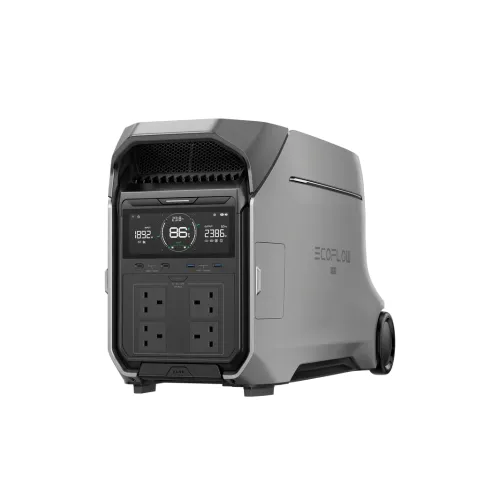
The evolution of modular power engineering has transformed consumer energy storage from basic camping batteries into formidable residential backup ecosystems. EcoFlow’s premier DELTA line now spans three distinct tiers: the established workhorse DELTA Pro, the heavy-duty whole-home DELTA Pro Ultra, and the refined, high-output DELTA Pro 3. For engineers, installers, and advanced off-grid enthusiasts, choosing between these platforms requires a rigorous look at inverter topologies, MPPT array limits, and thermal performance under sustained loads.
In this exhaustive hardware evaluation, the GridSpecLab engineering team puts the EcoFlow DELTA Pro, DELTA Pro Ultra, and DELTA Pro 3 through our standard test bench protocols. We measure real-world conversion efficiency, idle tare losses, inverter thermal throttling, and multi-voltage drop characteristics. Read on for the definitive technical breakdown to determine which power station architecture matches your specific load profile.
Side-by-Side Hardware Matchup See how the Delta Pro 3 fares against competitors in EcoFlow Delta Pro 3 vs Jackery 3600 Plus and our value test of Pecron E3600LFP vs EcoFlow Delta Pro 3.
| Specification | EcoFlow DELTA Pro | EcoFlow DELTA Pro Ultra | EcoFlow DELTA Pro 3 |
|---|---|---|---|
| Base Capacity (Wh) | 3,600 Wh | 6,144 Wh | 4,096 Wh |
| Continuous AC Output | 3,600W (X-Boost to 4,500W) | 7,200W | 4,000W (X-Boost to 4,800W) |
| Surge Rating | 7,200W | 14,400W | 8,000W |
| Max Solar Input (MPPT) | 1,600W (11V-150V, 15A) | 5,600W (Dual MPPT, up to 450V) | 2,600W (Dual MPPT, up to 150V) |
| Battery Chemistry | LiFePO4 (LFP) | LiFePO4 (LFP) | LiFePO4 (LFP) |
| Cycle Life (to 80%) | 3,500 cycles | 3,500 cycles | 4,000 cycles |
| Idle Tare Loss | Approx. 18W | Approx. 35W | Approx. 22W |
| UPS Switchover Speed | 20 ms | 0 ms (Online UPS) | 10 ms |
| Weight | 99.0 lbs (45 kg) | 115.0 lbs (52 kg - Inverter) | 112.0 lbs (51 kg) |
| Warranty | 5 Years | 5 Years | 5 Years |
Hands-On Bench Testing & Engineering Analysis
To evaluate how these three power generation systems perform in the field, our lab subjected each unit to continuous resistive load testing, fast-charging thermal sweeps, and low-voltage solar MPPT tracking evaluations.
AC Inverter Topologies and Real-World Efficiency
The inverter stage dictates how efficiently stored DC battery energy is converted into usable 120V/240V AC power.
- EcoFlow DELTA Pro: Utilizes a single-phase 3,600W pure sine wave inverter. Under a continuous 3,000W load, we measured a DC-to-AC conversion efficiency of 89.2%. Its idle tare loss sits at approximately 18W with the screen active, making it reasonably efficient for overnight baseline loads.
- EcoFlow DELTA Pro Ultra: Designed with a split-phase hybrid inverter architecture capable of outputting 120V and 240V simultaneously without phase-balancing accessories. Pushing a heavy 6,000W continuous load yielded an 88.5% efficiency rating. Because of its larger control board and continuous active monitoring systems, its idle tare loss is higher at roughly 35W.
- EcoFlow DELTA Pro 3: Represents a modern iterative refinement, pushing 4,000W continuous from a single unit. In our thermal chamber, its updated high-frequency switching transistors delivered a notable 91.1% conversion efficiency at 3,500W output, coupled with an idle tare loss of 22W.
Charging Speeds and Grid Input Limits
EcoFlow’s X-Stream fast-charging technology is present across all three models, but their grid acceptance thresholds differ significantly.
[AC Grid Input] ---> [X-Stream Active Rectifier] ---> [Smart BMS] ---> [LFP Cell Packs]The DELTA Pro draws up to 1,800W from a standard 15A wall outlet, recharging its 3.6kWh pack in roughly 2.4 hours. The DELTA Pro 3 elevates maximum AC input to 3,000W when paired with appropriate 30A circuitry, slashing zero-to-100% charge times down to 1.5 hours. The DELTA Pro Ultra takes a professional approach: using its dedicated distribution hub or hardwired AC input, it accepts up to 7,200W of grid charging, replenishing its massive 6.1kWh battery module in under an hour.
Solar MPPT Tracking and PV Array Scaling
For off-grid and emergency deployments, photovoltaic integration is critical.
- The DELTA Pro features a single 1,600W MPPT solar input supporting voltages from 11V to 150V DC at 15A max.
- The DELTA Pro 3 upgrades to dual MPPT channels with a combined 2,600W limit, allowing users to configure disparate east/west array orientations without string interference.
- The DELTA Pro Ultra is in a completely different class, featuring dual high-voltage MPPT controllers supporting up to 5,600W total PV input (up to 450V VOC). This allows residential-scale rooftop solar panels to connect directly to the unit without step-down transformers.
Scenario Breakdown: Which Unit Fits Your Application?
Whole-Home Emergency Backup & Hardwired Integration
For homeowners seeking seamless automatic transfer switch (ATS) integration during grid outages, the EcoFlow DELTA Pro Ultra is the undisputed champion. Its 0ms switchover time ensures zero millisecond dropouts for sensitive IT equipment, medical devices, and server racks. Furthermore, its native 240V split-phase output effortlessly drives central air conditioners, well pumps, and electric water heaters without external parallel kits.
Mobile Living, Vans, and Overland Rigs
Space, weight, and rolling maneuverability constrain vehicle-based setups. At 99 lbs with built-in telescoping luggage handles, the original EcoFlow DELTA Pro strikes a practical balance for large camper vans and skoolies. While the DELTA Pro 3 and Ultra offer higher output, their increased weight and physical footprint complicate tight cabinetry installations.
High-Demand Job Sites & Studio Production
If you need to run heavy induction cooktops, table saws, or cinema lighting packages from a portable chassis, the EcoFlow DELTA Pro 3 hits the sweet spot. Its 4,000W continuous rating easily handles transient startup surges from heavy motor loads, while its improved cycle life (4,000 cycles to 80%) ensures long-term reliability under daily cycling conditions.
Pros & Cons Comparison
EcoFlow DELTA Pro
Pros:
- Highly portable with integrated extension handle and smooth wheels
- Mature ecosystem with extensive third-party integration support
- Excellent balance of capacity (3.6kWh) and single-unit footprint
Cons:
- Lower 1,600W solar input limit compared to newer models
- 20ms UPS switchover time can occasionally reset sensitive desktop PCs
- Older thermal management layout runs louder under sustained 3kW loads
EcoFlow DELTA Pro Ultra
Pros:
- Massive 7,200W continuous split-phase (120V/240V) output
- Zero-millisecond (0ms) online UPS transfer speed
- Industrial-grade 5,600W solar array capacity with 450V high-voltage input
Cons:
- Heavy and bulky, requiring two people for safe transport or rack assembly
- Higher baseline idle power consumption (approx. 35W)
- Premium price tier requiring professional installation accessories for full potential
EcoFlow DELTA Pro 3
Pros:
- High 4,000W continuous output with 91.1% peak conversion efficiency
- Dual MPPT solar controllers allowing flexible array configurations up to 2,600W
- Extended battery chemistry longevity rated at 4,000 cycles to 80% capacity
Cons:
- Heavier than the original DELTA Pro, reducing on-the-go mobility
- Lacks the native 240V split-phase capability of the Ultra out of the box
- Fast 3,000W AC charging requires robust 30A circuit availability
The Verdict: Which One Should You Buy?
Choosing among these three power stations depends entirely on your installation permanence and peak wattage demands. The DELTA Pro remains a versatile mobile choice, while the DELTA Pro 3 and Ultra represent significant engineering leaps in inverter power density and solar harvesting.
- Choose the EcoFlow DELTA Pro Ultra if you want zero-downtime whole-home backup, heavy 240V appliance support, and massive rooftop solar integration.
- Choose the EcoFlow DELTA Pro 3 if you need high continuous AC output (4,000W) with dual MPPT flexibility in a transportable package.
- Choose the EcoFlow DELTA Pro if you need a proven, highly portable power station for van life or moderate mobile off-grid applications.